Search This Blog

Showing posts with label Godzilla. Show all posts

Saturday, 18 May 2019

Godzilla: A Viewing Guide


Godzilla: King of the Monsters is almost in cinemas, as of writing, and is coming out in to celebrate Godzilla's 65th anniversary. 65 years, countless comics and video games, 34 movies, and two more movies on the way (King of the Monsters and Godzilla vs. Kong) the King of the Monsters has become a pop culture icon. Originating as a haunting allegory for Japan's post-war nuclear nightmares Godzilla has changed repeatedly going from Japan's tormentor to its protector, from a force of nature to the friend of children, and from nuclear to environmental allegories. One of my original ideas for my history undergraduate thesis was to actually look at how Godzilla has reflected Japanese, and at times American, worries, and we did a blog post about this topic here. After so many movies it can be difficult to know where to begin - in December 2018 I vowed to watch every movie in order of release before the release of the newest one and I still am not finished (albeit part of that is due to me being busy with my undergraduate thesis, and I've been really dragging my feet about watching the three anime movies). Hence, I thought a nice little list of my own recommendations would be nice. I want to also give a shout out to the fantastic James Rolfe of Cinemassacre for doing his own version which I would definitely recommend watching here - I had this post planned in early April but was debating whether to actually write it, but his video was so good it confirmed my commitment to actually writing it. Would highly recommend. 

A Note on Continuity
Other than the sheer number of movies, one of the biggest tasks for a new Godzilla fan is making sense of the various continuities. Luckily, you can watch any Godzilla movie out of order and the plot would make sense - imagine it like the Marvel Cinematic Universe, skipping one entry will leave you confused by a plot point or two but you'll be able to catch up fast. Also, the Godzilla franchise is a shared universe. Several weapons, monsters, and, occasionally, characters debuted in non-Godzilla films made by the same company (Toho). Two of the most iconic monsters of the Godzilla franchise - Mothra and Rodan - debuted in their own movies before meeting Godzilla, and in the 1990s Mothra got its own film series called Rebirth of Mothra. Toho in 1973 made its own version of Ultraman called Zone Fighter which featured several Godzilla monsters, including Godzilla himself. Incidentally, Ultraman was created by Tsubaraya Eiji - the man who helped create Godzilla - and some of the kaiju (giant monsters) that Zone Fighter fought were old Godzilla costumes with added extra parts.
The friendlier design of Godzilla for the later Showa movies
The simplest movie to explain is the original 1954 classic - almost all successive series position themselves as sequels to this original. The first series is the 'Showa series' starting with 1955's Godzilla Raids Again and ending with 1975's Terror of Mechagodzilla. In Japan, periods of time are named after the reign of the emperor, so these movies were released during the reign of the Showa Emperor. All these movies are sequels, but you can largely watch them in any order seen as for almost all of them the only recurring character is Godzilla. The only two movies which are sort of 'out of continuity' are 1968's Destroy all Monsters, set in the 1990s so is chronologically last in the Showa series, and 1969's All Monsters Attack which is set entirely in the imagination of a Godzilla loving child. These movies are often known for their cheesiness with bad acting, goofy costumes, Godzilla slowly turning from villain to hero, and wobbly sets - and that is why they are so beloved. The second series, Heisei, ignores the Showa series, and positions itself as a direct sequel to the original. Gone is the cheesiness, the tone is mostly darker, Godzilla is an intimidating villain or anti-hero, and each movie somewhere there is an allegory or message. Some fans refer to this series as either the 'Second' series as it can get a bit confusing when looking at the Heisei era. The first film in the Heisei series actually came out during the reign of the Showa Emperor, and as the Heisei Emperor only abdicated this April meaning that King of the Monsters is actually the first actual post-Heisei Godzilla movie. After the Second series ended with 1995's Godzilla vs. Desotroyah there was the brief TriStar series. The 1998 American made Godzilla was hated by both Godzilla fans and non-fans, so plans for a sequel were scrapped - if we count the decent animated series which ended in 2000 then the TriStar ended in 2000. The disaster of Godzilla (1998) inspired Toho to immediately release a new movie, Godzilla 2000, starting the Millennium series. Each of these (bar two) are direct sequels to the original, and largely had new directors experimenting with Godzilla - this produced both successes, like GMK, and failures, like Godzilla X Megaguirus. Godzilla Against Mechagodzilla brought some non-Godzilla Showa movies back into continuity, and is the only in the Millennium series to have a sequel with Godzilla: Tokyo SOS. The final entry, Godzilla: Final Wars, was intended as Godzilla's swansong coming out on Godzilla's fiftieth anniversary, and exists in a vacuum - it has no prequels or sequels in terms of continuity.
The Heisei Godzilla
There would not be another Godzilla movie for a decade until Legendary's Godzilla in 2014. This started the 'Monsterverse' and includes Kong: Skull Island in preparation for 2020's Godzilla vs. Kong. However, a Japanese series co-exists with the Monsterverse. In 2016 Shin-Gojira, or Godzilla Resurgence, was released and is a standalone movie - right now we don't know if there will be a sequel, or if Toho will start a new series. Finally, we have the, thankfully, completed anime series. They exist independently of all other Toho kaiju movies, and exist in their own continuity. I would recommend the World War Z like prequel novels, but the anime movies themselves aren't the best. Now that continuity is out of the way, we can get into the movies I most recommend.

Godzilla (1954)

There is no doubt that you have to start with the original. Although not all of the acting and effects have lasted the test of time, most still hold up today. Tsubaraya Eiji can be credited for revolutionising special effects, and Steven Spielberg cited him for paving the way for Jurassic Park decades later. A haunting tale of the horrors of nuclear weaponry coming back to haunt Japan has been discussed many times, and was almost what I wrote about for my undergraduate thesis. I what recommend the Japanese version over the American. It was common at the time for foreign movies to be edited for American audiences, and the American version - Godzilla: King of the Monsters! - made quite drastic changes. An American journalist called Steve Martin, played by Raymond Burr, was edited in, at times quite clumsily, and harsh allegories and denunciations were completely left out. Consequently, the American version is not only shorter, but also a shallower movie - especially as the smart and organised Dr Yamane is given a goofy voice. They would repeat this with 1984's The Return of Godzilla - the, fairly conservative, American distributing company inserted comical characters, goofy voices, obnoxious product placement, and removed allegories and internationalism. They would have butchered the Japanese version even more if not for Raymond Burr, in a stellar performance, putting his foot down. Godzilla, King of the Monsters! is not a bad movie, it feels very much like a Japanese take on The Beast from 20,000 Fathoms (which inspired Godzilla), and Burr's narration over Godzilla's destruction of Tokyo creates a feeling of dread. The Japanese version is just far better - a deep, allegorical meaning mixed with revolutionary special effects creating a cinematic classic.

Mothra vs. Godzilla (1964)

This is not to be confused with the Heisei 'remake' - Godzilla vs. Mothra - and you may see it referred to as Godzilla vs. the Thing. This was the big clash between Toho's monsters - Mothra had been introduced beforehand in her own movie, and Godzilla had appeared in three other movies, including his infamous battle with King Kong. A staple of most of Mothra's appearances the movie takes an environmentalist and a quasi anti-capitalist stance as a company, Happy Enterprises, claims an unearthed egg of Mothra in order to make money. Godzilla raises from the earth, after being buried by a hurricane, and starts devastating Japan, so Mothra has to fight him. Good special effects and interesting human characters it is the first of the many times that Godzilla and Mothra shared the big screen.

Ghidorah, The Three-Headed Monster (1964)

My personal favourite of the Showa series this not only introduced Toho's greatest villain, the three-headed dragon King Ghidorah, but it also brought together Toho's three biggest monsters. Naturally, Godzilla and Mothra returned - although Mothra remains a larvae - but the pterosaur Rodan joins them. It also has a fantastically zany plot. Millennia ago a monster destroyed Venus, some translations Mars, and the remaining Venutians travelled to Earth where they bred with humanity. A princess, descended from the Venutians, wakens her alien side as this monster begins its way to Earth, just as assassins try to kill her! On top of this, Rodan emerges from Mt. Aso, where it had been buried since Rodan, and Godzilla rises from the sea. The princess and her new friends manage to get Mothra to try and unite the other two monsters as the awe-inspiring Ghidorah arrives. Tsubaraya's effects are just superb with intricate miniatures being realistically destroyed by kaiju, and the costume design of Ghidorah is fantastic. The clumsy looking costumes of Godzilla and Rodan add to the charm. This was also the first time when Godzilla wasn't firmly a villain, and it began a trend when the movies were aimed at a younger audience. The monster fights are more choreographed and with instances of humour, and there is even a little dialogue between Godzilla, Mothra, and Rodan. The English translation adds more humour as Godzilla, Mothra, and Rodan argue about whether to help humanity, with Mothra's fairies translating, and apparently Godzilla has a foul-mouth. 'Oh, Godzilla, what terrible language' says Mothra. Prepare for a few references to this movie in King of the Monsters: Michael Dougherty is a Godzilla fan and the new movie features these four monsters.

Godzilla vs. Megalon (1973)

This is not a good film, but you have to see it. Made on virtually no budget it features clumsy costumes, bad acting, shaky sets, and enough cheese to make a fondue. Like The Room or Birdemic it is a classic 'so-bad-it's-good' movie, perfect for a bad movie night. A scientist, his kid brother, and friend create an Ultraman-esque robot called Jet Jaguar which is captured by an undersea race angered by nuclear testing, so they unleash a cockroach monster Megalon onto Japan. As Godzilla comes to save the day the undersea people use an alliance with aliens who send their scythe-wielding chicken-cyborg Gigan to ally with Megalon. Made on such a low budget it recycles a lot of scenes from prior Godzilla movies - an American reviewer praised the effects not realising that the destruction scenes were actually from Ghidorah, The Three-Headed Monster. As a result, as the monsters are fighting or stomping around the time of day changes regularly. Hilariously bad and super cheesy it is a classic. Also, Jet Jaguar has his own song...

Godzilla vs. Biollante (1989)

My personal favourite of the Heisei series it is a sequel to 1984's The Return of Godzilla - a critical and financial bomb Toho was reluctant to bring back Godzilla, and decided to take note from the Showa series. While Return was more realistic, (as realistic as a Godzilla movie can be), and darker vs. Biollante introduced a more fantastical plot with a new monster. A tale detailing the fears over genetic modification and terrorism a grieving scientist merges his deceased daughter's DNA with that of a rose and Godzilla inadvertently creating a new kaiju - Biollante. Bio-terrorists, meanwhile, threaten to release a sleeping Godzilla if the Japanese government does not give them the monster's DNA. This movie also introduced the psychic Saegusa Miki, and she would become the most recurring human character in the Godzilla series appearing in all future Heisei movies. One of my favourite scenes in the series - at Miki's psychic school children are drawing, and when asked to show their drawings each one turned out to have drawn Godzilla. As the adults look fearful the famous Godzilla theme plays. Finally, the design of Biollante is fantastic. One of the things that cannot be denied about the Heisei series is the quality of the kaiju designs and the special effects, and vs. Biollante is a perfect example of this.

Godzilla, Mothra, King Ghidorah: Giant Monsters All-Out Attack (2001)

My favourite in the series, after the original, it reinvents many of the Godzilla monsters, and reflects a current issue in Japan. With fantastic special effects it also is directed by Kaneko Shusuke who reinvented the other giant monster Gamera. GMK happens to be one of the most political entries to the series; when it was made prime minister Koizumi Junichiro created controversy by visiting the Yasukuni Shrine who honours the war dead, including over 1,000 war criminals. Japan's memory and outright denial of its imperial and wartime atrocities has been the centre of culture wars, so GMK came out during a spike in these debates. It was not the first time that Godzilla had been caught in wartime controversy - Godzilla vs. King Ghidorah in its time travel plot featured a non-mutated Godzilla saving the Imperial Army from American GIs. In GMK the souls of those killed by Japan during the Second World War, angered by Japanese war crime denial, attach themselves to the remains of the original Godzilla and attack Japan. However, the guardians of the land - Baragon, Mothra, and Ghidorah - awaken to fight Godzilla. Godzilla's design in this movie reflects the dark origin of the monster - he has pale white eyes of the dead.

Godzilla Against Mechagodzilla (2002)

Of course, Godzilla basically had a live-action mecha anime in the early-2000s. The staggering success of the mecha anime Neon Genesis Evangelion reinvigorated the anime industry, and mecha, in particular, became a popular genre. Mechagodzilla, called Kiryu in this movie, offered a way for Godzilla to fight a mecha. Lieutenant Yashiro Akane is a pilot helping remotely co-pilot the new Kiryu - a giant robot using the bones of the original Godzilla to fight a new Godzilla. Straight out of Evangelion when hearing the roar of Godzilla the bones inside Kiryu go mad and start attacking Japan once more. Akane is a great character and her actress, Shaku Yumiko, does a stellar job. The effects are great and the design of Kiryu is perhaps my favourite of any other incarnations of the robot. If you like anime you will like Godzilla Against Mechagodzilla. It is the only one in the Millennium series to have a sequel - Godzilla: Tokyo SOS was released in 2003. Good, but not as good as its predecessor, Mothra threatens to attack Japan if they do not lay Godzilla's bones to rest, and saw a cast member from Mothra return. Another fun fact about these two movies, they are canon with some Showa movies including Rodan and even War of the Gargantuas

Godzilla (2014)

Of course, to watch the sequel you have to watch its predecessor. Legendary's movie I can triumphantly call a Godzilla movie - Godzilla is intimidating, fights another monster, and serves as an allegory (natural disasters and climate change). Bryan Cranston and Ken Wantanabe are naturally fantastic, and the design of the kaiju are really good. However, it does have its flaws. The film is slow at times, it shies away from wanting to openly show the kaiju, the secondary cast is somewhat uninteresting, and the last act is very dark - you struggle to actually see it. Luckily, early reviews of King of the Monsters have, at the moment of writing, seem to suggest that this is the opposite in the new film.

Godzilla: Resurgence (2016)

The most recent live-action Godzilla movie it again returns back to allegory. Instead of a radiated dinosaur, Godzilla is now a rapidly evolving organism mutated thanks to pollution and radiation from nuclear waste dumping in Tokyo Bay. Godzilla's last form (he takes four in the movie) is truly intimidating - I would say it ties with GMK's design for the most terrifying Godzilla. It is also the first Japanese Godzilla movie to use CGI over practical effects, but, surprisingly, the effects are really good. The destruction scene adds so much detail that previous films often overlook - such as tiles falling from roofs as Godzilla walks. CGI also allowed more creativity with what they could do with Godzilla, so they even turn Godzilla's tail into a weapon. Only with 'Kamata-kun', (the fan name for the second form), does the CGI seem poor. It does fall apart with the lengthy human scenes which largely comprises of meetings. This was a satire of the government's bureaucratic and lacklustre response to the Fukushima nuclear disaster and tsunami - very apparent with the destruction scenes. If you go in knowing this it makes the movie better, if not it makes the human scenes drag.

Other Godzilla Media?
If you want to more Godzilla media you have plenty of things to choose from. A good animated series was released to tie-in with the 1998 American movie - the creators were genuine fans of Godzilla so the cartoon is far better than the movie. There are books, both fiction and non-fiction, concerning Godzilla - the prequel novels to the anime series are very interesting, but are unfortunately only in Japanese at the moment. For non-fiction, there are several recommendations. William Tsutsui's Godzilla on My Mind (2004) gives brief reviews of all the movies which were out at the time, details the impact on pop culture, and the history of the fandom. However, at times his writing can be cringe-worthy, and he gets the plot to GMK wrong. The Official Godzilla Compendium by J.D. Lees and Marc Cerasini I would highly recommend. Although out of date now, it was written in 1998, it goes into detail about previous movies and the monsters featured in it. Finally, if you like comics read Godzilla: Rulers of Earth by IDW Publishers - a love story to Godzilla fans it features just about very monster featuring aliens, undersea civilisations, and plenty of monster fights.

Thank you for reading and I hope you found it interesting. For future blog updates please see our Facebook or catch me on Twitter @LewisTwiby.

Saturday, 15 December 2018

Paleo Profiles: Gojirasaurus

A hypothetical reconstruction of Gojirasaurus. From © Nobu Tamura, spinops.blogspot.com, 01/01/2008
This week, as of writing, the new trailer for Godzilla: King of Monsters was released so I thought it would be interesting to look at a dinosaur named after the 'King of Dinosaurs'. The Gojirasaurus was one of the first truly large carnivorous dinosaurs, but it may not actually be a real dinosaur at all. 

Discovery and Fossils
A common occurrence in palaeontology is that fossils are often found but are left years, sometimes decades, before being examined. The same happened with Gojirasaurus. This dinosaur was originally named by Adrian Hunt in 1994 as he looked at some fossils from the Triassic naming the animal 'Revueltoraptor lucasi'. However, as this name was coined in his dissertation based on flimsy remains this classification was deemed a nomen nudum. A nomen nudum is used to describe a scientific name given to an organism that hasn't been formally published, and therefore, reviewed by other experts. In 1997 Kenneth Carpenter formally described the bones giving them the name Gojirasaurus quayi - 'Gojira lizard from Quay'. As you can tell Gojirasaurus got its name from the iconic movie dinosaur Godzilla - as a side-note Gojira means 'Gorilla whale' referencing the monster's original design of gorilla-whale hybrid. Gojira is a portmanteau of the Japanese words for gorilla, gorira, and whale, kujira

Gojirasaurus is only known from a few poorly preserved bones. Bones only preserve in optimal conditions, including soil acidity and the type of soil, so not all fossils are known from well-preserved remains. With Gojirasaurus we only have a handful of bones and they are not well-preserved to boot. What we know of Gojirasaurus comes from a mix of disarticulated bones, a tooth, four dorsal vertebrae, a pubis, a tibia, a scapula (shoulder bone), ribs, and a chevron (tail bone). It was enough to formally name the animal, and create a holotype and reconstructions. In 2007 a small group of palaeontologists, (Sterling Nesbitt, Randall Irmis and William Parker), decided to look at early carnivorous dinosaur remains and found issues with the Gojirasaurus bones. Here we need to bring in the pseudosuchians; this is a clade closely related to the dinosaurs which consists of modern crocodilians and their extinct relatives. During the Triassic the pseudosuchians were an incredibly diverse group, far more diverse than the dinosaurs. Steve Brusatte's research has shown that for the 30 million years that the two groups co-existed during the Triassic the pseudosuchians overshadowed the dinosaurs. It has been said that several pseudosuchians resembled dinosaurs, like Effagia, but it is more accurate to say that the dinosaurs resembled the pseudosuchians! Analysis of Gojirasaurus' bones found not all of them came from a dinosaur - the vertebrae were found to likely be from a pseudosuchian called Shuvosaurus. Even with well-preserved bones it can be difficult to classify dinosaurs never mind poorly preserved remains. Furthermore, the tibia resembled that of a different dinosaur called Coelophysis. These similarities had long before been used to classify the Gojirasaurus as a coelophysid. The paper was reluctant to classify Gojirasaurus as Coelophysis as the tibia was so much more robust compared to that of Coelophysis. Hence, Gojirasaurus has been declared a dubious genus. For the rest of this post we'll treat Gojirasaurus as a separate genus for the sake of simplicity, but we'll bring in Coelophysis biology to better understand the dubious dinosaur.

Biology
The size of Gojirasaurus, from prehistoric-wildlife.com
One thing that can be certain about Gojirasaurus is that it was a large predator. One thing unifying palaeontologists is that Carpenter's description of the dinosaur's size is correct - it was between 5.5 to 6 metres long. In comparison the Coelophysis bauri, the most common coelophysid from North America and a possible contemporary, was only 3 metres long. It was fitting it got the name Gojira - it was a true giant during the Triassic. During the Late Triassic the dinosaurs started getting big - ancestors to the sauropods (including Brachiosaurus and Diplodocus) like the Plateosaurus could grow to 9 metres (30 foot) in length. Why the dinosaurs came to replace the pseudosuchians we don't have a clear idea yet, but their increase in size could be due to the dinosaurs evolving to fill a vacuum left by them. Gojirasaurus, like all coelophysids, were theropods - a bipedal group of dinosaurs which would include Velociraptor, Tyrannosaurus, and modern birds. Theropods would become a diverse group evolving to fill many environmental niches, but at this early stage most had fairly similar adaptations. This included diet and Gojirasaurus had serrated teeth indicating that it was a carnivore. Coelophysids were uniformly lightly built with long, slender tails; fairly long arms; and a long neck. It is fairly likely that Gojirasaurus was also built this way, especially if it turns out to be a species of Coelophysis.
Although now inaccurate the body of Coelophysis from Walking with Dinosaurs would resemble what Gojirasaurus looked like
Now we're getting into more hypothetical territory. In the past palaeontologists just expected to find bones but over the last twenty years, mostly thanks to the discovery of feathered dinosaurs, palaeontologists have been increasingly on the look out for other features. Gojirasaurus may have had a crest - later coelophysids, like Jurassic Park's Dilophosaurus, had crests and some species of Coelophysis had very small crests. We cannot be certain if Gojirasaurus had a crest - especially as we are still unsure if Gojirasaurus is a valid genus. These crests would be used for display so were likely very brightly coloured to attract a mate, or intimidate a rival. There is a chance that Gojirasaurus, and Coelophysis, were feathered; albeit these 'feathers' would be far more basic compared to the feathers of modern birds. It could even be considered more like fluff than 'true' feathers. Increasingly palaeontologists have highlighted how more and more species of dinosaurs were in fact feathered, however, Gojirasaurus was a very early dinosaur. Feathers and feathering have, so-far, only been found on dinosaurs from the Jurassic and Cretaceous, not the Triassic. Feathers had to come from somewhere, but when did somewhere start? As Gojirasaurus lived at the end of the Triassic it likely had a very basic proto-feathering. 

When and Where
A map of Pangea with modern continents 
Gojirasaurus lived 210 million years ago, Coelophysis from 221 to 196 million years ago, during the first period of the Mesozoic era called the Triassic. Dinosaurs appeared sometime between 243 and 233 million years ago making Gojirasaurus one of the first dinosaurs. The fossils were found in the Cooper Canyon Formation in New Mexico - the southern US (especially New Mexico and Texas) is particularly good for Triassic fossils. The New Mexico of the Triassic was very different from the New Mexico of today. Instead of the deserts we would instead find well-watered forests full of conifers occasionally subject to flooding - at Ghost Ranch in New Mexico around 1,000 almost Coelophysis were caught in a flash flood leaving their remains perfectly preserved. The world of the Triassic that Gojirasaurus called home was very different to our world. There was just one continent, a supercontinent, called Pangea and one giant ocean, Panthalassa. Steve Brusatte has described the climate as living in a 'sauna'. More carbon dioxide in the atmosphere caused higher temperatures, something we're experiencing now thanks to human caused climate change, which was exacerbated by the planet's geography. Air currents moved unimpeded from equator to pole as there was just one continent making the poles extremely warm - the poles had the same temperature as modern London or San Francisco. Intense monsoons, called megamonsoons, were created thanks to a scorching land which were so large that they could provincialise the environment. Vast stretches of desert (which had temperatures exceeding 35 degrees Celsius) were divided from hot and humid equatorial regions. New Mexico lay on the equator creating the hot and humid environment that Gojirasaurus existed in.

Gojirasaurus' New Mexico
What would become north Mexico and the southern US would create a vibrant habitat for Late Triassic animals. As we only have these scatty remains of Gojirasaurus it is possible that it was a rare animal - very large carnivores are generally rarer compared to smaller ones due to increased competition. With its large size Gojirasaurus would have been near the top of the food chain, although it would have had to fight to be at the top. The Postosuchus, a large crocodilian cousin which you might recognise from Walking with Dinosaurs, could potentially rival Gojirasaurus as the animal at the top of the food chain. The warm climate created a perfect environment for diverse plants to evolve which in turn allows a diverse range of herbivores to prey upon. Herbivorous early dinosaurs and other reptiles were potential food for the Gojirasaurus although some could fight back. The Desmatosuchus was a very large and armoured reptile with spikes on its side which would leave it protected from predators. We know very little on how social dinosaurs were so we don't know if Gojirasaurus was a pack hunter - it was once believed that Coelophysis flocked together but we now know that they were actually victims of a flash flood. Judging how birds and many reptiles, including crocodiles, care for their young we can imagine that so did Gojirasaurus and other coelophysids. 

Thank you for reading. The sources I have used are as follows:
-Gregory S. Paul, The Princeton Field Guide to Dinosaurs, Second Edition, (Princeton, NJ: Princeton University Press, 2016)
-Steve Brusatte, The Rise and the Fall of the Dinosaurs: The Untold Story of a Lost World, (London: Macmillan, 2018)
-'Gojirasaurus', Prehistoric-Wildlife.com, (Accessed 13/12/2018)
-Kenneth Carpenter, 'A Giant Coelophysoid (Ceratosauria) Theropod from the Upper Triassic of New Mexico, USA', Neues Jahrbuch für Geologie und Paläontologie, Abhandlungen, 205:2, (1997), 189-208
-Sterling J. Nesbitt , Randall B. Irmis & William G. Parker, 'A critical re‐evaluation of the Late Triassic dinosaur taxa of North America', Journal of Systematic Palaeontology, 5:2, (2010), 209-243
-Robert Sullivan and Spencer Lucas, 'Eucoelophysis baldwini, a New Theropod Dinosaur from the Upper Triassic of New Mexico, and the Status of the Original Types of Coelophysis', Journal of Vertebrate Paleontology, 19:1, (1999), 81-90
-'Coelophysis', Prehistoric-Wildlife.com, (Accessed 13/12/2018)

Thank you for reading. If you felt I should add something, disagree with what I have written, or just fancy having your say please leave a comment. For other Paleo Profiles we have a list, and for future blog updates please see our Facebook or catch me on Twitter @LewisTwiby.

Saturday, 24 February 2018

Godzilla: The Kaiju in the Shadow of History

Gojira
Since his debut in 1954's Gojira Godzilla has remained a hallmark of popular culture. From fighting King Kong to space aliens to stomping through model cities Godzilla has a certain perception in the media. However, Godzilla has his origins in a dark part of Japan's history. When we watch the later Godzilla movies we often forget how dark and foreboding the first movie was - after all when Godzilla is destroying Tokyo a mother clutches her sons saying 'We'll be with daddy soon'. Since 1954 Godzilla has represented fears of both the past and future. 

Japan Before Godzilla
The ruins of Hiroshima
In 1945 Japan's attempt at empire came crashing down. On 16 July 1945 years of work as part of the Manhattan Project succeeded in creating the most destructive weapon in human history: the nuclear bomb. On August 6 the destructive potential of the bomb was shown to the world when 'Little Boy' was dropped on Hiroshima. Three days later another, 'Fat Man', was dropped on Nagasaki. A brief flash of bright light precipitated a loud boom and firestorm which tore through the two cities. Twelve square kilometers of Hiroshima and 30% of its population were wiped out by the fires of Little Boy. Meanwhile, Nagasaki burnt as winds pushed the bomb's fires through the city, but due to the lack of fuel density which Hiroshima had no firestorm occurred in Nagasaki. Thanks to the two bombs somewhere between 129,000 and 226,000 people were killed - most of whom were civilians. Despite the destruction of two cities in such a manner it would take until the obliteration of the Kwantung army by the Soviet Union for Japan to surrender.

After Japan's surrender until 1952 Japan was occupied in theory by the Allied powers, but in reality it was just the United States - it can also be argued that as the US has military bases on Okinawa the Occupation is still happening. The Supreme Commander for the Allied Powers (SCAP), George MacArthur, oversaw a radical shift in Japanese society, aided by Japanese officials themselves, to ensure that Japan would never be a threat to primarily the US again. As mentioned Japanese officials often aided SCAP with the Occupation; for example, many politicians were in favor of Article 9 of the Constitution which prevents Japan from declaring war or holding an official army (although the Self-Defense Force is an army in all but name). We could easily devote an entire post to the Occupation but for discussing Godzilla we need to look at one thing in particular: censorship.
SCAP had this image of MacArthur with Emperor Hirohito distributed The Japanese press tried to censor it but SCAP overrode them
Censorship was a current during the Occupation. At first SCAP authorities, and Japanese officials, applied censorship only to Japan's imperial past where texts which venerated the empire, and to an extent the emperor, were heavily censored. Although it must be noted that freedom of expression did increase under the Occupation. One key example of SCAP's censoring is the censoring of textbooks. Since 1868 Japan had focused heavily on schools and had used them to basically indoctrinate children. Until new textbooks could be printed entire sections of existing textbooks were blotted out! SCAP was fearful of criticisms of the Allies and the Occupation as criticisms could allow the increase in support for the old Japan, or possibly garner support for communism which had become a major issue for the US in East Asia - especially after the formation of the People's Republic of China in 1949. As a result negative discussion of the bombings of Nagasaki and Hiroshima were censored, and when it was discussed it wasn't treated particularly seriously. For example, the 1952 movie Never Forget the Song of Nagasaki features the bombing as a side-note to romance story where a beautiful hibakusha (survivor of a nuclear bomb) overcomes her hatred of Americans when she falls in love with a kind GI. Only after the end of Occupation did criticism of the bombings happen.

Godzilla's Origin
On 1 March 1954 the US tested a new thermonuclear weapon in the Bikini Atoll in the present-day Marshall Islands. The fallout through unexpected weather spread outside the danger zone and into the path of a tuna trawler named Lucky Dragon 5. The crew of the trawler were exposed to radiation and the radio operator, Kuboyama Aikichi, died of the poisoning which caused Japan to go into panic. Soon memories of Hiroshima and Nagasaki came to the forefront and fears over nuclear bombs permeated every section of society. Things were amplified a year later when 12-year old Sadako Sasaki from Hiroshima died of leukemia caused by the nuclear bomb. With memories of the bombs circulating in Japan director Tanaka Tomoyuki became inspired. Tanaka had seen the movie The Beast from 20,000 Fathoms - a movie about a monster freed from the Arctic ice by nuclear weapons and then went on to attack New York - and had wanted to make his own kaiju (giant monster) movie. He had been in Jakarta trying to get the Indonesian government to release an Indonesian-Japanese movie about the Japanese occupation (which he failed to get approved), and when flying back home he imagined making a movie where a sea monster rose from the depths to attack Japan like the Rhedosaurus in 20,000 Fathoms. This idea blended with the news of the Lucky Dragon 5 to create Gojira. Director Honda Ishiro was brought on board and soon cinematic history would be made.
Godzilla as a mushroom cloud
Godzilla was initially envisioned to be a gorilla-whale hybrid and his Japanese name was meant to be a mixture of the Japanese of 'gorilla' and 'whale' (gorira and kujira) but it was changed to be a dinosaur mutated by American bomb tests. Gojira's design was heavily inspired by recent memories of nuclear warfare. His head was constructed was so that at certain angles it would resemble a mushroom cloud and his scales were meant to resemble the burns caused by the bomb on hibakusha. When Godzilla marched around he emitted radiation and the opening of the movie a boat with 'No.5' on the side is destroyed in a white blast. The movie also focuses on dead tuna, poisoned by Godzilla's radiation, as a metaphor for what was happening in Japan. Following the Lucky Dragon 5 Incident Japan faced a tuna shortage as the government banned fishing in case irradiated fish went onto the markets. Finally, Gojira's destruction of Tokyo resembled the destruction caused by American bombing of Japan's cities during the Second World War. Gojira is only killed by an even more destructive weapon than the nuclear bomb, the oxygen destroyer, and its creator went down with the weapon to avoid its secret getting out. When Gojira was released in the US, under the name Godzilla: King of Monsters!, it was heavily edited for an American audience (something common at the time). However, distributors feared a backlash thanks to the movie's allegories so cut out most of the references to nuclear bombs and the Second World War - over thirty minutes were cut out of a ninety-six minute long movie. Despite this Godzilla's fame erupted in both the US and Japan, but this would not be the last Godzilla movie to feature allegories and metaphors.

Allegories since '54
During the 1960s and 1970s the Godzilla franchise was geared firmly at a family audience with Godzilla becoming a friendly defender of humanity represented by a man (Nakajima Haruo) in a rubber suit. 1971's Godzilla vs. Hedorah largely continued this trend but decided to adopt a darker tone as it brought in the issues of the 1970s. Other than the LSD-inspired party, with a random cat, vs. Hedorah features a major issue of the 1970s: environmentalism. One of the movements to come from the 1960s was environmentalism and many were inspired to act by Rachel Carson's warning about DDT in Silent Spring. The 1970s green politics started to become a factor and if a green party didn't exist there would be significant support for it among the public. Japan's industrial economy proved to be a fertile breeding ground for green politics and environmentalism. Yokkaichi in Mie Prefecture was known for high rates of asthma caused by air pollution. Hedorah was a kaiju from space which grew to gigantic proportions by feasting on Japan's pollution. Later, in 1984's The Return of Godzilla Godzilla once again came to represent nuclear fears. In the 1980s Ronald Reagan was president and with him came a conservative campaign built on intense anti-communism. Reagan took a hard stance against the Soviet Union and at times of his early presidency there were genuine fears that nuclear war would break out; it is no surprise that this was shown in the media with 99 Luftballons by Nena and the movie WarGames being released around this time. In Return Godzilla destroys a Soviet submarine which almost escalates to nuclear war when the US is blamed for it. Meanwhile, in the 1990s reaction against nuclear power started growing, especially in Japan, and this was again shown in Godzilla vs. Desotroyah. In this movie it is revealed that Godzilla's heart is a biological nuclear reactor and is going into meltdown which potentially could destroy life on Earth. Several nuclear incidents during the 1980s and 1990s had turned many against nuclear energy with 1986's Chernobyl disaster in the Ukraine hitting many with the fear that nuclear energy could potentially wipe out humanity. In Japan this blended with memories of 1945 and 1954, and then again in Godzilla.
Godzilla going into meltdown
Since the 1980s memory in Japan has shifted. By the 1980s the generation which grew up under the militaristic/fascistic governments of the 1930s and 1940s started coming to prominence in society, and this mixed with virtual uninterrupted rule of the conservative Liberal Democratic Party since 1947. Since the 1980s casting Japan as a victim of the Second World War, something which began in the 1950s according to historian James Orr, began more and more mainstream. Among this was the ongoing textbooks controversy where Japan's war crimes, including the Rape of Nanjing and 'comfort women' (women forced to be sex slaves for the military), became downplayed or overlooked. Hiroshima and Nagasaki became symbols of Japanese victimhood, although nothing was done to actually help surviving hibakusha. A virtual culture war over history is still going on in Japan comparable to the memory of the Confederacy in the US, Churchill in the UK, or the History Wars in Australia. Vitriolic debates between sections of society who wished to downplay/whitewash Japan's role in World War Two, and those who argues that it should be acknowledged. This is still happening: the current prime minister, Abe Shinzo, is firmly on the denial side. Godzilla eventually waded into this debate, and then very firmly on one side. In 2001's Godzilla, Mothra, and King Ghidorah: Giant Monsters All-Out Attack the new Godzilla is actually the souls of all those who died thanks to Japan during World War Two which are seeking revenge for Japan's denial of its past. 
Godzilla in GMK
Finally, we have the two most recent movies: the Gareth Edwards' Godzilla (2014) and Shin-Gojira (2016). Quite interestingly Godzilla mixes Godzilla's fictional origin with his real-world origin: the 1954 thermonuclear tests were really an attempt to kill Godzilla. Edwards treats Godzilla as a force of nature and watching the aftermath of the San Francisco battle stark images of Hurricane Katrina can be seen. People queue for medical aid, water damaged buildings are seen everywhere, and thousands wait in stadiums for aid. Like Katrina Godzilla is a force of nature which humanity cannot hope to match. Shin-Gojira treats Gojira as both a force of nature and humanity's mistake. Memories of the Fukushima nuclear disaster of 2011 caused by the earthquake is evoked in Shin-Gojira. Gojira evolves rapidly causing a wave of destruction like an earthquake that emits radiation. The endless meetings and quibbling of bureaucrats in the movie is reminiscent to the government's lethargic reaction to Fukushima. One can read Shin-Gojira as an either left-wing movie or a right-wing one. Military attacks on Gojira make matters worse, (especially US intervention), the government (heavily based on the Liberal Democrats) are portrayed as being more concerned about their own position than the loss of human life, and that Japan's greatest threat is itself. Meanwhile, continued international (i.e. US) intervention is needed to ensure Gojira doesn't return, the Self-Defense force are the ones to defeat Gojira, and the movie definitely lacks the anti-war message of 1954's Gojira. Abe Shinzo has even praised the supposed nationalism in Shin-Gojira

Over sixty years after Godzilla's debut he has consistently represented the fears of the day and memory of the past. From the ruins of Hiroshima and Nagasaki to the Fukushima disaster Godzilla has always been the kaiju in the shadow of history.

Thank you for reading. For future blog updates please check out our Facebook or catch me on Twitter @LewisTwiby. The sources I have used are as follows:
-Jason Barr, The Kaiju Film: A Critical Study of Cinema's Biggest Monsters, (Jefferson: McFarland & Co, 2016)
-William Tsutsui, Godzilla on My Mind: Fifty Years of the King of Monsters, (New York: Palgrave Macmillan, 2003)
-James Orr, The Victors as Hero: Ideologies of Peace and National Identity in Postwar Japan, (Honolulu: University of Hawaii Press, 2001)
-Andrew Gordon, A Modern History of Japan: From Tokugawa times to the Present, (Oxford: Oxford University Press, 2014)
-John Dower, Embracing Defeat: Japan in the Aftermath of World War II, (London: Penguin, 2000)

Sunday, 19 March 2017

Review: Kong: Skull Island (2017)

Warning: Contains Some Spoilers
Kong: Skull Island
I went to see two movies this week and my love of kaiju movies made me want to review Kong: Skull Island. I am a huge fan of King Kong. The original 1933 classic is in my top ten movie list, I was blown away by Peter Jackson's epic movie, and I endlessly watched Toho's King Kong vs. Godzilla when I was younger. I even enjoyed Dino De Laurentiis' 1976 remake. However, going into Skull Island you have to go in expecting a kaiju movie, not a Kong movie. Most of the harshest reviews of this movie which I have seen expected a Kong movie, (which is expected considering Kong is the titular character), and hence were disappointed. I went in knowing that this was more like a kaiju movie so my expectations were much lower compared to other people. Skull Island is a fun but flawed movie.

Plot
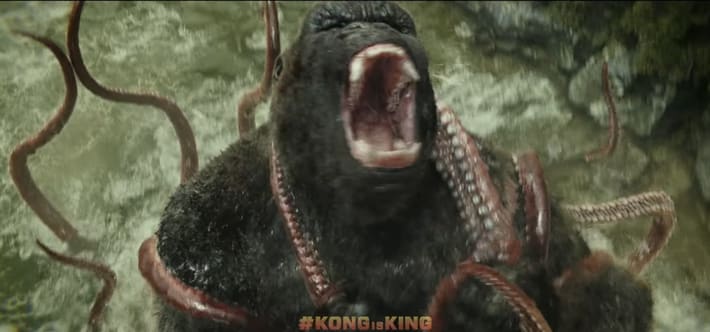
As the United States is withdrawing from Vietnam Bill Randa (John Goodman) and Houston Brooks (Corey Hawkins) of Monarch (from the 2014 Godzilla) organize an expedition to the newly discovered Skull Island. They recruit former SAS captain James Conrad (Tom Hiddleston) to act as a tracker, antiwar photographer Mason Weaver (Brie Larson), and Lieutenant Colonel Preston Packard (Samuel L. Jackson) to escort the expedition. Under the guise of a geological survey they arrive on Skull Island and start launching explosive which are supposedly used to map out the island's topography. However, this draws out Kong (motion captured by Terry Notary) who attacks the group. The expedition is split in two with one half wanting to escape the deadly island, meeting a stranded World War Two pilot (John C. Reilly), while the other half under Packard tries to kill Kong in revenge for killing some of the soldiers.

The plot is very simplistic. This is no Cooper or Jackson Kong. With this in mind it is a good standard kaiju movie and reminded quite a bit of the classic B-movie monster flicks like Creature from the Black Lagoon or some of the Showa Godzilla movies. However, it is lacking something which could make it even greater. Pacific Rim showed us that you can have a simplistic plot which is really engaging. I watched Pacific Rim and thought 'I want to see the characters and the monsters' whereas with Skull Island I just thought 'I want to see Kong'. There is only a handful of character development scenes which seem quite shoehorned in. Marvel movies have shown that you can have action oriented, light-hearted plots but still have good character development. With Skull Island this felt like it was a last minute decision due to the high profile cast. 

Acting and Characters
Some of the Cast
Skull Island has a dichotomy towards the characters/actors. It has good acting but appallingly written characters. A friend of mine described it well: good acting but in the wrong roles. It is a shame as well considering that Tom Hiddleston, Brie Larson, and John Goodman, (normally fantastic actors), are given quite forgettable characters whose entire character is based around one trope. Of those three actors I only learnt one of their characters' name. I actually forgot at one part that Tian Jing was in the movie. On top of that there are several scenes where they try and develop these characters but they are so short that they leave much to be desired. My two particular favorites both involve Brie Larson and Kong which were very well done. However, I would hazard a guess that they add up to a total of ten minutes. However, there are some really well done characters in this movie. Particularly those of Samuel L. Jackson and John C. Reilly. They were surprisingly well written and the charisma of their actors helped pull off the character. Jackson in particular was great. He struck as someone like Marlon Brando in Apocalypse Now. Near the start of the movie as the Vietnam War is ending for the USA he acts disheveled but when he gets a call for the Skull Island mission he perks up. This was a character who had become devoted to war. It was interesting watching him become more and more consumed by his vendetta towards Kong. Also, I found it quite amusing seeing him say 'bitch please'. For some reason I found it quite funny. Surprisingly, I really enjoyed Shea Whigham as well. It was a small thing but really well done.

Tone
Skull Island has a strange tone to it. At times it is deathly serious while at other times it is extremely goofy. When Kong first attacks it is a brutal scene but just as he was going to bite one soldier it cuts to someone eating a sandwich. It is okay to have a goofy movie which has serious parts to it, Marvel has done extremely well with this format, but I felt at times it went too serious and too goofy. I felt that a tone similar to Pacific Rim could have worked to Skull Island's benefit. The serious moments really did work well, and conversely the more light-hearted moments did so as well. The movie takes much influence to movies about the Vietnam War. During the Vietnam War the US army fought the Vietcong who were guerrillas, and here the US army fought King Kong who was a gorilla...I saw homages to Platoon, Apocalypse Now, and Full Metal Jacket which were creatively put into the movie. However, like with the character development scenes it feels lacking. One character mentions how they went to Vietnam and created an enemy which ties in the idea that Kong was only their enemy as they made him their enemy. When they did that connection it was really good but it could have had more to it. Also, I was grateful that they toned down the stereotypes for the tribal people in this movie compared to the others. Surprisingly it was the only thing which I preferred in this one to the others.

Effects
Kong
As everyone who has read my blog before knows that I much prefer practical effects to CGI. Skull Island falls into a recent slew of movies, including Godzilla and Jurassic World, which could have benefited from the usage of more practical effects. As The Force Awakens, Mad Max: Fury Road and Rogue One have shown you can mix practical effects with CGI to make a visually stunning movie. The scene where Brie Larson, Tom Hiddleston and Kong interact could have worked well with some practical effects. However, the CGI for Kong and the other monsters was fantastic. Kong was created via motion capture like in Jackson's King Kong and the recent Planet of the Apes films. It made the action scenes extremely good and this shows in the last third of the movie. The monster fights are spectacular in this movie. It is also a surprisingly gory and brutal movie which I did not expect. Characters are impaled by a giant spider, arms ripped off by a bird/bat/pterosaur creature, and the 'skullcrawlers' are torn apart by Kong. This is by far the most gory Kong movie. Although the monster and fighting CGI was done well some ambient CGI was not done as well. There is one scene where Hiddleston and Larson are watching an aurora which looks really fake, and there are two scenes with explosions surrounding Kong with the human characters which looked too fake. It resembled something from a early 2010s video game rather than a big budget movie. Overall the CGI was a mixed bag.

World/References (Contains spoilers!)
A possible reference
Skull Island is full of references to previous Kong movies, future movies and non-kaiju movies (excluding the prior mentioned Vietnam movies). My particular favorite is when the expedition is approaching Skull Island Samuel L. Jackson says 'Hold on to your butts'. One of my all time favorite movies is Jurassic Park and Jackson's character says this line in that movie. The movie is primarily filmed in two areas: Vietnam and Hawaii. One of the Hawaii locations was Kualoa Ranch where both Jurassic Park and Jurassic World were filmed, and of course dinosaurs live on Skull Island (although the only dinosaur we see is a Triceratops skull). There is also a reference to Them! (a movie about giant killer ants) when Reilly mentions that birds in the trees could be giant ants; in Them! the ants sound like birds. At one point Kong fights a giant octopus which he also fights in King Kong vs. Godzilla but in this movie he eats the octopus. This could be a reference to Eiji Tsuburaya, who did the effects for King Kong vs. Godzilla, as he ate one an octopus which was shown in that movie. Speaking of Godzilla this movie is set in the same universe as the 2014 Godzilla, now called the MonsterVerse. Both Monarch and MUTOs from Godzilla are mentioned in this movie as well as the 1954 nuclear tests (in this cinematic universe the tests were actually trying to kill Godzilla). It seems that everyone is trying to copy the Marvel success; we have the MonsterVerse, the DC Extended Universe, and Universal is trying to do the same with their monsters starting with The Mummy. In 2020 Legendary is planning to release King Kong vs. Godzilla and. the Kong in this movie is far taller and more bipedal compared to past Kong's. There is even an after credit scene showing cave paintings of Godzilla, Mothra, Rodan, and King Ghidorah (as well as Godzilla's roar), foreshadowing Godzilla: King of Monsters. It is strange how a cinematic universe which I was not expecting to exist has been thought out more compared to the DCEU...

Conclusion
Kong: Skull Island is a flawed movie but I thoroughly enjoyed it. If you go in expecting King Kong you will be disappointed but if you just want to see a giant ape fight giant monsters you will enjoy the movie. Although I am overall against creating cinematic universes as I feel they easily fall into the trap of being rushed, a big marketing tool for the next big marketing tool, and stifling creativity I am more forgiving towards Skull Island. It feels like it is its own movie and not trying to advertise the next movie like Batman v. Superman and Suicide Squad were. However, for the clash in 2020 I hope they chose a tone similar to that of Godzilla or Pacific Rim over the tone of this movie. Overall, I give Kong: Skull Island a 6.8/10.  

Friday, 8 April 2016

What If: Godzilla Was Real?

http://www.thefocuspull.com/features/gojira-japanese-original/
This post will be the 100th post on this blog! To celebrate I'm remaking my second alternate history scenario. I am a massive fan of the Godzilla movies and this original scenario was released to coincide with the 2014 remake of the series. Godzilla has been one of the most endearing movie characters appearing in over twenty films, having a star on the Hollywood Walk of Fame and, having two remakes to his name (a bad one be Roland Emmerich and a good one by Gareth Edwards). With a new film being released this year in Japan by Toho it is more fitting to revise what the world would be like if he existed. The existence of a giant monster (kaiju) in real life would fundamentally change world history and Godzilla would seriously change the course of history if he existed. Although Godzilla could not exist in real life, (this very good VSauce video explains why: https://www.youtube.com/watch?v=3cesaPTik_Q), we'll overlook this issue and do two scenarios: one following the Toho films and one following the 2014 film.

The King of Monsters Rises
http://manapop.com/film/retrospective-review-gojira-1954/
The first Godzilla movie was released in 1954; the world was gripped in the fear of total nuclear war between the United States and Soviet Union, the occupation of Japan had mostly ended and, the economies of Japan and the United States were booming. Japan is peaceful until one day one of the Bonin Islands is attacked by a 50 meter tall creature. The world press soon learn of the existence of the kaiju Godzilla: a giant dinosaur which can breathe fire as well as leaving a trail of destruction and radioactivity in its wake. Soon Godzilla attacks Tokyo completely destroying it. The Japanese Self-Defense Force is powerless to fight the kaiju and it is only stopped when scientist, Daisuke Serizawa, sacrifices himself to kill the creature with a new weapon called the 'Oxygen Destroyer'. 

Following Godzilla's rampage Japan is devastated. Most of Tokyo is destroyed and the area, as well as the surrounding area, is bathed in radiation. One scene in the film shows fish dying from the residue of Godzilla's radiation so we can assume that the same would happen in Tokyo. In 1955 Tokyo had a population of around 8,037,000 so following Godzilla's attack millions would die due to there being little time to evacuate the city. Thousands more would go on to die of radiation poisoning. Everyone who was not killed through Godzilla or his radiation would be left homeless. Japan would face a major refugee crisis with thousands fleeing inland or to one of the other islands, like Hokkaido. Some may flee abroad to the United States and Australia, especially those who had family. Hawaii and California would have a massive influx in the Japanese population. The politics and economy of Japan would collapse. With Tokyo an irradiated wasteland the capital would have to move to Osaka and the government of Shigeru Yoshida would be discredited. Far right and far left politics would flourish in the turmoil of Godzilla and, Shigeru would likely be forced to resign over it. The Post-War Economic Miracle would collapse. Many major companies like Sony and Casio were located in Tokyo so they would likely disappear thanks to Godzilla; not to mention how the withdrawal of foreign investment and high unemployment (created via refugees and collapsing companies) would place so much pressure on the economy. Finally we would see large amounts of anti-Americanism in Japan. Through US nuclear bomb testing Godzilla awoke so people would blame the US for their suffering; the USSR, China and North Korea may even use it as propaganda to criticize the US. Riots would occur on Okinawa where the United States still held military bases. In modern day Okinawa there is still large amounts of resentment to the presence of US forces on the island so following Godzilla's attack this would be greatly escalated. Clashes between Japanese citizens and US forces would exacerbate already frayed tensions. 
https://mubi.com/films/godzilla-raids-again
Just a year after Godzilla Toho released the (much weaker) Godzilla Raids Again. Here a new Godzilla emerges and fights another kaiju called Anguirus in Osaka. In this scenario just a year after Godzilla's attack a new Godzilla duels another giant monster in the new capital. Like what happened in Tokyo Osaka is destroyed. Hundreds of thousands of people are killed and many more are left as refugees. Here the world makes three realizations: the weapons that did so much damage just ten years prior are useless against kaiju, kaiju attacks are becoming common and nuclear weapons had now created three monsters. Full blown anti-American riots break out in Japan as soldiers are lynched in Okinawa, American aid workers are attacked and, stores selling US goods are vandalized. The Japanese people are angry that America's carelessness had destroyed their two largest cities, killed millions of their family members and had destroyed their economy. The Communist Party gets thousands of members among the unemployed while the (then newly formed) far-right Ishin Seito Shimpu gets just as many with ultra-nationalists driven to the edge thanks to the kaiju. Between 1955 and 1975 (the last of the Showa Godzilla films) thirteen Godzilla movies would be released as well as thirteen other kaiju films including Mothra, Rodan and Varan the Unbelievable. With the constant kaiju attacks Japan would fundamentally change. Cities near the sea like Kobe and Yamato would become deserted as people flee inland with there being a reduced chance of kaiju attack. Hawaii, Australia and California would become heavily influenced by Japanese culture due to the amount of people fleeing there. Sydney, Los Angeles and San Diego would have large numbers of Japanese citizens living there and Japanese would become an everyday language in these cities alongside English. 

As the years drag by and Godzilla (and other monsters) ravage cities more frequently the Pacific world would change. Most of Japan's economy would be devoted to the Self-Defense Force in order to fend off the monsters. Conscription for all adults for several years would be implemented early on and coastal cities such as Yamamto would become virtually military bases preparing for the inevitable attacks. Tokyo would slowly be reclaimed although food and water would have to be imported as the land (and Tokyo Bay) would still be too unsafe to take food/drink from. The coastal cities would be lightly populated with the military comprising the largest residents although there would be civilians to cater for the army like store owners and teachers for a soldier's family. Many aspects of Japanese culture now big in the west, such as anime, would never even develop never mind leave Japan. With a total war economy Nintendo, for example, would never be created so there would be no video game industry, anime got big in the 1970s so we would not see anime outside of Japan and, many domestic appliances were developed in Japan so they would not be created in this timeline. In the Heisei era films it is implied that kaiju attack cities as they are heavily populated. In real life cities cannot be instantly rebuilt as they are in the films so likely many future attacks would happen on cities on the Pacific. Due to the fact that the initial attacks only occurred on Japan these cities would be instantly taken off-guard. Darwin, Seoul, Beijing, Hong Kong and Singapore just to name a few cities would be demolished by Godzilla, Mothra and various other kaiju. Like Japan, countries bordering the Pacific would spend millions turning coastal areas into defensive areas against giant monsters. Richer countries like China and the US would build coastal walls to prevent monsters ravaging their lands. Military technology, however, would become something equivalent to that of a sci-fi movie, almost like the film Pacific Rim, as the world realizes they have to upgrade warfare as tanks and planes prove ineffective against kaiju. Inevitably wars between countries would become ever more devastating. However, as nuclear weapons had created the monsters and proved to be effective the campaigns against nukes would be universally supported. In 1998 Roland Emmerich created an abysmal remake of the King of Monsters but, in a Toho movie (Godzilla, Mothra, King Ghidorah: Giant Monsters All-Out Attack) made a reference to that film. That means in this scenario there is a monster attack in the Atlantic and New York is devastated. The world then realizes: nowhere is safe from kaiju.

2014 Godzilla
http://cinefantastiqueonline.com/2014/05/godzilla-2014-review/
In this new scenario Godzilla awakens to battle the two MUTO where the 1954 attack never happened. Like in the film the three kaiju battle leaving Las Vegas, Honolulu and Los Angeles devastated in their wake. Following the battle America would be in crisis. Los Angeles, Las Vegas and Honolulu have a combined population of 19,528,146 people and we can assume all three cities were devastated thanks to the MUTOs and Godzilla. A good few million of this number would manage to make it out okay as Los Angeles was mostly evacuated. However, Honolulu and Las Vegas received no warning so it is likely that there was a high casualty rate. Worse case scenario and only a quarter of this number survived that means around 4,882,036 would be displaced. North Korea would use the kaiju rampage as propaganda hailing it is a great victory against the United States. The economy would be seriously hit. All three cities offer huge revenue in regards to tourism but, the loss of Los Angeles would be especially hard on the USA. Many major companies are located in Los Angeles, such as 20th Century Fox, so the stock in these companies would plummet. Naturally unemployment would skyrocket and billions would have to be paid to rebuilt what was destroyed. Unlike the last scenario Godzilla did not emit radiation in the 2014 film so rebuilding Los Angeles, Las Vegas and Honolulu would be an easier task (although still extremely costly). Sanitation, rubble clearing, road surfacing and fire control would be the main tasks although in Las Vegas and Honolulu the job would be harder. Honolulu was flooded by a tsunami created by Godzilla surfacing and Las Vegas is in a desert where the nearest water source is many miles away. Rebuilding could take generations but the immense loss of life (through displacement or death) would leave a toll on the cities. Nuclear issues, however, would be a much less controversial case. In the UK General Election in 2015 there were intense debates about whether to keep the UK's Trident program (the UK's nuclear weapon program). In the light of nuclear weapons attracting the MUTO and awakening Godzilla the general consensus would be they have to go. World populations would be fearful if the nuclear weapons of their countries would attract other kaiju. Three had appeared virtually out of nowhere so the feeling would be that there could be many more. The campaign for nuclear disarmament would get a new lease of life.

Thanks for reading and staying with me over 100 posts! Did you like the two alternate history scenarios? Please leave any comments.