Search This Blog

Showing posts with label Napoleon. Show all posts

Saturday, 3 November 2018

World History: The Haitian Revolution

A painting of the 1803 Battle of Vertieres
On World History at the moment we're looking at the Age of Revolution where from the late-1700s to the mid-1800s revolutions, (political, social, and economic), ended up drastically changing the world we live in. Today we're looking at a unique revolution: the Haitian Revolution. This revolution saw the abolishing of slavery and the independence of Haiti, however, its perception has changed over the years. Originally it was seen as merely a successful slave revolt which had reactionary anti-white elements to it until the coming of the landmark The Black Jacobins by C.L.R. James which highlighted the influences of the French Revolution. James also highlighted the African elements of the Revolution which has now been brought back into the historiography. The Haitian Revolution shows how those lacking agency in a society can obtain it more pertinently than what we saw in the French and American Revolutions. 

Background
Free Women of Color with their Children and Servants, by Agostino Brunias, Dominica, c. 1764–1796. Although not from Haiti this scene was replicated in the pre-Revolution colony
The Haitian Revolution took place in the French colony of Saint-Domingue on the island of Hispaniola, the island where present day Haiti and Dominican Republic are. Colonised in the late-1600s Saint-Domingue was a plantation economy growing a variety of crops, largely sugar and coffee. In 1787 the island had 655 sugar plantations producing 131,000,000 pounds of sugar; 1,962 coffee plantations; and 398 cotton and indigo plantations. Saint-Domingue became extremely rich as a result as it provided most of the coffee and sugar to Europe becoming known as the 'Jewel of the Antilles'. Cities like Le Cap Francois and Port-au-Prince were larger than many cities in what would become the United States. The colony was heavily divided along regional, (North, South and West), lines as each competed for economic superiority. Society was also split into three groups: whites, gens de couleur, and slaves. Even then each group could be further divided. Les blancs numbered around 24,000 individuals and were heavily divided by class - planters, despite very small in number, dominated Saint-Domingue society compared to the more numerous petit blancs who served as labourers, small merchants, and workers on plantations. The plantation owners replicated their wealthy aristocratic counterparts in France embodying the finery of the aristocrats; French traveller Jean-Bernard Bossu told a story how some sailors went for dinner at the invitation of a plantation owner. Their host was decked out in fine clothing with rich food so they assumed a wedding was happening until their host told them that this was just a normal dinner. The gens de couleur were made of freed slaves and mixed-race individuals; most of the original colonials were male so would take advantage of female slaves. They could own property and some even owned slaves including the later hero of the Revolution, Toussaint Louverture (also spelt L'Ouverture). There was great tension between gens de couleur and petit blancs for various reasons. Although the 1685 Code Noir made them French citizens they were still legally barred from political activity where over the next century their political rights were eroded. In neighbouring Spanish America at this time it was possible for a wealthy mixed-race individual to 'buy whiteness' and it was possible for gens de couleur to do so as well, however, they had to be three generations removed from their last black ancestor. Meanwhile, petit blancs in theory were 'superior' to gens de couleur but as they often lacked property, and worked for gens de couleur, they heavily resented this and expressed this through racism. Women also took part in this racism fostering hostility to neighbours who entered interracial relationships or businesses.
A modern depiction of Vodou, even today you can see the synchronicity of Catholicism and West African imagery, https://adventure.com/real-vodou-haiti/  
Finally, we have the slaves who made up 90% of Saint-Domingue's population. As we saw when we looked at the Atlantic slave trade this time period was the height of the slave trade. In 1787 there was at least 408,000 slaves and in 1788 alone 29,506 slaves were imported to the colony. Due to harsh living conditions most slaves died at a young age, 50% died in their first year of arriving at the colony, so most had to be imported in. The Code Noir was on the surface benevolent, or as benevolent as a pro-slavery law could be, but in practice it was regularly violated. With the exception of market day slaves had to work long hours in the Caribbean sun and could be subjected to physical abuse, mutilation, and, for women, rape. Grands blanc owned them, petit blancs wanted to own them, and gens de couleur both owned and resented them - slaves reminded them of their black skin and apparent inferiority. Slaves did have some agency. Sometimes kind owners offered slaves the opportunity to buy their freedom. Slave rebellions did occur - maroon settlements existed and before the Haitian Revolution there were slaves uprisings. In 1700 300 slaves near the capital of Le Cap Francois rose up and between 1751 and 1757 a Vodou priest called Francois Mackandal led a popular rebellion until he was burnt at the stake in 1758. Slaves also got agency in less overt ways. They knew that they were worth something to their masters so would poison themselves, or others, to spite them. Go-slows were common as well. They also formed their own culture - most slaves came from the Kongo in modern Angola or the Bight of Biafra so a wide variety of different cultures, languages and religions were brought together. At times a slave could go through several owners in Africa before they were sent to the Caribbean. The journey was traumatic but not enough to destroy their heritage so all came together uniting old and new, shared ones. In particular, the imposition of French and Catholicism merged into this. Vodou, or voodoo, emerged from this combining Catholicism with West African belief. If you look at Vodou ceremonies you can see the Catholic influences such as chanting and holy water in purification rituals. However, as it combined African and Christian beliefs it was instantly distrusted by the pious French Catholics, and at times slaves could use this distrust for agency. Vengeful slaves at times cast curses against harsh overseers and owners. 

No that is the situation at the dawn of the Haitian Revolution. Each group distrusted one another in a colony that was extremely wealthy, albeit most of that wealth was in the hands of a small group, but based on chattel slavery. Historian Paul Fregosi describes it well 'Haiti was hell, but Haiti was rich.'

Beginnings of the Revolution
Normally we see the start of the Revolution as beginning in 1791 but in reality we must trace it back to 1789 to properly understand the ideology of it. Tensions in France fed into tensions on Saint-Domingue. Seeing that in 1788 the king was having to bring back the Estates-General the North seized the opportunity to grant themselves further rights and power. They formed a committee, illegal according to French law, to send to Paris wanting to abolish military justice, have legislation and taxes to be voted by a provincial assembly subject to only the king and Colonial Committee, and that they should elect their own delegates. However, as they restricted representation to property owners which excluded women and petit blancs. Gens de couleur did manage to send their own deputies, separate from whites, to Paris to negotiate their own freedom. There they made alliances with Parisian allies and an abolitionist group called the Amis de Noirs, formed 1788. Like their counterparts in Britain and the US they were largely an elite group who opposed slavery but they faced an issue in Revolutionary France. A large part of the French Revolution's rhetoric involved property rights and this was a society which viewed slaves as property, not people, and several key coastal cities had an economy reliant upon the slave trade, like Nantes. The gens de couleur's delegates offered the perfect way to boost their support. As they were also fighting for their liberty the Amis des Noirs could indirectly attack slavery. However, the colonial delegates remained deeply divided and the creation of the Declaration of the Rights of Man and Citizen terrified white delegates; it paved the way for emancipating the gens de couleur, and they initially embraced the revolutionary ideas. A way to get higher in society for non-whites was to take part in the colonial militia - in 1789 104 out of 156 companies were largely made of gens de couleur. They adopted the red cockade of the Revolution and started modelling themselves after the National Guard. Soon enough the support for the slavers started waning after those in France noticed the hypocrisy of demanding freedom while denying it to gens de couleur, however they remained quiet about slavery and women's rights. The Count of Mirabeau declared:
You claim representation proportionate to the number of inhabitants. The free blacks are proprietors and tax-payers, and yet they have not been allowed to vote. And as for slaves, either they are men or they are not; if the colonists consider them to be men, let them free them and make them electors and eligible for seats; if contrary to the case, have we, in appointing deputies according to the population of France, taken into consideration the number of our horses or our mules?
When news of the Fall of the Bastille arrived in the colony it served as a spark to a powder keg. Petit blancs, calling themselves Patriots, started their own political clubs which forced the Intendant to flee, while they attacked gens de couleurs and slaves protesting for rights. The French Assembly began slowly edging towards emancipation of gens de couleurs but due to them dragging their feet, and with continued white opposition, this upset many delegates. One delegate, Vincent Ogé, returned to Saint-Domingue to replicate the events in France in October 1790. He planned to lead a revolt of male gens de couleur and with between 250-350 men planned to lead a revolt. However, as argued by C.L.R. James, he was a 'good Liberal' he did not seek allies with the slaves and he was more a politician than a revolutionary. Ogé was soon defeated and in February he was brutally executed firing the flames of revolt. As Patriots forced the governor from Port-au-Prince the French Assembly on May 15 decided to emancipate the gens de couleurs. However, this angered the whites and the slaves remained in chains. In August things would change. On 22 August, quoting Thomas Ott, 'The slaves had joined the Haitian Revolution'.

The Slave Revolution
An image of slave leader Biassou
When the slaves entered the Revolution it became the largest slave revolt in history since Spartacus's revolt against the Romans, and it would turn out to be one of the few successful slave revolts. In August a Vodou priest named Dutty Boukman, and possibly a female religious figure called Cecil Fatiman, did a religious ceremony at Bois Caiman vowing that Saint-Domingue's slaves would be freed under the command of Jean-Francois Pappillon, Jeannot and Georges Biassou. This ceremony had much African folklore mixed in with Catholicism. James has argued as such a conspiracy on such a large scale had not been discovered serves as a 'testimony to their solidarity'. Not long after at a ceremony during a storm on August 22 1791 signalled the beginning of the slave rebellion. It has retroactively been descried as a Vodou ceremony although we cannot be sure how much Vodou influenced this ceremony. From the Noe plantation in the North slaves started rising up in their thousands often taking their revenge on their former masters. Within a few weeks 100,000 slaves were in revolt burning down plantations and killing several thousand whites. However, this was not universal. Some slaves opted to defend their masters through various and personal reasons including the future leader of the revolution, Toussaint Breda (later Louverture). Before he joined the slaves Toussaint made sure that Madame Bayou de Libertas went safely to Le Cap. Toussaint is a semi-unique case - he managed to gain his own freedom around 1776, became well educated very quickly, and even owned his own plantation and slaves. Despite the slaves being under-equiped they had their own armies. John Thornton is just one historian who has stressed an actual African origin of this - many male slaves were captured soldiers so were already used to military formations. The slaves were led by three main individuals: Jean-Francois, an intelligent maroon leader from long before the revolution; Biassou, a bold fighter who had belonged to a religious establishment instead of the regular planters; and Jeannot, a slave who readily enacted revenge on whites and gens de couleur. Directly quoting James 'Jeannot was a cruel monster who used to drink the blood of his white victims and commit abominable cruelties'. The African origins of the slaves, the solidarity among them, and efficient leadership ensured that the slaves were not immediately crushed as many others were. Although not a major player yet Toussaint acted in the background under Biassou offering advice. A letter from Toussaint on 15 October 1791 advised that 'make sure with the spy you have sent to have him clearly explain where the powder works are in Haut du Cap so we can succeed in taking the powder works.' 

As slaves rebelled in the North gens du couleur joined them in the West and some made common ground in September when the May decree was annulled. However, there were distrust among them. At times gens du couleur forced slaves to fight for them, and these slaves became known as 'Swiss', and slaves who surrendered themselves to their masters (through fear or being tired of fighting) were killed on sight. Clashes between whites and free blacks, and mixed-race individuals, actually caused Port-au-Prince to be set on fire in November which women took part in. Like the French Revolution we see the Haitian Revolution as a male affair but many women took part in both the fighting and radicalising of the revolution. As the slave revolt spread from the North France sent a new governor to bring the peace. Leger-Felicite Sonthonax was a radical Jacobin, although no abolitionist, and aimed to preserve the French Revolution in France, remove Royalism, bring racial equality, and quell slave uprisings. Although Thomas Ott's assertion that Sonthonax was 'anti-white' is hyperbolic (Sonthonax wanted to retain slavery as to not alienate whites) he did want to curb white power as he saw it as blocking equality. Sonthonax started enforcing the May 15 decree and exiled even radical whites if they opposed racial equality. He even barred whites from entering the militia at times as he thought this would allow white dominance and possible Royalism. However, he still kept in place slavery and then matters worsened when Britain and Spain declared war in 1793. In the Caribbean revolution was just as terrifying to them as it was in Europe. There was a fear that slave revolts could spread to Jamaica, Cuba, Santo Domingo and other slave economies inspired by Saint-Domingue as slave revolts had also broken out in the French colonies of Guadeloupe and Martinique. Jamaica's governor Lord Effington restricted entry to the colony in case revolutionary ideas, both French and slave, spread there as well. The British and Spanish both wanted Saint-Domingue to crush the revolt and to seize its wealth. Key leaders including Biassou and gens du couleur Andres Rigaud ended up joining the Spanish for various reasons.

African Ideology and the Revolution
It is curious how those inspired by the French Revolution ended up joining Britain, Spain, and French Royalists. After sacking Le Cap in June 1793 slave leader Macaya wrote that 'I am the subject of three kings: of the King of Congo, master of all blacks; of the King of France who represents my father; of the King of Spain who represents my mother. These three Kings are descendants of those who, led by a star, came to adore God made Man.' James saw this royalism as being part of a backward looking African thought which Toussaint Louverture weaned them out of. John Thornton has looked at the African royalism in a different way; many slaves were royalists but their royalism differed to European royalism. Many of Saint-Domingue's slaves came from the Kingdom of Kongo, such as Macaya, which saw turbulent times in the 1700s. A series of civil wars broke out over the power of the king; all accepted that there should be a king but a king's rule had to be tempered by generosity and selflessness. Christianity had been introduced to Kongo around three centuries prior and it had blended with local institutions and ideas. A member of the Antonian movement in Kongo, Beatriz Kimpa Vita, sought to end the civil wars by saying the king should be decided by Saint Anthony, and the selfishness of the rulers had to end for Jesus to allow a ruler to basically lead. Slaves often coalesced in groups from the region they came from so these ideas continued, even amongst creole communities, so at least amongst Kongolese slaves a form of royalism continued. As we saw earlier Vodou was formed through a mix of different West African beliefs so it is not out of the question to believe that this idea could have the potential to spread outside Kongolese communities. Of course, we also have Vodou's influence. It served as a way to connect each slave community by combining beliefs with Catholicism.

War, Abolition, and Toussaint
A posthumous painting of Toussaint Louverture
In May 1793 Biassou and Jean-Francois joined the Spanish forces taking their armies with them.  From 1793 to 1798 there is a lot of switching sides so I'll have to do a broad overview. Toussaint, now changing his name from Breda to Louverture, made his mark during this time. In June his force of 600 defeated a much larger French force putting Northeast Saint-Domingue under his control. As mentioned earlier Toussaint was educated in everything from economics to history to military strategy making him an ideal general. A big reason why the Spanish had so many early victories was due to Toussaint. Meanwhile, the British and Spanish were having issues thanks to supplies and disease. Yellow fever devastated their forces so they resorted to offering freedom to any slave who joined them, a tactic Britain also used during the American Revolution. Thanks to this the British troops ended up having more black than white troops. However, this did not stop intense violence - the British massacred insurgent slaves who had surrendered at La Charbonier and when Fort Dauphin was captured by Jean-Francois in July 1794 he had his troop kill as many French whites as they could. However, it was very evident since the slaves joined the Spanish in 1793 that the only victory they would accept involved the abolition of slavery.

Beset by the Spanish, British and French royalists, as well as the skills of figures like Toussaint, Sonthonax was desperate. He knew that slavery was the main concern of the insurgent slaves and their allies, not British or Spanish rule. In August he issued a decree abolishing slavery in the North and by October 1793 he had expanded it to include the entirety of Saint-Domingue. By this time the radical Jacobin faction had seized control of France and its leaders, like Robespierre, were sympathetic to abolition. Now in February 1794 the Convention abolished slavery in France and all of its colonies. However, this was more due to pragmatism as to appear more morally righteous compared to Britain. Sometime in the spring of 1794 Toussaint joined the French. Historians still do not know why Toussaint unexpectedly swapped sides but abolition must have been a major factor. The gap between his defection and the decree may have been due to Toussaint scoping to see if the abolition was genuine. Thomas Ott has suggested it was a mixture of abolition and pragmatism which caused the switch. Toussaint was blocked by Biassou and Jean-Francois so a switch to the French side would allow his promotion, and abolition convinced him that the French side were just. However, we may never know his exact reasoning. Despite almost being captured by an ambush by either Jean-Francois or Biassou, which killed his brother Pierre, in March 1794 his 4,000 troops proved highly useful for the French. Several key and skilled leaders joined him as well including Jean-Jacques Dessalines. Toussaint became popular for his intelligence and his willingness to work with whites and gens du couleurs. Toussaint fought the Spanish as Andre Rigaud fought the British and by 1798 both powers had been forced from Saint-Domingue, albeit with a lot of help from yellow fever, or the 'black vomit' as the British called it. Biassou and Jean-Francois went into exile by November 1796 and in 1795 France even took over Santo Domingo putting all of Hispanola under French control.

Toussaint in Control
An 1802 engraving of Toussaint
Even before the British and Spanish were defeated Toussaint had started to move himself into power in the North and West. Defending Governor Laveaux from a coup by gens du couleur soldiers in March 1796 this allowed him to become deputy-governor; Laveaux would declare him the 'black Spartacus, the negro Raynal [an earlier writer] predicated would avenge the outrages done to his race'. When he was declared Commander in Chief in May 1797 he used this to oust Sonthonax and when the British were defeated in 1798 he had enough power to sign a trade, and non-aggression, treaty with them. However, in 1799 he clashed with Andre Rigaud. Rigaud was a threat in two ways: first, he was a powerful figure controlling a large section of Saint-Domingue; and, Rigaud wanted a society where gens du couleurs were on top of blacks despite his respect for Toussaint. For almost a year, June 1799-July 1800, the 'War of Knives' was waged between the two resulting in Rigaud to flee to France and Dessalines to massacre mixed-race troops; Toussaint even chastised him saying that he didn't want him to 'tear up the roots'. In 1801 he also invaded Santo Domingo formally annexing it into Saint-Domingue. However, he started to become a ruler. Toussaint at this stage was not willing to declare independence but he knew that he had to create a state. What they had done was ambitious and there was a widespread belief in Europe that blacks were mentally inferior to whites. He wanted to show that they could hold revolutionary ideals while making Saint-Domingue a thriving and wealthy state.

In this section we see his radicalism and his moderation. As early as 1797 he had planned to resuscitate the plantation system, something James refers to as one of his few mistakes. Many former slaves wanted to divide the former plantations into smaller holdings for subsistence farming or regional markets. Toussaint feared that if Saint-Domingue's economy failed this would bring back slavery, and he saw this desire to break the plantation economy as allowing that. Using the military he made sure former slaves remained on the plantation, would allot people found vagrant to a plantation, and even offered white planters a return of their property if they renounced slavery. Naturally this was very unpopular and his own adopted nephew, Moyse, supported a revolt in October 1800 against the plantation system. Moyse was later executed for his role. Like his contemporary Napoleon, he is sometimes referred to as 'the Black Napoleon', he also made himself governor-for-life. However, at the same time he was fairly radical. In May 1801 a constitution was declared which vowed that slavery should never return, an Assembly shall be voted in every two years, prohibiting racial discrimination, and equality before the law. It did have its limits - equality only applied to men and divorce was prohibited. Like in the US and France citizenship was for active men. Racial equality, nevertheless, was a radical idea for this time period.

Independence
An 1845 painting of the Battle for Palm Tree Hill
The radicalism of the constitution made Britain and the US fearful, and both informed Napoleon that they would not do anything if he wanted to depose Toussaint. Napoleon wanted to build a French empire to rival Britain and to do that he needed two things: Saint-Domingue and slavery. Saint-Domingue was very important to the French economy and empire; now that Louisiana was back in French hands it served as a useful link to protect the American continental holdings. Napoleon sent his brother-in-law Charles Emmanuel Leclerc on February 1802 with a force of 1,200 to bring back French power over the island. Toussaint saw Napoleon's attack as a violation of the ideas that they had fought for. He ordered Henry Christophe to burn down Le Cap and wrote to Dessalines saying:
Do not forget, while waiting for the rainy reason which will rid us of our foes, that we have no other resource than destruction and fire. Bear in mind that the soil bathed with our sweat must not furnish our enemies with the smallest sustenance. Tear up the roads with shot; throw corpses and horses into all the foundations, burn and annihilate everything in order that those who have come to reduce us to slavery may have before their eyes the image of the hell which they deserve.
He saw how well yellow fever had ravaged European forces so all he did was wait for disease to take its toll before attacking. It proved to be a good tactic. France sent around 80,000 battle hardened troops to Saint-Domingue of which 50,000 died of disease, including Leclerc himself. However, Toussaint would not see French defeat. At Gonaives he was betrayed and arrested by Leclerc; we do not know who betrayed him and one theory is that Dessalines did so. He told his captors:
In overthrowing me you have cut down in Saint Domingue only the trunk of the tree of liberty; it will spring up again from the roots, for they are numerous and they are deep.
The hero of the revolution would die in a French prison on 7 April 1803 through malnutrition, infection and exposure. Dessalines soon took over and continued the fight, and when war in Europe began again in May Napoleon decided to abandon Saint-Domingue. On 31 December Saint-Domingue declared its independence as a new nation called Haiti. Rejecting its European name it took an indigenous name reflecting the island's mountainous geography. Dessalines soon began a massacre of the white population claiming up to 5,000 victims, declared himself emperor, and continued the plantation system with some debating whether they were still slaves.
An 1806 engraving depicting Dessalines as a brute holding the severed head of a French woman

Aftermath and Conclusion
Haiti's first steps to independence were fragile. The rigid plantation system continued, the mixed-race population monopolised power, Dessalines was soon assassinated, and the Santo Domingo half would try to break away (it eventually did so as the Dominican Republic). Haiti's economic prosperity soon came to an end. Colonial powers feared that Haiti would inspire slave revolts in their lands, and occasionally it did fund slave revolts. To ease peace between the two Haiti had to pay France 150 million francs, (bearing in mind it sold Louisiana Territory to the US for just 80 million), so Haiti had to turn to the US for a loan. The US forced them to take such a large loan that it took until 1947 to pay off. Furthermore, Haiti hoped to trade with its old trading partners of France, the UK, and the US who all refused to do so - for a long time they continued to blockade the island. They only recognised independence when each state abolished slavery, and as late as 1898 US politicians were warning about the Haitian threat. Everything about Haiti was distorted into being negative. For example, in the North Atlantic world we see Vodou as a superstitious, devil-worshipping cult where its followers create zombies and do sacrifices for the spirits - a very different view of what Vodou is.
Ann Whitney's 1870 carving of Toussaint
However, the Haitian Revolution had a truly revolutionary aspect to it. For one, it was a successful slave revolt which tried to bring about racial equality - this was at a time when slavery was seen as morally right by many people. Abolitionists even pointed to Haiti as a way to bring their aims about; either they were encouraged by it as there was a chance that a slave revolt could be successful, or as a warning to what happens when slavery continues. Haiti was not only Latin America's first successful independence revolution but also when an 'other' truly succeeded. A marginalised group in society managed to overthrow their oppressors and bring about a new society. It explains why many Afro-Caribbean writers and historians are still inspired by the Haitian Revolution. Afro-Trinidadian historian C.L.R. James wrote The Black Jacobins and a play about Toussaint to bring the Haitian Revolution back into view instead of just being a slave revolt on the world's periphery. Truly that is the radical legacy of the Haitian Revolution.

The sources I have used are as follows:
-David Geggus, (ed.), The Haitian Revolution: A Documentary History, (Indianapolis: Hackett Publishing, 2014)
-C.L.R. James, The Black Jacobins: Toussaint L'Ouverture and the San Domingo Revolution, Second Edition, (New York: Vintage Books, 1963)
-Jean-Bertrand Aristide, (ed.), Revolutions: Toussaint L'Ouverture, The Haitian Revolution, (London: Verso, 2008)
-David Geggus, Haitian Revolutionary Studies, (Indianapolis: Indian University Press, 2002)
-Jeremy Popkin, Your are All Free: The Haitian Revolution and the Abolition of Slavery, (Cambridge: Cambridge University Press, 2010)
-Thomas Ott, The Haitian Revolution: 1789-1804, (Knoxville: University of Tennessee Press, 1973)
-Carolyn Fick, 'The Haitian Revolution and the Limits of Freedom: Defining Citizenship in the Revolutionary Era', Social History, 32:4, (2007), 394-414
-John Thornton, '"I Am the Subject of the Kong of Congo": African Political Ideology and the Haitian Revolution', Journal of World History, 4:2, (1993), 181-214
-'The Haitian Revolution', In Our Time, BBC

Thank you for reading. Next time on World History we'll be looking at perhaps the most important revolution which created our modern world: the Industrial Revolution. For other World History posts please see our list here. For future blog updates please see our Facebook or catch me on Twitter @LewisTwiby.

Saturday, 8 September 2018

World History: The French Revolution

A painting depicting the Storming of the Tuileries Palace
Last time on World History we looked at the start of the Age of Revolutions with the American Revolution but today we're looking at arguably the more important revolution: the French Revolution. Seen as the birth of the modern world and a turning point in human history with Eric Hobsbawm characterising it as one of the two main revolutions of this period which shaped the world, the other being the Industrial Revolution. The French Revolution is seen as being more chaotic, violent, and radical than its earlier cousin in America so today we'll look at why we have this perception and if there is any truth to the matter.

Origins
Louis XVI
Like many events in history the French Revolution doesn't have one singular origin. A key factor was economic issues. Since the reign of Louis XIV the French monarchy had undergone several major and expensive building projects, including the palace of Versailles, and even more expensive wars. Although France was an economic heavyweight in Europe these expenses really dented the French economy - especially after it lost most of its colonies during the Seven Years' War. Louis XVI came to the throne in 1774 inheriting a mountain of debt which he added to by intervening in the American War of Independence; he even dismissed his economic ministers to appoint Jacques Necker who supported it. Especially since the reign of Louis XV the French monarchy had trouble taxing the nobles due to court parties so Necker relied on loans adding to France's debt. This added another million livres to the debt and Necker's replacement in 1783 also failed to relieve France's debt issue. Furthermore, the taxation system was fairly inefficient. All the population had to pay a tenth of their wage to the Church called a tithe, there was a further tax based on the amount of people in your family, and the poor faced extra taxes. This included corvée which was a tax paid in your labour such as being conscripted to build canals or roads, (this was not limited to France), and taxes if you needed to use noble owned buildings including mills and bakeries. The nobles and clergy were normally exempt from these taxes, with the exception of tithes, leaving the rest of society to shoulder the burden; attempts by several monarchs like Louis XV to tax the nobility were generally unsuccessful. Tariffs between different regions prevented a united market, there was a 300% difference in food prices in different cities, and tax collection was handed out to individuals in a not too dissimilar way to what happened in the Ottoman and Mughal Empires. In something that can be retroactively described as privatisation individuals could collect tax and keep some of it so naturally to increase revenue they increased taxes. Taxes could prove devastating to the poor and just before 1789 harvest failures caused the price of bread to skyrocket. By 1789 debt was over 8 billion livres with many being unemployed, including 20,000 in Lyon and 12,000 in Abbeville.
A caricature of the Estate system
We also have the social and intellectual origins of the Revolution. French society was split into three groups called estates: the First Estate was the clergy; the Second Estate was the nobility; and the Third Estate was everyone else. This ranged from everyone from wealthy merchants to poor rural peasants. Throughout the eighteenth century in particular a bourgeois middle class started emerging with some becoming wealthier than nobles. Members of the Third Estate were irate that despite comprising more of the population they had less privileges than the smaller nobility. In January 1789 a member of the clergy called Emmanuel Joseph-Sieyes in a pamphlet called Qu'est-ce que le tiers-état? (What is the Third Estate?) writing: What is the Third Estate? Everything. What has it been hitherto in the political order? Nothing. What does it desire to be? Something. This pamphlet would become the ideological backing of the French Revolution in the same sense that Thomas Paine's Common Sense was to the American Revolution. A rise in commercial printing, although heavily censored at times, allowed new ideas to circulate among the coffee houses and clubs of cosmopolitan France spreading new ideas and criticisms of the nobility. Criticisms of the monarchy, but not the king, circulated especially when taxes were raised as despite rising food costs the nobility remained unaffected. Although most of the attacks on the queen Marie Antoinette was simply misogynistic rumours her lavish spending, such as her playing a milk maids, angered the populace - she never actually said 'Let them eat cake'. However, even if most accusations were false they were widely believed. Entry into the American War of Independence had also brought French soldiers into contact with American revolutionaries who then also brought ideas of liberty back with them.

Finally, we have the Enlightenment. The Enlightenment was not a unified movement with it differing even in the same state never mind different ones. In France the Enlightenment was fairly radical - especially compared to the more moderate English and Scottish one which inspired the American Revolution. Part of this was that France had more limited freedom of expression compared to their British counterparts. One of the key thinkers of the French Enlightenment was Voltaire who spent large parts of his life in exile in Germany due to French censors. Despite attempts to ban or censor Enlightenment works they were widely read - book sellers were only reluctant to sell Voltaire's works as he had a habit of editing his work immediately after they had been published. The French Enlightenment offered scathing criticisms of the nobility and religion. Rousseau was the one who offered the most biting critiques of Marie Antoinette and Diderot in the Encyclopédie inserted sly jabs at religion including having the entry for 'Transubstantiation' say 'See Also: Cannibalism'. Enlightenment thinkers were well read in the cities and those who could not read, or get a hold of them, knew about what was said due to a vibrant public reading community; Marie Antoinette was also a big lover of Rousseau and Montesquieu. 

Outbreak of Revolution
A depiction of the Tennis Court Oath
1788 was a year of crisis for Louis XVI. In June a revolt broke out in Grenoble and in August the treasury was declared empty. However, the clergy and nobility did not want to give up their tax privileges and after failing to reach a solution Louis XVI brought back Jacques Necker (popular with members of the Third Estate) and decided to call a meeting of the Estates-General. This was a large parliament which had last been convened in 1614 with representatives from each three estates: 303 for the First; 291 for the Second; and 610 for the Third. In January 1789 Sieyes published his revolutionary pamphlet and was elected a representative of the Third Estate despite originally being a member of the clergy. The Estates-General met in May in Versailles but things quickly soured. Louis's brothers had wanted to limit Necker's influence; Marie Antoinette openly showed contempt; and Louis made it clear himself that the Estates-General was thanks to his own writ. The Third Estate was particularly irate; they wanted individual votes to count which they saw as reflecting the population instead of block voting where each Estate voted which allowed the First and Second Estates to out vote the Third. In June the Third Estate declared themselves separate from the Estates-General representing a new idea called 'the People' in a new National Assembly. To prevent the Assembly from meeting Louis forbade them from entering, although Colin Jones has argued that this was done to allow the King's Council to offer reforms feeling that no further debates were necessary. So on June 20 1789 the Third Estate convened at a nearby tennis court vowing not to separate until they had drafted a constitution in what became known as the Tennis Court Oath. Most of the clergy and even members of the nobility joined the National Assembly seeing the closing of the hall as an 'act of despotism' and the king's supporters started backing down. Necker declared that in the future taxes and loans had to be agreed to by the Estates-General, the creation of provincial assemblies, and the abolishing of serfdom, arbitrary imprisonment and corvée labour. However, at the same time the nobility and clergy could veto matters concerning them, and the king surrounded the meeting hall with troops declaring that nothing the Estates did was valid without his approval. When the meeting ended the Third Estate and their allies refused to leave and Necker resigned causing letters to pour in supporting the Assembly and even riots in Paris. 
Storming of the Bastille
In June and July we see more actions from the public including a crowd of 4,000 storming a prison to free four French Guards who had joined political clubs. As Necker was seen as manipulating public opinion he was dismissed on 11 July, just two days after the National Assembly turned itself into the National Constituent Assembly, prompting riots across France as grievances over bread and food prices mixed with anger over Necker's dismissal. Paris in particular became the forefront of rebellion and soon Parisian mobs turned their attention on a state prison called the Bastille. Not only was the Bastille a symbol of the monarchy's despotism but also they wanted what was inside: arms, ammunition and possibly even bread. On July 14 Parisian insurgents laid siege to the Bastille which surrendered that same day after 83 were killed (another 15 were to die from wounds); the governor Bernard-Rene de Launay was soon after killed by the mob. The Bastille was later torn down, part of it was actually sent to George Washington as a gift which he cherished, and today July 14 is celebrated in France. Following this Necker was brought back, riots continued across France, armed militias were made, and fearful aristocrats fled abroad calling themselves émigrés. The king was brought to Paris wearing a newly created tricolour cockade to show that he was supportive of this revolution. In August the Assembly under Necker started a series of reforms including abolishing the privileges and feudal rights of the nobility, announcing freedom of speech and religion, and pushing France closer to a constitutional monarchy as seen in Britain. However, inspired by radical Enlightenment ideas several figures criticised the reforms as not going far enough. A new group movement described as the sans-culottes (without breeches) comprising of militant, urban and poorer men emerged and newspapers calling for radicalism started being published setting the stage for the later Jacobins. One key thinker, Jean-Paul Marat, denounced the reforms calling it 'A plot uncovered to lull the people to sleep' as he saw it as appeasing the people with them not realising that they still were oppressed.

On August 27 one of the most radical documents in history was made: the Declaration of the Rights of Man and Citizen. Largely drafted by the new leader of the National Guard and hero of the American Revolution, Lafayette, (as well as Thomas Jefferson and Honore Mirabeau) it was directly inspired by Enlightenment thought and the American Declaration of Independence and Constitution. It granted legal equality, freedom of expression, and various 'natural rights' including that to security, liberty, property and resistance to oppression. However, like the American Constitution women and non-property owning men were declared 'passive citizens' so unable to vote and slavery remained untouched. The Assembly may have made the document but it also granted the king the ability to veto legislation and more radical voices opposed it - Camille Desmoulins even organised a failed uprising against the inclusion of the king's veto. On October 1 rumours spread that the king's guards had trampled on the tricolour cockade while wearing white ones (white was the symbol of the monarchy) at a banquet fuelling outrage. Crowds of women started marching in Paris over the rumours: both as it was seen as disrespecting the Assembly and that banquets were seen as unpatriotic when there was a bread shortage. On October 5 Marat called for a march on Versailles and initially women marched to the Hotel de Ville and then onto Versailles. 7,000 armed women, some even dragging cannons, marched to Versailles demanding that the king and his family go to Paris. They were soon joined by 20,000 National Guardsmen, Lafayette reluctantly came along, and by the time that the king moved to Paris 60,000 had joined the march. Soon after the Assembly moved as well. As the 1790s set in the Revolution would become more radical.

Reactions 
The reactions to the French Revolution were mixed. Throughout this entire period assassinations and riots took place across France as political aspirations mixed with discontent over bread prices. Normally the French Revolution has been portrayed as being almost entirely Parisian, and there is validity in this, but in reality it reached both rural and urban areas of France. At the early stages of the Revolution the Third Estate was virtually all in favour of it and so were members of the other Estates, particularly the First. Most members of the First Estate were local clergy who disliked the inequality of France, and many nobles had read Enlightenment texts or even fought in the American Revolutionary War, such as Lafayette. Women and slaves were inspired by the Revolution. In 1790 and 1791 there was an explosion of women's clubs which campaigned for political independence, despite the fact that women led the March on Versailles. In 1791 Olympe de Gouges wrote the Declaration of the Rights of Women and the Female Citizen writing 'Man, are you capable of being fair? A woman is asking: at least you will allow her that right. Tell me? What gave you the sovereign right to oppress my sex?' Gouges was a playwright with a long history of political activity criticising not only the treatment of women but also monarchical despotism and slavery. The treatment of women would remain one of the great hypocrisies of the Revolution as revolutionary men refused to extend their rhetoric to women - Gouges in 1793 was even guillotined for her Declaration. The Assembly allowed communes to exist in their remaining colonies but refused to abolish slavery despite protest from Les Amis des Nois. As white and mixed race communities in the colonies started campaigning for rights free blacks and slaves also started causing clashes. The only reason why slavery was abolished in 1794 was because of slave uprisings. 
Olympe de Gouges
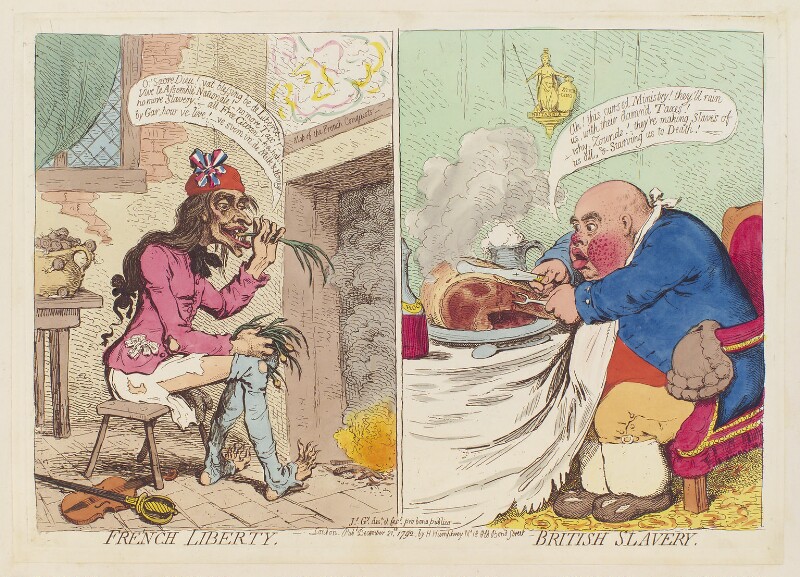
Abroad reaction to the Revolution was mixed. In Britain and the US it was largely welcomed with figures seeing it as France finally catching up to their liberal constitutions created by the Glorious Revolution of 1688/9 and the American Revolution. As mentioned earlier Washington gladly accepted, and boasted of, a piece of the Bastille and American revolutionaries complimented the Revolution. Jefferson and Thomas Paine welcomed it and Paine would move to France publishing further pamphlets encouraging revolution. However, not all welcomed the revolution. A conservative Anglo-Irish politician Edmund Burke in 1790 wrote Reflections on the Revolution in France saying that unlike the Glorious Revolution the one in France was built on abstract ideas so was destined to fall into chaotic violence and lead to a new autocrat coming to power. Meanwhile, continental monarchs like Joseph II of Austria and his brother Leopold II (who were also brothers of Marie Antoinette) viewed the Revolution with distrust and after the fall of the Bastille émigrés influenced negative perceptions of the Revolution. When the Revolution turned increasingly violent after 1792 only more radical people in Britain and the US would see the French Revolution warmly. Although the US would remain close to France, even declaring war on Britain in 1812, there were fears of war, restrictions of freedom of speech and immigration under John Adams, and even accusing Jefferson of being a French puppet. The spectre of the French Revolution would haunt Britain, and Europe as a whole, well into the nineteenth century. British cartoons began portraying the French being starved on their 'liberty' as Britain was fat on its 'autocracy' while supporters readily adopted tricolours and red hats.
James Gillray's French Liberty, British slavery shows the typical arguments of British opponents to the Revolution

The Road to Radicalism
1790 and 1791 would see increasing radicalism of the French Revolution. In November 1789 the state had replaced the Church as the one to hand out charity and had moved to include Protestants into the Assemblies (Jews were unfortunately excluded at this stage) so the next year the Civil Constitution of the Clergy was created in July 1790 which confiscated Church lands to solve the debt issue, bishops and priests were to be elected by local departments instead of the pope, and the clergy had to swear an oath of loyalty to the Civil Constitution. However, this proved to be fairly unpopular, especially as the pope refused to acknowledge the Constitution, where just under a quarter of clergy agreed to the oath. The measures against the Church even caused anti-revolutionary riots to break out across France. Meanwhile, radical groups began to emerge including the Jacobins and the Cordeliers Club whose motto was 'Liberty, Equality and Fraternity' - the later motto of the Revolution. There was also a proliferation of bread riots, sans-culotte agitation, and political clubs inviting men and women to take part. Marat was seen as a radical and soon a lawyer called Maximilian Robespierre emerged as a radical voice in the Assembly. As a side note in the Assembly those who supported the king sat on his right and those wanting reform sat on the left - this is how our modern terms Left-wing and Right-wing emerged. In July 14 1790 the Fête de la Fédération marked the anniversary of the Fall of the Bastille combining the old and the new; the king pledged his loyalty to the constitutional movement and the Assembly pledged their loyalty to the king. However, in secret the king was writing to fellow monarchs in Spain and Prussia asking for help as several powers (including Britain) started prepping for a potential war with France. A year later on June 20 the king planned to move himself and his family to land controlled by a loyalist general Francois Claude, the Marquis de Bouille. His long term aims are still unknown but we are aware that he wanted to repudiate all that had happened since October 1789. The royals were found at Varennes and brought back to Paris in what William Doyle described as 'the second great turning-point' (the first being the Civil Constitution). It forced the French, who were mostly in favour of a constitutional monarchy, to choose who it supported: the Assembly or the King. His flight was seen as an attempt to join the Austrians, which is one of his possible aims, and allowed republicans to more openly come out into the open. On June 24 a crowd of 30,000 escorted a petition by the Cordeliers Club to the National Assembly demanding a republic or to have a referendum on his fate as across Paris monarchical symbols were destroyed.
A depiction of the Fête de la Fédération
This helped spurn a radicalism of the Revolution. Things got worse in July when Leopold called on Europe's monarchs to help restore Louis to his throne, after Varennes Louis's powers were suspended. Fears of invasion grew worse when on August 27 Prussia and Austria (and the Holy Roman Empire) at Pillnitz declared that they wanted to 'put the King of France in a state to strengthen the bases of monarchic government.' Louis was made to accept the new Constitution but he tried to veto a law requiring émigrés to return or face death and seizure of property. Fearing invasion the new Legislative Assembly started organising volunteers preparing for invasion. This also caused a split in the radical centres - those favouring war were described as 'Girondins' as most came from Gironde while those opposing it under individuals like Robespierre would be called 'Montagnards' or 'Jacobins'. Robespierre at a Jacobin club in January 1792 explained his view: No one loves armed missionaries. 

On April 20 1792 France declared war on Austria seeking to preserve the Revolution and to redraw France's borders on 'rational' and 'natural' lines - their plan was for natural borders to be France's borders. Although the French managed to overtake the Austrian Netherlands (present day Belgium and Luxembourg) by the end of the month major parts of their forces defected to the Austrian-Prussian coalition. Setbacks were blamed on domestic insurrectionists who wanted an end to the Revolution causing a climate of radicalism and fear. A secret insurrectionary committee was set up by the Paris Commune led by Georges Danton and Louis Pierre Manuel to look into possible opponents to the Revolution. When Lafayette criticised the rise of the radicals an order for his arrest was announced and he defected to the Austrians causing a crisis: if Lafayette deserted who else would? In July when an Austrian commander said there would be reprisals if the royal family was harmed it immediately was circulated in Paris causing outrage, especially against the king. The National Guard of the more radical Paris Commune under Danton on August 10 1792 attacked the Tuileries Palace, where the royals were living, as the king fled to the Assembly. The royal family was imprisoned and the Assembly replaced with the Convention, elected by universal manhood suffrage. Foreshadowing later revolutionary violence in September after the Prussians took Verdun. Danton declared that 'If we are bold, bolder still, and forever bold, then France is saved!'. However, Parisian sans-culottes panicked fearing that if Royalists invaded they would open the prisons to attack the Revolution. Immediately seventeen prisoners were killed on their way to Abbaye prison but the attacks on prisoners increased. Soon other prisons, overwhelmingly in Paris, were invaded, kangaroo courts set up, and prisoners executed in what became known as the September Massacres. Over the next few days between 1,100 and 1,400 were killed although surprisingly a few were returned to their cells and others were actually freed as they were seen as 'patriots'. In public the revolutionary elite never supported the Massacres but in private several did, and in the Convention both the Girondins and Montagnards blamed one another for the Massacres. The French Revolution was now seen as violent. At the Battle of Valmy on September 20 the French army unexpectedly defeated the Prussians which brings us to the next stage of the Revolution as on 22 September 1792 the First French Republic was declared.

Republic and Terror
An image synonymous with the Revolution and the Terror; crowds eagerly watching someone getting guillotined
On December 10 Louis XVI would be put on trial and eventually sent to the guillotine on January 21 1793. A common perception of the French Revolution is a period called the 'Reign of Terror' where thousands upon thousands were sent to the guillotine until those who were chopping the heads themselves were guillotined. There are many debates surrounding the Terror trying the filter through misconceptions such as was it like in Francois Furet's view that the Terror was an aberration? Was it inevitable? The traditional date for the start of the Terror, September 5 1793, is problematic as the institutes of the Terror had been created long before then in March and April: the Convention created a revolutionary tribunal on March 10 and the Committee of Public Safety (CPS) was made on April 10. Louis had been guillotined in January and there had been violence since really 1789. The Terror is often used to show that the American Revolution was 'ordered' while the French was 'chaotic' but this view has been contested: Dan Edelstein has argued that the American Revolution was in fact the outlying revolution based on other ones as its violence, for the most part, was largely limited to the Revolutionary War. If you were smart you could switch sides during the Terror. Charles-Maurice de Talleyrand-Périgord served in government under every regime change until his death; a political cartoon portrayed him with six heads saying 'Vive le Roi', 'Vive le revolution' and 'Vive Napoleon'. Victor Hugo has also characterised the Terror well saying 'Out of the eleven thousand two hundred and ten decrees that the Convention issued, one third had a political purpose, and two thirds had a humane purpose.' The executions were just one part of the Terror and its build-up; the Louvre, Natural History Museum and metric system were all created between 1792 and 1794. As armed uprisings took place across France, war abroad continued (France was now on the offensive), and the economy was in tatters the Terror happened in France. Strangely, by the traditional end of the Terror in 1794 the revolts had virtually ended, the economy had slightly improved, and France had managed to push against foreign coalitions. Danton justified the Terror saying 'let us be terrifying in the place of the people' - in his view the Terror was to avoid situations like the earlier September Massacres. However, the reason for the Terror is still debated.
The execution of Louis XVI
We won't go into all the people and groups who faced the guillotine as that will take a very long time. Instead we'll do an overview. On May 31 armed sans-culottes took control of the Convention allowing the Jacobins (Montagnards) to take control of the CPS causing the downfall of the Girondins. What sealed their fate was the death of Marat. Charlotte Corday despite her young age, she was 24 in 1793, had been active in politics for years and had become a devout Girodin so she was outraged by the Jacobin coup and arrests of Girodins. Showing the sexism of her time the reason why she was spared arrest was possibly because she was a woman. While in the bath Marat allowed Corday to come in - she claimed that she had important information on locations of Girondins. Instead she stabbed him saying that 'I killed one man to save a hundred thousand' and she was guillotined on July 17. Although Marat had been sidelined by the Montagnards his death made him a martyr allowing the Jacobins to have public support for executing the Girondins. At the start of September a law was passed allowing the CPS to put on trial and execute those deemed a threat to the Revolution. Two leading radicals, Danton and Jacques Herbert, with their respective followers were also guillotined with the Girodins and monarchists. Danton had allowed corruption to flourish and had benefited himself giving the CPS the reason to execute him but quite likely it was due to a power issue, and the Herbertists tried to lead an insurrection seeing the Montagnards as not being radical enough. Marie Antoinette was executed and so was Olympe de Gouges for her earlier criticisms of the exclusion of women. In all almost 17,000 were guillotined of which around 2,600 were in Paris. The Terror ended with the fall of Robespierre and his faction. The deaths of his friends, including Danton, had put mental and physical strain on him and opponents started growing in power as his health forced him out of the public light. As he did not explicitly denounce the Terror members of the Convention feared another purge. On 28 July 1794 Robespierre and his allies were guillotined ending the Terror.

The Terror also tried to replace Christianity with a new religion based on religion and nature. It is important to note that atheism was rare in Enlightenment thought - deism was far more common. Of the major figures only a few, including Herbert, were atheist. Instead of God there was the Supreme Being and places of worship, like Notre Dame, were converted into Temples of the Supreme Being, Notre Dame itself was made into the Temple of Reason. On June 8 1794 there was even the Festival of the Supreme Being. The metric system was created as a more rational way to take measurements and the Republican Calendar was created. The inauguration of the Republic, 22 September 1792, was declared the start of the new calendar; there would be twelve thirty-day months named after the seasons (which British politicians made fun of calling it 'month sneezy' as an example); and there would be three ten-day weeks in a month ending in a rest day. This remained in place for a while, so much so that Robespierre's downfall was called the Thermidorian Reaction. Finally, instead of titles men would be referred to as 'Citizen' instead of 'sir' and women would be 'Citizeness'. These reforms would remain until Napoleon's reign and even then we use the metric system today. The current departments of France were also made during this period.

Counterrevolution and Uprisings
The Sacred Heart: symbol of the royalist rebels in Vendée
There were many opponents to the Revolution and most sprang up during the Terror. Some viewed the Revolution as not going far enough, most notably the Herbertists. The most famous opponent, and one which people normally focus on, is the War in the Vendée. Vendée was slightly different than other areas of France as the nobility lived in a closer proximity to the populace so republican ideas were less prominent. The 1790 Clergy Constitution caused aggravation but it took until 1793 for grievances to turn violent. There were two reasons for this: the implementation of the levee en masse (conscription) and the closing of churches. When churches closed wealthy bourgeois, not peasants, bought the land angering locals. This mixed with longstanding loyalty to the nobility resulting in an uprising in March that was anti-Republic, pro-nobility, and pro-Catholic. Their symbol reflected the nobility and religion with their army being named the 'Catholic and Royal Army' and its insignia being a cross in a heart. The War was particularly brutal with royalists massacring republicans and the republican army brutally crushing royalist opposition. Between 170,000 and 200,000 were killed in the war from both sides although the vast majority of deaths were royalists. There were other uprisings not related to Vendée. These were the Federalist Revolts which served as the majority of the uprisings, discounting the continued revolts over economic issues. Mostly occurring in provincial cities like Lyon, Bordeaux, Toulon and Marseilles. The revolts were over two issues: the growing centralised power in Paris and the radicalisation of the Jacobins. These were compounded as many of the cities were at greater risk of invasion. As they were generally disorganised and limited to their own cities they were soon defeated, and at times brutally. Lyon has been signalled out for it being brutally crushed - in 1793 it had a population of 120,000 but by 1800 it had just 88,000.

Directory and Napoleon
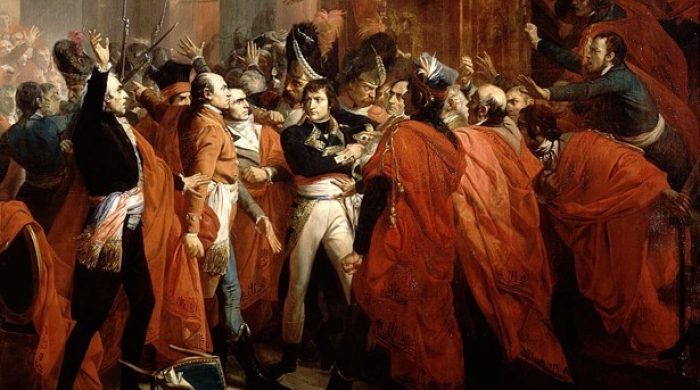
Napoleon's Brumaire coup
The CPS and Convention were replaced by the Directory which was a government of two chambers headed by five directors who would rule for five years. Although they accused the Jacobins of brutality they could be very violent themselves; the crushing of the War in the Vendée and several federalist revolts were under the Directory. The Directors distrusted democracy and very few historians view the Directory positively. While this was happening the Revolutionary army had continued fighting and had made gains in Italy, Germany, and had incorporated Belgium into France. With the army came French newspapers spreading revolutionary ideas to the rest of Europe. The army best reflected revolutionary ideas; with most former leaders being nobles the new leaders were chosen based on merit and ability. One who had made a name for himself in in Italy was a Corsican called Napoleon Bonaparte. His victories abroad were soon noted back at home thanks to the press. Defeating the Austrians in Italy between 1797 and 1799 he established republics in Italy to export the revolution. Napoleon became so popular that he quickly gained support in his plan to invade Egypt to disrupt Britain's connection to India. Initially he was welcomed as a saviour and middle-class, secular, and female Egyptians to name three groups enjoyed his policies. However, conservative elements did not and eventually Egyptian society turned on the French after the British destroyed the French navy. Napoleon returned to Paris but still remained popular. He eventually on 18-19 Brumaire VIII (9 November 1799) led a coup replacing the Directory with three consuls of which he was First Consul. Historians become divided after - was this the end of the Revolution or did it just end the Republican phase?

Napoleon - Revolution's saviour or betrayer?
Napoleon has been just as divisive as the Revolution: in this painting his is portrayed boldly crossing the Alps
Here he is far more humble
Historians, and even contemporaries, are intensely divided over Napoleon. Originally Beethoven devoted a symphony to Napoleon but scrubbed it out when he declared himself emperor. In Napoleon's career we see both the preservation of the Revolution and its ideals as well as its subversion. The most prominent example is Napoleon declaring himself emperor although it has been argued that he made himself emperor, not king, to respect the anti-king aspect of the Revolution. He tried to reverse the abolition of slavery but failed because of resistance in the former slave colonies; reaffirmed Catholicism in France with his Concordat with the Pope; imposed his siblings as monarchs in conquered regions; and ensured that women would remain second class citizens in his Napoleonic Code. However, at the same time he promoted meritocracy; emancipated Jews; spread the Revolution's ideas across Europe; promoted the metric system; and created a standardised secular secondary education system. As a result, Napoleon's legacy remains mixed.

Conclusion
Alongside the Industrial Revolution the French Revolution is the most influential Revolution in at least modern history. It set the stage for the modern world and laid to rest the Medieval one once and for all. It happens to be highly contested as well. Everyone agrees its legacy is profound but how we look at the Revolution is highly politicised between the Left and Right - likely as this is where the origins of Left-wing and Right-wing comes from. A general rule tends to be that the Left is more sympathetic to the Revolution whereas the Right is more critical. This is true as well for contemporaries. The two most famous paintings of Marat's death exemplify this; Jacques Louis-David was sympathetic and portrayed him as a martyr whereas the more critical Paul-Jacques-Aimé Baudry makes him look as a monster slain by the heroic Charlotte Corday.
Louis-David's The Death of Marat

Baudry's Charlotte Corday
The legacy of the Revolution cannot be understated. In his account of the Russian Revolution Leon Trotsky said that Russian workers sang La Marseilles, the song of the French Revolution. It either directly inspired others ranging from the 1848 Revolutions to colonial protests after the Second World War, or it laid the stage for the modern world including secularism, liberalism, and the idea of equality. Today France still has the tricolour and the words 'Liberty, Equality and Fraternity'. Even to this day the French Revolution offers a new way how it shaped our world. In 1968 very educated Chinese premier Zhou Enlai was asked what he thought the legacy of the French Revolution was. He responded: 'It's too early to say'. That is the best way to describe it.
Thank you for reading. Next time we will look at something referenced throughout this post. In Haiti slaves fought for their own freedom in the Haitian Revolution which we'll focus on next. The sources I have used are as follows:
-Eric Hobsbawm, The Age of Revolution, 1789-1848, (London: Abacus, 1962)
-Norman Hampson, A Social History of the French Revolution, (London: University of Toronto Press, 1963)
-David Andress (ed.), The Oxford Handbook of the French Revolution, (Oxford: Oxford University Press, 2015)
-Colin Jones, The Great Nation: France from Louis XV to Napoleon, (London: Penguin, 2002)
-Slavoj Zizek, Slavoj Zizek presents: Robespierre, Virtue and Terror, (London: Verso, 2007)
-William Doyle, The Oxford History of the French Revolution, (Oxford: Oxford University Press, 1989)
-Francois Furet, Revolutionary France, 1770-1880, Trans. Antonia Nevill, (Oxford: Blackwell Publishers Inc., 1988)
-Simon Schama, Citizens: A Chronicle of the French Revolution, (London: The Folio Society, 2004)
-Martin Lyons, Napoleon Bonaparte and the Legacy of the French Revolution, (London: Macmillan Press, 1994)
-The Declaration of the Rights of Man and Citizen, and The Declaration of the Rights of Woman and Female Citizen

Thank you for reading. For other World History posts we have a list. For future blog updates please see our Facebook or catch me on Twitter @LewisTwiby.