Search This Blog

Showing posts with label Age of Revolution. Show all posts

Saturday, 12 January 2019

World History: The Revolutions of 1848

An 1848 painting by Horace Vernet depicting the revolt in Paris
Today we're looking at the last event in what Eric Hobsbawm characterised as being in the 'Age of Revolution'. Later named the 'Springtime of Peoples' beginning in February 1848 revolution swept over Europe - they remain the most widespread revolutionary wave in European history. From nobles to labouring poor the masses rose up against autocracy and inequality, but most were crushed within the year resulting in even more autocratic regimes. However, the ideas of 1848, and the consequences of 1848, would continue on in Europe for much longer.

Origins
Europe in the 1840s was a time of transition. German democrat Victor von Unruh stated that 'We live in transitional times. The old has not yet been overcome, the new is still being born.' The legacy of the French Revolution lived on with its ideas of 'liberty, equality, and brotherhood', as well as the new European order created by the Congress of Vienna. Austrian diplomat Klemens von Metternich helped create a post-Napoleon order where conservative, absolutist powers of Austria, Russia, and Prussia aimed to crush potentially subversive ideas of liberalism, republicanism, socialism, and even nationalism. Regardless these ideas continued to flourish. In 1830 a revolution toppled the autocratic and conservative Bourbon monarchy in France leading to the rise of the July Monarchy under the constitutional monarch Louis-Philippe; however, this monarchy was still repressive and few people could vote and there was another failed revolt in 1832 which featured heavily in Victor Hugo's Les Miserables. More radical socialists emerged across Europe and major radicals, such as Karl Marx, were regular sent into exile. National identity started to emerge in divided Germany and Italy, as well as the multi-ethnic Austrian Empire. Metternich even tried to use this to his advantage - when Hungarian liberal and nationalist Louis Kossuth was elected to the Diet in the 1830s Metternich ensured that the government started supporting Croatian intellectual Ljudevit Gaj. However, when southern Slav nationalism grew this was withdrew in 1842. The conservative order was being challenged long before 1848 - revolts in France in 1830 and 1832, Galician peasants rose up in 1846, in 1847 bread riots swept Germany, and periodically Britain saw a series of protests by the Chartists who wanted increased suffrage and democracy. 
Eugene Delacroix's Liberty guiding the People depicting 1830
Economic and social issues also played a role in the origins of 1848. Populations started rapidly growing, especially in the cities, but there were issues thanks to harvest failures. This created a domino effect of economic decline - food prices rose, people spent less on manufactured goods, businesses started to collapse and so did the banks. Of course people are aware of inequality when times are good, but it is harder for autocratic regimes to justify themselves when everyone is poorer. Thanks to the Industrial Revolution demographics and economics started changing. Rising industrialisation caused more people to move to the cities, and balance of power shifted. As argued by von Unruh Europe was in transition - using a Marxist stance Europe was transitioning from feudalism to capitalism, or an early-modern economy to our present capitalist one. The old society was giving way to a new one, and naturally problems arose from that. Cholera epidemics are a good example - squalid cities changed thanks to industrialisation made cholera run rampant but states found it hard to deal with them.

Outbreak of Revolt - in Italy
Revolt in Palermo
Often we view the 1848 Revolts as starting in Paris, and the Parisian revolt did offer the spark for continent wide revolt. However, in January our first revolt broke out on Milan. Italy was divided by various states and under the Austrian protection, so nationalism played a role. Austria started taxing Italian states so Milanese nobles started boycotting tobacco on New Year's Day- the most lucrative tax. To frustrate the Milanese the Austrian garrison were encouraged to smoke and on January 3 an Austrian soldiers scuffled with Milanese citizens after a soldier started smoking in someone's face. The 'tobacco riot' led to the deaths of six and the wounding of fifty, and in Venice liberals were arrested in fear that they would also agitate. Not long after a revolt broke out in Sicily. Seeing reforms in Rome by Pius IX and the 'fiercely independent' islanders begrudging the Bourbon monarchy in Naples they decided to celebrate King Ferdinand II's birthday. They built barricades, unfurled an Italian tricolour, and declared 'Long live Italy, the Sicilian Constitution and Pius IX'. Peasants soon joined the revolt and a General Committee was formed under Ruggero Settimo. Hearing the revolt in Sicily the people took to the streets in Naples. Soon enough revolt spread to the Papal States. The once reformist pope Pius IX had started slowing liberal reforms and his own civic guard joined the masses. The revolt in Rome eventually became far more radical, largely thanks to events abroad, and in February 1849 the future unifiers of Italy, Giuseppe Garibaldi, Aurelio Saffi and Giuseppe Mazzini, declared the Roman Republic. In France, the revolt was always far more radical.

France
Paris was always a cultural hub of Europe, and there was a joke stating 'When France sneezed Europe caught a cold'. It was thanks to the more radical nature of the French revolt which allowed 1848 to spread. It is quite possible that Marx and Friedrich Engels wrote The Communist Manifesto in inspiration from the French revolt. Despite being a constitutional monarchy - and many radicals like Marx, and anarchists including Mikhail Bukharin and Pierre-Joseph Proudhon calling it home at some times - the legacy of 1789 made the monarchy very restrictive. Prime Minister Francois Guizot was just one politician who ensured that political discussion remained silenced - insulting the king was banned and one cartoonist joked that pears should be banned as Louis-Philippe resembled one. The suffrage was also very small - only 250,000 could and all were men of wealth. As public meetings were banned 'banquets' were held instead, and Guizot banning of a banquet on 22 February began the revolt. The National Guard, composed of middling and petty bourgeois individuals, joined students and workers (also women) causing a crisis for the Guizot ministry - they had just lost their guard. Guizot resigned, Louis-Philippe panicked and abdicated, and a provisional government was set up in the Hotel de Ville. Although those who made up the representatives were mainly wealthy men their politics were diverse: moderate republicans, dynastic opponents, and even socialists including Louis Blanc and a metalworker called Albert. As what would characterise the 1848 Revolutions after brief success division would splinter the revolt.
Barricades during the June Days
Workers, socialists, and Jacobins feared that 1848 would be a repeat of 1830 - when Louis-Philippe abdicated his son, the Comte de Paris, was made king. Jacobin intellectual, Francois Raspail, marched onto the Hotel on February 25 with a workers' society and got the delegates to declare the Second Republic. Louis and Albert, meanwhile, organised a commission of workers' delegates in the Luxembourg palace to prevent worker exploitation, but it was far less powerful than the Hotel de Ville filled with wealthier individuals. Radical press, political clubs, and the National Guard campaigned for universal manhood suffrage allowing women to become increasingly politicised. Why should only men benefit from the new revolution? Women's clubs and the paper, Voix de Femmes, demanded female suffrage but little came of it. Elections for the new Assembly brought moderates to power angering workers outside of Paris. Louis Blanc had formed National Workshops in order to combat unemployment, but his resignation and failure to properly challenge the issue let the Assembly to start closing them. Angry radicals and workers rose up on June 23 in the 'June Days', but unlike in February the National Guard did as the government wished. Led by Louis Cavaignac the National Guard (numbering 40,000) clashed with even more workers and their families. 10,000 were killed (mostly workers) and 4,000 insurgents exiled to Algeria in what political scientist Alexis de Tocqueville described as 'a class struggle, a sort of servile war'. Marx described the Second Republic as 'the dictatorship of the bourgeoisie by the sabre'. The French Revolt spread quickly across Europe thanks to the newly emerged modern press and telegraph. American charge d'affairs in Vienna William H. Stiles stated that it 'fell like a bomb amid the states and kingdoms of the Continent: and, like reluctant debtors threatened with legal terrors, the various monarchs hastened to pay their subjects the constitutions which they owed them.'

Habsburg Empire in Revolt
The Habsburg ruled Austrian Empire was prime for revolt. It was struggling to industrialise, intensely conservative, autocratic, and starting to be divided by emerging nationalism. Revolution was proven to be contagious when Metternich resigned. Telegraphs and the Augsburger Zeitung brought news of the abdication of Louis-Philippe to the Austrian Empire, and in the Hungarian Diet Lajos Kossuth, whom we met earlier, declared that 'the pestilent air [of Habsburg absolutism]...dulls our nerves and paralyses our spirit' and that Hungary should be 'independent, national and free from foreign interference'. Kossuth wasn't too radical - he advocated keeping the Emperor as the King of Hungary. Students at the University of Vienna started petitioning for freedom of the press, religion, speech and teaching with participation in government, and a new Germany. In March they started protesting and were joined by workers. Workers, students, men, and women clashed with troops in Vienna and the government decided to dismiss the hated Metternich who fled to Britain. Metternich's resignation opened the floodgate for revolution: Hungarians started moving towards independence, Czech students protested in Prague and formed barricades demanding the implementation of Czech and possible independence, German Jews in Prague (like Ignaz Kuranda in Grenzboten) tried to defend the German minority and Jewish rights, and in Galicia (now Ukraine and Poland) demanded Ukrainian to be taught and implemented. As we shall see, the Habsburg revolts soon became overtaken by counterrevolution.

Revolt in Germany
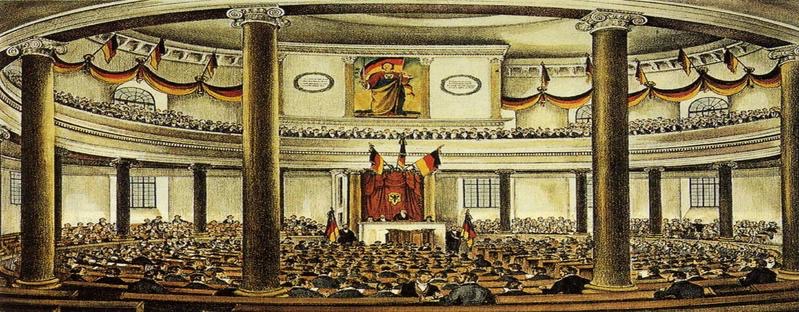
The Frankfurt Assembly
Like Italy, what would become Germany was divided by various states united by language and a customs union called the Zollverein. The two main powers were Prussia and Austria - the two conservative powers of Central Europe. Inspired by France revolt first broke out in 'Third Germany', the various German states that weren't Prussia or Austria, first in Baden. A common occurrence in these revolts was a rural-urban divide which played out in Baden - attempts to entice peasants failed when they asked 'What does freedom of the press mean to us? Freedom to eat is what we want.' In Cologne the Communist League encouraged artisans to demonstrate in March and across the Rhine insurgents attacked steamships which, in turn, caused propertied liberals to encourage reform. At the start of March Prussia's capital of Berlin saw revolution - students, artisans, and tradespeople gathered in the Tiergarten clashing with troops. Unexpectedly, Frederick William IV agreed to a constitution, free press, and a new assembly - after seeing the same masses who toppled Louis-Philippe and Metternich he feared the same would happen. Clashes still happened causing him to remove the troops and many liberals were soon elected into the new assembly. 

Nationalists, both liberal and radical, hoped to use the 1848 Revolutions to unite Germany so began organising the Frankfurt Assembly - organised in May it was an attempt to unite all of Germany. When we get to nationalism we will again see how early German nationalism could be quite inclusive - if you lived in a German state you were a German in their eyes which caused leading Czech nationalist Frantisek Palacky to reject the offer to attend stating that he spoke Czech, not German. Liberals overwhelmingly were represented in the Frankfurt Assembly - most came from wealthier backgrounds including lawyers, publishers, businessmen (specifically men), and industrialists. The Assembly saw both moderation and radicalism - all were deemed German, Jews were emancipated, and freedom of the press, religion, and speech were guaranteed, but universal suffrage was initially rejected, women were not emancipated, and they wanted Frederick William to be king. The Assembly failed through division between moderates and radicals, and Frederick William refused to accept 'a crown from the gutter'. 

Other Revolts
There are many different revolts which took place in 1848 so we'll just cover a few of them.
Poland - Poland had been divided between several states (Prussia, Russia and Austria) by the end of the 1790s but, of course, this did not destroy Polish national identity. Due to this it was difficult for a Polish national movement to emerge across all the former territories, and as a result other states helped crush revolts. In 1830 Polish nationalists rose up in Russia so Prussia helped crush the revolt. Poland was also being colonised by Prussian farmers and the Prussian state even reversed their antisemitic policies in just that area. To build support among Polish Jews against Poles Prussia started emancipating them - an irony considering in the west Prussia was implementing more antisemitic policies. Thanks to events in Berlin in Poland benefited - exiles could return, prisoners were released, and increased autonomy was granted. Polish reformers refused to work with Jews or Germans alienating them so when an uprising did take place it could only find support from Polish communities. The Prussian army then managed to defeat the uprising and all grants of autonomy were scrapped.
The 'March Days' in Stockholm
Scandinavia and Switzerland - Scandinavia was not immune from revolt. Protesters in Stockholm rioted on March 18 demanding a constitution which were soon dispersed. Denmark in January had been facing liberal and peasant protests so these led to marches for a constitutional monarchy in Copenhagen when a new king came to the throne. He quickly signed a constitution granting their demands, however, Schleswig-Holstein was left unmentioned. This was a Danish-German duchy under Denmark's rule. Events in Denmark and Germany caused the duchy to rise up hoping to come under German rule after the Danish constitution hoped to put the duchy under Copenhagen's direct rule. The First Schleswig War broke out as German states battled the Danish over the duchy - an 1852 treaty left the duchy free but under Danish supervision. Meanwhile, in Switzerland there were fears that the recently ended civil war could flare up again. The Catholic cantons, wanting to escape Protestant rule, had tried to secede in a short civil war. Wanting to avoid this a new constitution was quickly made forming a federal state which ended the near independence of the cantons.

Ireland - For a long time Ireland had been ruled by Britain and a settle community had emerged. Protestant farmers from the 1600s had dominated Ireland largely from Dublin and Ulster at the expense of the Catholic population. Attempts to enforce English, British laws and customs, and years of repression had led to various nationalist movements. One such was the Young Ireland movement. Ireland also faced genocide in the 1840s - failure of the potato crop caused a famine which the British government did little to solve. Making matters worse, fearing the famine would increase nationalist urges, the Crime and Outrage Bill was passed in 1847. On 29 July seeing the uprisings the Young Irelanders rose up - it was soon crushed.

Where did it not Hit?
Chartists in London
Revolution did not sweep over Europe equally. Only the most democratic and industrialised states, and the least industrialised and most autocratic escaped full blown revolt. Popular protests in Belgium were diffused, much to the dismay of radicals, by a quick expansion of suffrage, and likewise in the Netherlands the king issued a quick liberal constitution. As states had quickly responded this undercut radical demands before they could take root in public discourse. Meanwhile, on April 10 the quasi-socialist Chartists organised a protest of between 50,000-100,000 at Kennington Common in London. The Chartists were a working-class movement wanting to expand the electorate, introduce secret ballots, abolish property qualifications for suffrage and political office, and payment for Members of Parliament. However, thanks to previous expansion of the suffrage, and their association with socialism, had left the Chartists isolated, and news from France alienated the rest of the country from possible domestic radicals. As a result the Chartists were soon dispersed. In Russia we did not see revolt because of the strength of absolutism and a lack of industry. News of revolt found it harder to spread to Russia so it could be quickly silenced, and nationalist movements (like with the Poles) found it hard to communicate. To organise a movement when you cannot properly coordinate - it is no coincidence that when Russia properly started industrialising from the 1850s that revolts were more common. Russia even helped crush some of the revolts in other states.

Why did they Fail?
Casino Savorelli after bombardment by French forces
One key reason explains why 1848 failed: division. A common trend was that when more radical, often urban working-class, voices started taking hold the liberal moderates sided with conservative forces. Following the June Days the provisional government used a now conservative National Guard to oust radical voices, and the elections in December even brought Napoleon's nephew, Louis, to power. In Germany the Frankfurt Assembly was intensely divided between moderates and radicals, as well as what Germany should be. There were advocates for Grossdeutschland (including Austria), and Kleindeutschland (excluding Austria); Catholics didn't want to be under the rule of a Protestant state (and vice versa); and moderates wanted a monarchy compared to radicals which didn't. Prussia soon ignored the Assembly issuing a 'monarchist' constitution, and after defeating the revolution in its own borders Austria turned on the southern German states - the biggest supporters of the Assembly. In Italy the rural peasantry had been excluded from enfranchisement so in Naples when the king attempted to reverse the constitution the peasants refused to help the urban bourgeoisie allowing them to be defeated. The radical Roman Republic initially won support by abolishing hated taxes, employing unemployed labourers to repair monuments and slums, and dividing land among the peasants, but their anti-clericalism alienated the religious masses. Appealing to his own conservative Catholic supporters Louis Napoleon sent troops to destroy the Republic and restore the pope. The Austrian military soon ousted revolutionaries in Italy, Vienna, Bohemia and Hungary crushing the revolt there. Again a moderate-radical, national, and urban-rural divide aided in this - Magyar gentry helped organise against Budapest radicals who, in turn, had allowed the Austrian army take Vienna. Emperor Ferdinand abdicated in favour of his young nephew, Franz Joseph, who would rule until the end of the First World War.

Conclusion and Legacies
This cartoon effectively shows the results of 1848: German princes hide behind Prussia sweeping revolt away, revolutionaries fleeing across the Atlantic, Austria and Magyar gentry dismember Hungary, and Britain mocks the continent ignoring starving people in its own borders
On the surface 1848 was indeed a 'Springtime of Peoples': a brief time in the sun. Poles, Germans, Danes, Italians, Magyars, Czechs, Slovaks, Jews, Serbs, Croats, Romanians, and Irish had all protested or revolted for autonomy as ideas of liberalism and socialism dominated discourses. However, divisions between nationalities, class, and location spelled their end - Robert Gildea has argued that if France had possibly looked outward they might have found more success. Despite Marx's and Engels' call for 'workers of the world unite!' the workers were divided, The Communist Manifesto little read until after the revolution, and working-class revolt was crushed. Louis Napoleon, who would soon crown himself emperor, Franz Joseph and Frederick William would ensure conservative forces dominated Europe - Prussia's conservative powerhouse Otto von Bismarck entered politics just after 1848. In the long-term 1848 would see success. Nationalism and socialism soon came to dominate the late-nineteenth century: socialists soon came to be a major force (especially in Germany), a working-class revolt broke out in Paris in 1871, Italy and Germany unified, and new national movements emerged. Austria initially seemed unstoppable but gave way - martial law was eventually lifted, liberal reforms started to be passed, and national groups were given autonomy. In 1867 Austria became Austria-Hungary to reflected the strength of nationalism. 1848 was a turning point for Europe, and the 'Springtime of Peoples' was not so short-lived.

The sources I have used are as follows:
-Robert Gildea, Barricades and Borders: Europe, 1800-1914, Second Edition, (Oxford: Oxford University Press, 1996)
-Mike Rapport, 1848: Year of Revolution, (London: Abacus, 2008)
-Priscilla Robertson, Revolutions of 1848: A Social History, (Princeton, NJ: Princeton University Press, 1952)
-Frank Eyck, (ed.), The Revolutions of 1848-49, (Edinburgh: Oliver & Boyd, 1972)
-David Blackbourn, The Fontana History of Germany, 1780-1918, (London: Harper Collins, 1997)
-'1848: Year of Revolution', BBC In Our Time Podcast, 19/01/2012
-Eric Hobsbawm, The Age of Capital, 1848-1875, (London: Abacus, 1975)
-Karl Marx and Friedrich Engels, The Communist Manifesto, (London: Penguin, 1848/2015)

Thank you for reading. The next World History post will look at abolitionism, and the successes and failures of the end of slavery. For other World History posts we have a list. For future blog updates please see our Facebook or catch me on Twitter @LewisTwiby.

Saturday, 3 November 2018

World History: The Haitian Revolution

A painting of the 1803 Battle of Vertieres
On World History at the moment we're looking at the Age of Revolution where from the late-1700s to the mid-1800s revolutions, (political, social, and economic), ended up drastically changing the world we live in. Today we're looking at a unique revolution: the Haitian Revolution. This revolution saw the abolishing of slavery and the independence of Haiti, however, its perception has changed over the years. Originally it was seen as merely a successful slave revolt which had reactionary anti-white elements to it until the coming of the landmark The Black Jacobins by C.L.R. James which highlighted the influences of the French Revolution. James also highlighted the African elements of the Revolution which has now been brought back into the historiography. The Haitian Revolution shows how those lacking agency in a society can obtain it more pertinently than what we saw in the French and American Revolutions. 

Background
Free Women of Color with their Children and Servants, by Agostino Brunias, Dominica, c. 1764–1796. Although not from Haiti this scene was replicated in the pre-Revolution colony
The Haitian Revolution took place in the French colony of Saint-Domingue on the island of Hispaniola, the island where present day Haiti and Dominican Republic are. Colonised in the late-1600s Saint-Domingue was a plantation economy growing a variety of crops, largely sugar and coffee. In 1787 the island had 655 sugar plantations producing 131,000,000 pounds of sugar; 1,962 coffee plantations; and 398 cotton and indigo plantations. Saint-Domingue became extremely rich as a result as it provided most of the coffee and sugar to Europe becoming known as the 'Jewel of the Antilles'. Cities like Le Cap Francois and Port-au-Prince were larger than many cities in what would become the United States. The colony was heavily divided along regional, (North, South and West), lines as each competed for economic superiority. Society was also split into three groups: whites, gens de couleur, and slaves. Even then each group could be further divided. Les blancs numbered around 24,000 individuals and were heavily divided by class - planters, despite very small in number, dominated Saint-Domingue society compared to the more numerous petit blancs who served as labourers, small merchants, and workers on plantations. The plantation owners replicated their wealthy aristocratic counterparts in France embodying the finery of the aristocrats; French traveller Jean-Bernard Bossu told a story how some sailors went for dinner at the invitation of a plantation owner. Their host was decked out in fine clothing with rich food so they assumed a wedding was happening until their host told them that this was just a normal dinner. The gens de couleur were made of freed slaves and mixed-race individuals; most of the original colonials were male so would take advantage of female slaves. They could own property and some even owned slaves including the later hero of the Revolution, Toussaint Louverture (also spelt L'Ouverture). There was great tension between gens de couleur and petit blancs for various reasons. Although the 1685 Code Noir made them French citizens they were still legally barred from political activity where over the next century their political rights were eroded. In neighbouring Spanish America at this time it was possible for a wealthy mixed-race individual to 'buy whiteness' and it was possible for gens de couleur to do so as well, however, they had to be three generations removed from their last black ancestor. Meanwhile, petit blancs in theory were 'superior' to gens de couleur but as they often lacked property, and worked for gens de couleur, they heavily resented this and expressed this through racism. Women also took part in this racism fostering hostility to neighbours who entered interracial relationships or businesses.
A modern depiction of Vodou, even today you can see the synchronicity of Catholicism and West African imagery, https://adventure.com/real-vodou-haiti/  
Finally, we have the slaves who made up 90% of Saint-Domingue's population. As we saw when we looked at the Atlantic slave trade this time period was the height of the slave trade. In 1787 there was at least 408,000 slaves and in 1788 alone 29,506 slaves were imported to the colony. Due to harsh living conditions most slaves died at a young age, 50% died in their first year of arriving at the colony, so most had to be imported in. The Code Noir was on the surface benevolent, or as benevolent as a pro-slavery law could be, but in practice it was regularly violated. With the exception of market day slaves had to work long hours in the Caribbean sun and could be subjected to physical abuse, mutilation, and, for women, rape. Grands blanc owned them, petit blancs wanted to own them, and gens de couleur both owned and resented them - slaves reminded them of their black skin and apparent inferiority. Slaves did have some agency. Sometimes kind owners offered slaves the opportunity to buy their freedom. Slave rebellions did occur - maroon settlements existed and before the Haitian Revolution there were slaves uprisings. In 1700 300 slaves near the capital of Le Cap Francois rose up and between 1751 and 1757 a Vodou priest called Francois Mackandal led a popular rebellion until he was burnt at the stake in 1758. Slaves also got agency in less overt ways. They knew that they were worth something to their masters so would poison themselves, or others, to spite them. Go-slows were common as well. They also formed their own culture - most slaves came from the Kongo in modern Angola or the Bight of Biafra so a wide variety of different cultures, languages and religions were brought together. At times a slave could go through several owners in Africa before they were sent to the Caribbean. The journey was traumatic but not enough to destroy their heritage so all came together uniting old and new, shared ones. In particular, the imposition of French and Catholicism merged into this. Vodou, or voodoo, emerged from this combining Catholicism with West African belief. If you look at Vodou ceremonies you can see the Catholic influences such as chanting and holy water in purification rituals. However, as it combined African and Christian beliefs it was instantly distrusted by the pious French Catholics, and at times slaves could use this distrust for agency. Vengeful slaves at times cast curses against harsh overseers and owners. 

No that is the situation at the dawn of the Haitian Revolution. Each group distrusted one another in a colony that was extremely wealthy, albeit most of that wealth was in the hands of a small group, but based on chattel slavery. Historian Paul Fregosi describes it well 'Haiti was hell, but Haiti was rich.'

Beginnings of the Revolution
Normally we see the start of the Revolution as beginning in 1791 but in reality we must trace it back to 1789 to properly understand the ideology of it. Tensions in France fed into tensions on Saint-Domingue. Seeing that in 1788 the king was having to bring back the Estates-General the North seized the opportunity to grant themselves further rights and power. They formed a committee, illegal according to French law, to send to Paris wanting to abolish military justice, have legislation and taxes to be voted by a provincial assembly subject to only the king and Colonial Committee, and that they should elect their own delegates. However, as they restricted representation to property owners which excluded women and petit blancs. Gens de couleur did manage to send their own deputies, separate from whites, to Paris to negotiate their own freedom. There they made alliances with Parisian allies and an abolitionist group called the Amis de Noirs, formed 1788. Like their counterparts in Britain and the US they were largely an elite group who opposed slavery but they faced an issue in Revolutionary France. A large part of the French Revolution's rhetoric involved property rights and this was a society which viewed slaves as property, not people, and several key coastal cities had an economy reliant upon the slave trade, like Nantes. The gens de couleur's delegates offered the perfect way to boost their support. As they were also fighting for their liberty the Amis des Noirs could indirectly attack slavery. However, the colonial delegates remained deeply divided and the creation of the Declaration of the Rights of Man and Citizen terrified white delegates; it paved the way for emancipating the gens de couleur, and they initially embraced the revolutionary ideas. A way to get higher in society for non-whites was to take part in the colonial militia - in 1789 104 out of 156 companies were largely made of gens de couleur. They adopted the red cockade of the Revolution and started modelling themselves after the National Guard. Soon enough the support for the slavers started waning after those in France noticed the hypocrisy of demanding freedom while denying it to gens de couleur, however they remained quiet about slavery and women's rights. The Count of Mirabeau declared:
You claim representation proportionate to the number of inhabitants. The free blacks are proprietors and tax-payers, and yet they have not been allowed to vote. And as for slaves, either they are men or they are not; if the colonists consider them to be men, let them free them and make them electors and eligible for seats; if contrary to the case, have we, in appointing deputies according to the population of France, taken into consideration the number of our horses or our mules?
When news of the Fall of the Bastille arrived in the colony it served as a spark to a powder keg. Petit blancs, calling themselves Patriots, started their own political clubs which forced the Intendant to flee, while they attacked gens de couleurs and slaves protesting for rights. The French Assembly began slowly edging towards emancipation of gens de couleurs but due to them dragging their feet, and with continued white opposition, this upset many delegates. One delegate, Vincent Ogé, returned to Saint-Domingue to replicate the events in France in October 1790. He planned to lead a revolt of male gens de couleur and with between 250-350 men planned to lead a revolt. However, as argued by C.L.R. James, he was a 'good Liberal' he did not seek allies with the slaves and he was more a politician than a revolutionary. Ogé was soon defeated and in February he was brutally executed firing the flames of revolt. As Patriots forced the governor from Port-au-Prince the French Assembly on May 15 decided to emancipate the gens de couleurs. However, this angered the whites and the slaves remained in chains. In August things would change. On 22 August, quoting Thomas Ott, 'The slaves had joined the Haitian Revolution'.

The Slave Revolution
An image of slave leader Biassou
When the slaves entered the Revolution it became the largest slave revolt in history since Spartacus's revolt against the Romans, and it would turn out to be one of the few successful slave revolts. In August a Vodou priest named Dutty Boukman, and possibly a female religious figure called Cecil Fatiman, did a religious ceremony at Bois Caiman vowing that Saint-Domingue's slaves would be freed under the command of Jean-Francois Pappillon, Jeannot and Georges Biassou. This ceremony had much African folklore mixed in with Catholicism. James has argued as such a conspiracy on such a large scale had not been discovered serves as a 'testimony to their solidarity'. Not long after at a ceremony during a storm on August 22 1791 signalled the beginning of the slave rebellion. It has retroactively been descried as a Vodou ceremony although we cannot be sure how much Vodou influenced this ceremony. From the Noe plantation in the North slaves started rising up in their thousands often taking their revenge on their former masters. Within a few weeks 100,000 slaves were in revolt burning down plantations and killing several thousand whites. However, this was not universal. Some slaves opted to defend their masters through various and personal reasons including the future leader of the revolution, Toussaint Breda (later Louverture). Before he joined the slaves Toussaint made sure that Madame Bayou de Libertas went safely to Le Cap. Toussaint is a semi-unique case - he managed to gain his own freedom around 1776, became well educated very quickly, and even owned his own plantation and slaves. Despite the slaves being under-equiped they had their own armies. John Thornton is just one historian who has stressed an actual African origin of this - many male slaves were captured soldiers so were already used to military formations. The slaves were led by three main individuals: Jean-Francois, an intelligent maroon leader from long before the revolution; Biassou, a bold fighter who had belonged to a religious establishment instead of the regular planters; and Jeannot, a slave who readily enacted revenge on whites and gens de couleur. Directly quoting James 'Jeannot was a cruel monster who used to drink the blood of his white victims and commit abominable cruelties'. The African origins of the slaves, the solidarity among them, and efficient leadership ensured that the slaves were not immediately crushed as many others were. Although not a major player yet Toussaint acted in the background under Biassou offering advice. A letter from Toussaint on 15 October 1791 advised that 'make sure with the spy you have sent to have him clearly explain where the powder works are in Haut du Cap so we can succeed in taking the powder works.' 

As slaves rebelled in the North gens du couleur joined them in the West and some made common ground in September when the May decree was annulled. However, there were distrust among them. At times gens du couleur forced slaves to fight for them, and these slaves became known as 'Swiss', and slaves who surrendered themselves to their masters (through fear or being tired of fighting) were killed on sight. Clashes between whites and free blacks, and mixed-race individuals, actually caused Port-au-Prince to be set on fire in November which women took part in. Like the French Revolution we see the Haitian Revolution as a male affair but many women took part in both the fighting and radicalising of the revolution. As the slave revolt spread from the North France sent a new governor to bring the peace. Leger-Felicite Sonthonax was a radical Jacobin, although no abolitionist, and aimed to preserve the French Revolution in France, remove Royalism, bring racial equality, and quell slave uprisings. Although Thomas Ott's assertion that Sonthonax was 'anti-white' is hyperbolic (Sonthonax wanted to retain slavery as to not alienate whites) he did want to curb white power as he saw it as blocking equality. Sonthonax started enforcing the May 15 decree and exiled even radical whites if they opposed racial equality. He even barred whites from entering the militia at times as he thought this would allow white dominance and possible Royalism. However, he still kept in place slavery and then matters worsened when Britain and Spain declared war in 1793. In the Caribbean revolution was just as terrifying to them as it was in Europe. There was a fear that slave revolts could spread to Jamaica, Cuba, Santo Domingo and other slave economies inspired by Saint-Domingue as slave revolts had also broken out in the French colonies of Guadeloupe and Martinique. Jamaica's governor Lord Effington restricted entry to the colony in case revolutionary ideas, both French and slave, spread there as well. The British and Spanish both wanted Saint-Domingue to crush the revolt and to seize its wealth. Key leaders including Biassou and gens du couleur Andres Rigaud ended up joining the Spanish for various reasons.

African Ideology and the Revolution
It is curious how those inspired by the French Revolution ended up joining Britain, Spain, and French Royalists. After sacking Le Cap in June 1793 slave leader Macaya wrote that 'I am the subject of three kings: of the King of Congo, master of all blacks; of the King of France who represents my father; of the King of Spain who represents my mother. These three Kings are descendants of those who, led by a star, came to adore God made Man.' James saw this royalism as being part of a backward looking African thought which Toussaint Louverture weaned them out of. John Thornton has looked at the African royalism in a different way; many slaves were royalists but their royalism differed to European royalism. Many of Saint-Domingue's slaves came from the Kingdom of Kongo, such as Macaya, which saw turbulent times in the 1700s. A series of civil wars broke out over the power of the king; all accepted that there should be a king but a king's rule had to be tempered by generosity and selflessness. Christianity had been introduced to Kongo around three centuries prior and it had blended with local institutions and ideas. A member of the Antonian movement in Kongo, Beatriz Kimpa Vita, sought to end the civil wars by saying the king should be decided by Saint Anthony, and the selfishness of the rulers had to end for Jesus to allow a ruler to basically lead. Slaves often coalesced in groups from the region they came from so these ideas continued, even amongst creole communities, so at least amongst Kongolese slaves a form of royalism continued. As we saw earlier Vodou was formed through a mix of different West African beliefs so it is not out of the question to believe that this idea could have the potential to spread outside Kongolese communities. Of course, we also have Vodou's influence. It served as a way to connect each slave community by combining beliefs with Catholicism.

War, Abolition, and Toussaint
A posthumous painting of Toussaint Louverture
In May 1793 Biassou and Jean-Francois joined the Spanish forces taking their armies with them.  From 1793 to 1798 there is a lot of switching sides so I'll have to do a broad overview. Toussaint, now changing his name from Breda to Louverture, made his mark during this time. In June his force of 600 defeated a much larger French force putting Northeast Saint-Domingue under his control. As mentioned earlier Toussaint was educated in everything from economics to history to military strategy making him an ideal general. A big reason why the Spanish had so many early victories was due to Toussaint. Meanwhile, the British and Spanish were having issues thanks to supplies and disease. Yellow fever devastated their forces so they resorted to offering freedom to any slave who joined them, a tactic Britain also used during the American Revolution. Thanks to this the British troops ended up having more black than white troops. However, this did not stop intense violence - the British massacred insurgent slaves who had surrendered at La Charbonier and when Fort Dauphin was captured by Jean-Francois in July 1794 he had his troop kill as many French whites as they could. However, it was very evident since the slaves joined the Spanish in 1793 that the only victory they would accept involved the abolition of slavery.

Beset by the Spanish, British and French royalists, as well as the skills of figures like Toussaint, Sonthonax was desperate. He knew that slavery was the main concern of the insurgent slaves and their allies, not British or Spanish rule. In August he issued a decree abolishing slavery in the North and by October 1793 he had expanded it to include the entirety of Saint-Domingue. By this time the radical Jacobin faction had seized control of France and its leaders, like Robespierre, were sympathetic to abolition. Now in February 1794 the Convention abolished slavery in France and all of its colonies. However, this was more due to pragmatism as to appear more morally righteous compared to Britain. Sometime in the spring of 1794 Toussaint joined the French. Historians still do not know why Toussaint unexpectedly swapped sides but abolition must have been a major factor. The gap between his defection and the decree may have been due to Toussaint scoping to see if the abolition was genuine. Thomas Ott has suggested it was a mixture of abolition and pragmatism which caused the switch. Toussaint was blocked by Biassou and Jean-Francois so a switch to the French side would allow his promotion, and abolition convinced him that the French side were just. However, we may never know his exact reasoning. Despite almost being captured by an ambush by either Jean-Francois or Biassou, which killed his brother Pierre, in March 1794 his 4,000 troops proved highly useful for the French. Several key and skilled leaders joined him as well including Jean-Jacques Dessalines. Toussaint became popular for his intelligence and his willingness to work with whites and gens du couleurs. Toussaint fought the Spanish as Andre Rigaud fought the British and by 1798 both powers had been forced from Saint-Domingue, albeit with a lot of help from yellow fever, or the 'black vomit' as the British called it. Biassou and Jean-Francois went into exile by November 1796 and in 1795 France even took over Santo Domingo putting all of Hispanola under French control.

Toussaint in Control
An 1802 engraving of Toussaint
Even before the British and Spanish were defeated Toussaint had started to move himself into power in the North and West. Defending Governor Laveaux from a coup by gens du couleur soldiers in March 1796 this allowed him to become deputy-governor; Laveaux would declare him the 'black Spartacus, the negro Raynal [an earlier writer] predicated would avenge the outrages done to his race'. When he was declared Commander in Chief in May 1797 he used this to oust Sonthonax and when the British were defeated in 1798 he had enough power to sign a trade, and non-aggression, treaty with them. However, in 1799 he clashed with Andre Rigaud. Rigaud was a threat in two ways: first, he was a powerful figure controlling a large section of Saint-Domingue; and, Rigaud wanted a society where gens du couleurs were on top of blacks despite his respect for Toussaint. For almost a year, June 1799-July 1800, the 'War of Knives' was waged between the two resulting in Rigaud to flee to France and Dessalines to massacre mixed-race troops; Toussaint even chastised him saying that he didn't want him to 'tear up the roots'. In 1801 he also invaded Santo Domingo formally annexing it into Saint-Domingue. However, he started to become a ruler. Toussaint at this stage was not willing to declare independence but he knew that he had to create a state. What they had done was ambitious and there was a widespread belief in Europe that blacks were mentally inferior to whites. He wanted to show that they could hold revolutionary ideals while making Saint-Domingue a thriving and wealthy state.

In this section we see his radicalism and his moderation. As early as 1797 he had planned to resuscitate the plantation system, something James refers to as one of his few mistakes. Many former slaves wanted to divide the former plantations into smaller holdings for subsistence farming or regional markets. Toussaint feared that if Saint-Domingue's economy failed this would bring back slavery, and he saw this desire to break the plantation economy as allowing that. Using the military he made sure former slaves remained on the plantation, would allot people found vagrant to a plantation, and even offered white planters a return of their property if they renounced slavery. Naturally this was very unpopular and his own adopted nephew, Moyse, supported a revolt in October 1800 against the plantation system. Moyse was later executed for his role. Like his contemporary Napoleon, he is sometimes referred to as 'the Black Napoleon', he also made himself governor-for-life. However, at the same time he was fairly radical. In May 1801 a constitution was declared which vowed that slavery should never return, an Assembly shall be voted in every two years, prohibiting racial discrimination, and equality before the law. It did have its limits - equality only applied to men and divorce was prohibited. Like in the US and France citizenship was for active men. Racial equality, nevertheless, was a radical idea for this time period.

Independence
An 1845 painting of the Battle for Palm Tree Hill
The radicalism of the constitution made Britain and the US fearful, and both informed Napoleon that they would not do anything if he wanted to depose Toussaint. Napoleon wanted to build a French empire to rival Britain and to do that he needed two things: Saint-Domingue and slavery. Saint-Domingue was very important to the French economy and empire; now that Louisiana was back in French hands it served as a useful link to protect the American continental holdings. Napoleon sent his brother-in-law Charles Emmanuel Leclerc on February 1802 with a force of 1,200 to bring back French power over the island. Toussaint saw Napoleon's attack as a violation of the ideas that they had fought for. He ordered Henry Christophe to burn down Le Cap and wrote to Dessalines saying:
Do not forget, while waiting for the rainy reason which will rid us of our foes, that we have no other resource than destruction and fire. Bear in mind that the soil bathed with our sweat must not furnish our enemies with the smallest sustenance. Tear up the roads with shot; throw corpses and horses into all the foundations, burn and annihilate everything in order that those who have come to reduce us to slavery may have before their eyes the image of the hell which they deserve.
He saw how well yellow fever had ravaged European forces so all he did was wait for disease to take its toll before attacking. It proved to be a good tactic. France sent around 80,000 battle hardened troops to Saint-Domingue of which 50,000 died of disease, including Leclerc himself. However, Toussaint would not see French defeat. At Gonaives he was betrayed and arrested by Leclerc; we do not know who betrayed him and one theory is that Dessalines did so. He told his captors:
In overthrowing me you have cut down in Saint Domingue only the trunk of the tree of liberty; it will spring up again from the roots, for they are numerous and they are deep.
The hero of the revolution would die in a French prison on 7 April 1803 through malnutrition, infection and exposure. Dessalines soon took over and continued the fight, and when war in Europe began again in May Napoleon decided to abandon Saint-Domingue. On 31 December Saint-Domingue declared its independence as a new nation called Haiti. Rejecting its European name it took an indigenous name reflecting the island's mountainous geography. Dessalines soon began a massacre of the white population claiming up to 5,000 victims, declared himself emperor, and continued the plantation system with some debating whether they were still slaves.
An 1806 engraving depicting Dessalines as a brute holding the severed head of a French woman

Aftermath and Conclusion
Haiti's first steps to independence were fragile. The rigid plantation system continued, the mixed-race population monopolised power, Dessalines was soon assassinated, and the Santo Domingo half would try to break away (it eventually did so as the Dominican Republic). Haiti's economic prosperity soon came to an end. Colonial powers feared that Haiti would inspire slave revolts in their lands, and occasionally it did fund slave revolts. To ease peace between the two Haiti had to pay France 150 million francs, (bearing in mind it sold Louisiana Territory to the US for just 80 million), so Haiti had to turn to the US for a loan. The US forced them to take such a large loan that it took until 1947 to pay off. Furthermore, Haiti hoped to trade with its old trading partners of France, the UK, and the US who all refused to do so - for a long time they continued to blockade the island. They only recognised independence when each state abolished slavery, and as late as 1898 US politicians were warning about the Haitian threat. Everything about Haiti was distorted into being negative. For example, in the North Atlantic world we see Vodou as a superstitious, devil-worshipping cult where its followers create zombies and do sacrifices for the spirits - a very different view of what Vodou is.
Ann Whitney's 1870 carving of Toussaint
However, the Haitian Revolution had a truly revolutionary aspect to it. For one, it was a successful slave revolt which tried to bring about racial equality - this was at a time when slavery was seen as morally right by many people. Abolitionists even pointed to Haiti as a way to bring their aims about; either they were encouraged by it as there was a chance that a slave revolt could be successful, or as a warning to what happens when slavery continues. Haiti was not only Latin America's first successful independence revolution but also when an 'other' truly succeeded. A marginalised group in society managed to overthrow their oppressors and bring about a new society. It explains why many Afro-Caribbean writers and historians are still inspired by the Haitian Revolution. Afro-Trinidadian historian C.L.R. James wrote The Black Jacobins and a play about Toussaint to bring the Haitian Revolution back into view instead of just being a slave revolt on the world's periphery. Truly that is the radical legacy of the Haitian Revolution.

The sources I have used are as follows:
-David Geggus, (ed.), The Haitian Revolution: A Documentary History, (Indianapolis: Hackett Publishing, 2014)
-C.L.R. James, The Black Jacobins: Toussaint L'Ouverture and the San Domingo Revolution, Second Edition, (New York: Vintage Books, 1963)
-Jean-Bertrand Aristide, (ed.), Revolutions: Toussaint L'Ouverture, The Haitian Revolution, (London: Verso, 2008)
-David Geggus, Haitian Revolutionary Studies, (Indianapolis: Indian University Press, 2002)
-Jeremy Popkin, Your are All Free: The Haitian Revolution and the Abolition of Slavery, (Cambridge: Cambridge University Press, 2010)
-Thomas Ott, The Haitian Revolution: 1789-1804, (Knoxville: University of Tennessee Press, 1973)
-Carolyn Fick, 'The Haitian Revolution and the Limits of Freedom: Defining Citizenship in the Revolutionary Era', Social History, 32:4, (2007), 394-414
-John Thornton, '"I Am the Subject of the Kong of Congo": African Political Ideology and the Haitian Revolution', Journal of World History, 4:2, (1993), 181-214
-'The Haitian Revolution', In Our Time, BBC

Thank you for reading. Next time on World History we'll be looking at perhaps the most important revolution which created our modern world: the Industrial Revolution. For other World History posts please see our list here. For future blog updates please see our Facebook or catch me on Twitter @LewisTwiby.