Search This Blog

Showing posts with label Paleo Profiles. Show all posts

Sunday, 10 May 2020

Paleo Profiles: Spinosaurus

From the National Geographic Museum
A recent discovery, as of writing, has once again changed how we view the large, carnivorous dinosaur Spinosaurus. Every new discovery revolutionises how we see this dinosaur, and truly shows how diverse dinosaurs were as a group. While fairly accurate for its time of release, Jurassic Park III boasted that they were showing a carnivore larger than Tyrannosaurus, but since then new discoveries have completely changed how we see Spinosaurus. A new discovery could mean this blog could become quickly outdated. I also want to stress, the recent paper is still somewhat contested so bare that in mind while reading today.

Discovery and Fossils

Saying that Spinosaurus changed with each discovery is an understatement. The first fossils of Spinosaurus were discovered in the Bahariya Formation in Egypt in 1912, and was later formally described by German palaeontologist Ernst Stromer. He could tell from the fragmentary remains that it was a theropod, the bipedal carnivorous dinosaurs, but it had curious neural spines which formed a sail on its back. Due to this, Stromer named it Spinosaurus aegyptiacus, 'Spined Lizard from Egypt', and with the fragmentary remains he based the reconstruction on another, recently discovered, big theropod - Tyrannosaurus. Spinosaurus was reconstructed as being like a T rex with a sail on its back, but scientific knowledge of the 1910s meant that it was portrayed as dragging its tail along the ground. Stromer would discover many other dinosaurs from Egypt, but they are all sadly lost. An Allied bombing raid in 1944 destroyed the museum which kept Stromer's fossils, and the specimens were destroyed. As a result, a new reconstruction wasn't made until the 1990s! With the destruction of Stromer's specimens palaeontologists found it hard to identify which fossils belonged to Spinosaurus, however, new discoveries and other spinosaurids being found, such as the Baryonyx from England, allowed a new reconstruction. This one changed the skull from resembling a tyrannosaur, to the one we have today with an elongated jaw - this is the reconstruction used in Jurassic Park III. In 1996 a new find from Morocco indicated a possible second species, but that it still heavily debated with palaeontologists debating whether it is the same species as the first one discovered. Then, in the mid-2000s, it was discovered to have a small crest on its head, and in the late-2000s a well-preserved snout revealed a series of nerves. Isotope analysis, mixed with this, indicated that Spinosaurus was largely a fish eater - something long theorised which was now confirmed.
From 1915 to 2014 to 2020, from National Geographic
A 2014 paper, led by Nizar Ibrahim revolutionised how Spinosaurus has been reconstructed. This paper made the dinosaur a quadruped, semi-aquatic, and had a newly shaped sail, which was likely covered in some skin. This caused waves in the palaeontological community, albeit for some controversial reasons. Many agreed that Ibrahim's reconstruction, which utilised 3D modelling, offered a new insight into the life of Spinosaurus - palaeontologists had realised that it was top-heavy, but a quadrupedal lifestyle would solve that issue. However, as Ibrahim had combined several specimens together it was criticised, and the reconstruction shortened the hind legs of the Spinosaurus. It was seen as being a combination, and not an actual specimen, and the now shorter hind legs created issues with other spinosaurids. Baryonyx and Suchomimus, for example, had much longer hind legs, although the only specimens of these animals were juveniles. Others have theorised that younger spinosaurids had longer legs which ceased to grow at the same rate as the rest of the body as the animal aged. This brings us to 2020. Ibrahim and his team had discovered more tail bones of a Spinosaurus, something which had not been found before. Neural spines and chevrons were found on the tail, these spines were long, and did not overlap allowing flexibility. This means that the tail was adapted to an aquatic lifestyle - it has a resemblance to a crocodile's tail. Spinosaurus had gone from a sailed bipedal lizard which dragged its tail on the ground, to a fish-eating, aquatic or semi-aquatic dinosaur.

Biology
The spines at the National Geographic Museum
We've largely looked at the biology of the Spinosaurus in the discussion about the fossils discovered, so we'll go over it quickly here. The most iconic aspect of Spinosaurus is its 'sail'. Since the early-2000s it has been debated whether it was a sail or a hump - something which would heavily determine what type of lifestyle the Spinosaurus had. One theory, which is widely accepted regardless of whether it was a hump or sail, is that it could be used for display - bright and intimidating colours, including the sheer size of it, could be used to deter rivals or attract mates. When it was more accepted that dinosaurs were cold-blooded, a theory argued that the sail could be used for thermoregulation with the Spinosaurus basking in the sun to warm itself up. However, it has largely been found that dinosaurs, especially larger dinosaurs, were more warm-blooded than cold, with them likely being somewhere in-between. Consequently, this theory has largely gone out of favour. The hump theory argues that it is a fatty buildup to sustain the dinosaur while it was searching for new food reserves. Since 2014, it has generally been seen as some form of 'sail' with skin covering it. With recent discoveries revealing an increasingly aquatic lifestyle, a likely function was to aid in locomotion. Ibrahim's findings have revealed a much more streamlined animal making it more aerodynamic to cut through the water. The 'sail' would serve as a way to cut through the water more efficiently.
The new tail, from National Geographic
The new paper is still being debated - Mark Witton, for example, has argued that the tail bones may not be entirely suited to an aquatic lifestyle. However, we do see a lifestyle mostly suited for the water, maybe a semi-aquatic one like a crocodile. Ibrahim has reconstructed the dinosaur with webbed feet, for example. Before 2014 it was assumed to be a terrestrial animal which fed on fish - the long snout with crocodile-like teeth was suited to grabbing hold of fish, it had strong forearms to swipe at its prey, and its skull seemed adapted to standing for long-hours at the waterside. The BBC documentary Planet Dinosaur, for example, used this idea. This theory had Spinosaurus hunting like a heron or stork, largely based on the skull. The eyes and nostrils are high up the head while the snout was covered in nerves and receptors. The snout could be in the water to detect movement, while the nostrils and eyes could be out of the water, so it could see what it was hunting and it could still breathe. However, the recent discoveries has changed how this would work. Instead, Spinosaurus would hunt like a crocodilian - using its sensitive snout to find fish and turtles through the murky waters. With the nostrils and eyes high up the head, this would allow the Spinosaurus to poke its head out of the water while remaining submerged. The new shorter hind legs is part of the aquatic lifestyle - short but muscular to give propulsion to power the dinosaur through the water.

Finally, we have the size of the Spinosaurus itself. Until relatively recently many of the established sizes were estimates. Even today, the size of the Spinosaurus is still based on estimates. Back when Spinosaurus was thought to be bipedal estimates placed the dinosaur at over 4 metres in height (discounting its sail), but the recent findings have placed this as being around 3 metres (again discounting the sail). The original height placed it as being one of the most, if not the most, tallest carnivorous dinosaurs - taller than the Tyrannosaurus. Spinosaurus is still very big coming to a minimum length of 15 metres (about 49 foot), and its largest length is estimated to be around 18 metres (59 foot). Its skull was big coming to around 1.75 metres (5.7 foot) from snout to the back of the skull. It was full of teeth evolved to grasp hold of fish, these teeth could be over an inch in length.

When and Where 
Unfortunately for Jurassic Park III fans, Spinosaurus would never have met Tyrannosaurus. Not only is it found in an entirely different continent, but it lived several million years before the Tyrannosaurus came about. Tyrannosaurus evolved at the very end of the Cretaceous period being one of the last dinosaurs, whereas Spinosaurus lived in the early Cretaceous until the late Cretaceous. The oldest fossils date around 112 million years ago, and the most recent fossils have been dated to around 93 million years ago. This was a time when large, carnivorous dinosaurs became very diverse. There were the spinosaurids, abelisaurids, tyrannosaurids, carcharodontasaurids to name a few. Spinosaurus, meanwhile, lived in two areas - the Bahariya Formation in Egypt and the Kem Kem Beds in Morocco. As a result, both species are named in reference to where they have been found: Spinosaurus aegyptiacus and Spinosaurus maroccanus. However, as mentioned earlier, there have been debates about whether the Moroccan species is actually the Egyptian species. 

The World of Spinosaurus
From National Geographic, Art by Davide Bonadonna
Knowing that Spinosaurus was aquatic, or semi-aquatic, you may be wondering why the Spinosaurus lived in the arid regions of North Africa. However, back in the Cretaceous North Africa was a shoreline and a mangrove forest creating the perfect environment for a giant, crocodile-like dinosaur. Both sites where the dinosaur has been found are full of a diverse range of fish and aquatic life - sharks, sawfish, coelacanths, lung fish, ammonites, crabs, oysters, rays, and crocodiles. A mangrove swamp full of life with access to the sea proved to be the perfect habitat for the Spinosaurus. Other dinosaurs lived in the region including the giant sauropods (long-necked dinosaurs) Paralititan and Aegyptosaurus. However, the Bahariya Formation and Kem Kem Beds were full of giant carnivorous dinosaurs - these places have been described as possibly the most dangerous places to go on safari in history. Possibly the largest carnivorous dinosaur Carcharodontosaurus were found here, as well as many other big carnivores like Deltadromeus and Rugops being just the most well known. With so many carnivores around it is evident that they had to specialise to avoid competition, Spinosaurus could happily hunt the waves to avoid contact with a hungry Carcharodontosaurus. This does not mean there were overlaps in prey. The spinosaurid Baryonyx has been found to have preyed upon the herbivorous Iguanodon, so it is not too far-fetched that the Spinosaurus could prey on dinosaurs which went too close to the shoreline. Neural spines have been found with chunks taken out of them by a large carnivore, likely Carcharodontosaurus, indicating that at times clashes could have happened. 

The sources I have used are as follows:
-Michael Greshko, 'Bizarre Spinosaurus makes history as first known swimming dinosaur', National Geographic, (29/04/2020), [Accesed 08/05/2020]
-Jason Treat and Mesa Schumacher, 'Reconstructing a Gigantic Aquatic Predator', National Geographic, (29/04/2020), [Accessed 08/05/2020]
-'Spinosaurus', Prehistoric-Wildlife.com, [Accessed 08/05/2020]
-Ben G Thomas, 'The New Look of Spinosaurus', YouTube, (03/05/2020), [Accessed 08/05/2020]
-Trey the Explainer, '"New" Spinosaurus', YouTube, (30/05/2015), [Accessed 08/05/2020]
-Nizar Ibrahim, Simone Maganuco, Cristiano Dal Sasso, Matteo Fabbri, Marco Auditore, Gabriele Bindellini, David M. Martill, Samir Zouhri, Diego A. Mattarelli, David M. Unwin, Jasmina Wiemann, Davide Bonadonna, Ayoub Amane, Juliana Jakubczak, Ulrich Joger, George V. Lauder & Stephanie E. Pierce, 'Tail-propelled aquatic locomotion in a theropod dinosaur', Nature, 581, (2020), 67-70
-Nizar Ibrahim1, Paul C. Sereno, Cristiano Dal Sasso, Simone Maganuco, Matteo Fabbri, David M. Martill, Samir Zouhri, Nathan Myhrvold, and Dawid A. Iurino, 'Semiaquatic adaptations in a giant predatory dinosaur', Science, 345:6204, (2014), 1613-1616
-Thomas Holtz, 'Spinosaurs as crocodile mimics', Science, 282:5392, (1998), 1276-1277
-Simone Maganuco and Cristiano Dal Sasso, 'The smallest biggest theropod dinosaur: a tiny pedal ungual of a juvenile Spinosaurus from the Cretaceous of Morocco', PeerJ, (2018), 6
-Jan Gimsa, Robert Sleigh, and Ulrike Gimsa, 'The riddle of Spinosaurus aegyptiacus’ dorsal sail', Geological Magazine, 153:3, (2016), 544-547
-Planet Dinosaur, (2011), BBC, 14 September

Thank you for reading. For other Paleo Profiles we have a list here, and for other blog posts we have a Facebook or catch me on Twitter @LewisTwiby.

Sunday, 12 April 2020

Paleo Profiles: Pikaia


When we think of important fossil discoveries we might think of Sue, the near-complete Tyrannosaurus, the Archaeopteryx, whose feathers provided a 'missing link' between dinosaurs and modern birds, or the Tiktaalik, which we looked at last time in Paleo Profiles. However, there is another, and is so important that it might help shed light on the evolution of chordates, back-boned animals. This evolutionary question was the Pikaia. First appearing in the fossil record over 500 million years ago this tiny creature has become one of the most discussed and controversial fossils in the study of evolution.

Discovery and Fossils
The first Pikaia fossil was found in Alberta, Canada by geographer and palaeontologist Charles Walcott. Alberta and British Columbia are well known in palaeontological circles for the abundance of fossils dating from the Cambrian period - the earliest part of the 'Phanerozoic Eon', a time lasting from over 500 million years ago to now where plant and animal life as abundant. Especially with the Burgess Shale in British Columbia, has allowed palaeontologists to understand the abundance and diversity of animal life which emerged millions of years ago. Finding the little fossil near the Pika Peak in Alberta, Walcott named the fossil Pikaia in honour of the mountain. However, due to the regularly segmented body of the animal, he classified it as a worm. This was not particularly an unusual find - Walcott himself would discover a vast array of worm species from Canada. Nearby Burgess Shale would allow palaeontologists to find a plethora of Cambrian fossils, including the Pikaia. Today, we have over 100 Pikaia fossils with most coming from the Burgess Shale. In 1979, Simon Conway Morris, who specialised in the Cambrian, went back and looked at the Pikaia fossils at hand. He did this again in 2012 as more Pikaia fossils were unearthed. Paleontologists often look back on discovered fossils to find things which might have been missed, or to relate them to new findings. Conway Morris found that Pikaia was not a worm, instead he argued it was a very primitive chordate. Quite possibly, Pikaia was a stem chordate - the ancestor to every back-boned animal to exist since then.

Biology
Conway Morris's and Caron's reconstruction
Compared to later vertebrates, the Pikaia was a very simple chordate. With segmented bodies and two tentacles on the head it strongly resembled a worm. It was also very small at just 38 millimetres in length, it could easily fit on your fingernail. Within this tiny body there was a relatively complex system for respiration and digestion, so much so, it could potentially question when diversity of life exploded. Traditionally, the Middle Cambrian has been described as the 'Cambrian Explosion' for the diversity of life which emerged, so the complexity of Pikaia at such a period could indicate that this occurred even earlier. Palaeontologists have compared the Pikaia to an animal still in existence today - the lancelets (shown below).
Lancelets, like Branchiostoma above, bear a striking resemblance to Pikaia - a streamlined respiratory system and filter-feeding on plankton and zooplankton. Quite possibly it may have been somewhat see-through just like the lancelet. During the Middle Cambrian the earliest fish, or what would evolve to become the earliest fish, have been preserved so palaeontologists could see their organs - Haikouichthys from China is a good example of this. Thurston Lacalli has further analysed the segments of the Pikaia's body and found that they would likely have been a fairly slow swimmer, a bit like a hagfish. There are still controversies around where Pikaia fit into the evolution of chordates. Simon Conway Morris has argued that it was a stem chordate, so Pikaia could have been one of several species which served as the ancestor to the chordates. However, it is not certain as Pikaia could instead be a close relative of the stem chordates.

When and Where
Pikaia has only been discovered in Canada, with most of them being discovered in the Burgess Shale in British Columbia. The Burgess Shale has allowed palaeontologists to uncover a wide range of plant and animal life from the Cambrian period - roughly 514 million years ago. The world of the Cambrian was incredibly different from the world of today. There was one continent, clustered around the southern hemisphere, which made the planet's climate much colder; the Earth was further recovering from the 'Snowball Earth'. As a result, the Cambrian was cold. Oxygen content was two-thirds the level than it is today, and the levels of carbon dioxide was seven times the level than it was before the Industrial Revolution. The ozone layer is believed to have only came into existence around 600 million years ago, so by the Middle Cambrian it had started shielding the planet's surface from the sun's radiation. This meant that the surface was dangerous for life, but it was safer in the seas, (which covered most of the planet). The Cambrian, as mentioned earlier, saw the 'Cambrian Explosion' where the diversity of life exploded.

Pikaia's Habitat
A Burgess Shale reconstruction by Carel Brest van Kempen
The Burgess Shale of the Middle Cambrian resembled that of a modern coral reef. The large amount of soft-bodied animals and plants to be fossilised at the Burgess Shale indicates that it had muddy grounds. Quite possibly, a big reason why the animals and plants died at Burgess Shale was because of mud slides which buried the life underneath. Due to this, palaeontologists have managed to unearth such a wide range of life, and find well-preserved fossils, such as the Pikaia fossils. The Cambrian was home to a very bizarre group of animal life. Periodically through the planet's history there are explosions of diverse life adapted to very specific ecological niches, however, extinction events often wipe out the variety of life so the truly unique species vanish without descendants. In Burgess Shale we see the first jellyfish, hard-bodied arthropods, worms, trilobites, and sponges. However, alongside Pikaia were truly weird animals. Among them included Hallucigenia, a tentacled worm with spikes, Wiwaxia, a soft-bodied mollusc with spikes, and Anomalocaris, a prawn-like predator designated the world's first 'superpredator'. One, Opabinia, caused laughter when it was first revealed for its jaws on the end of tentacles and five eyes. Quite possibly, Pikaia could have been preyed upon by Opabinia and Anomalocaris.

The sources I have used are as follows:
-'Pikaia', Prehistoric-Wildlife.com, [Accessed 09/04/2020]
-Simon Conway Morris and Jean-Bernard Caron, 'Pikaia gracilens Walcott, a stem-group chordate from the Middle Cambrian of British Columbia', Biological Reviews, 87, (2012), 480-512
-Jon Mallat and Nicholas Holland, 'Pikaia gracilens Walcott: Stem Chordate, or Already Specialized in the Cambrian?', Journal of Experimental Zoology, 320:4, (2013), 247-271
-Thurston Lacalli, 'The Middle Cambrian fossil Pikaia and the evolution of chordate swimming', EvoDevo, 3:12, (2012)

Thank you for reading. For other Paleo Profiles we have a list here. For future blog updates please see our Facebook or catch me on Twitter @LewisTwiby.

Sunday, 23 February 2020

Paleo Profiles: Tiktaalik

A reconstruction and skull, from National Geographic
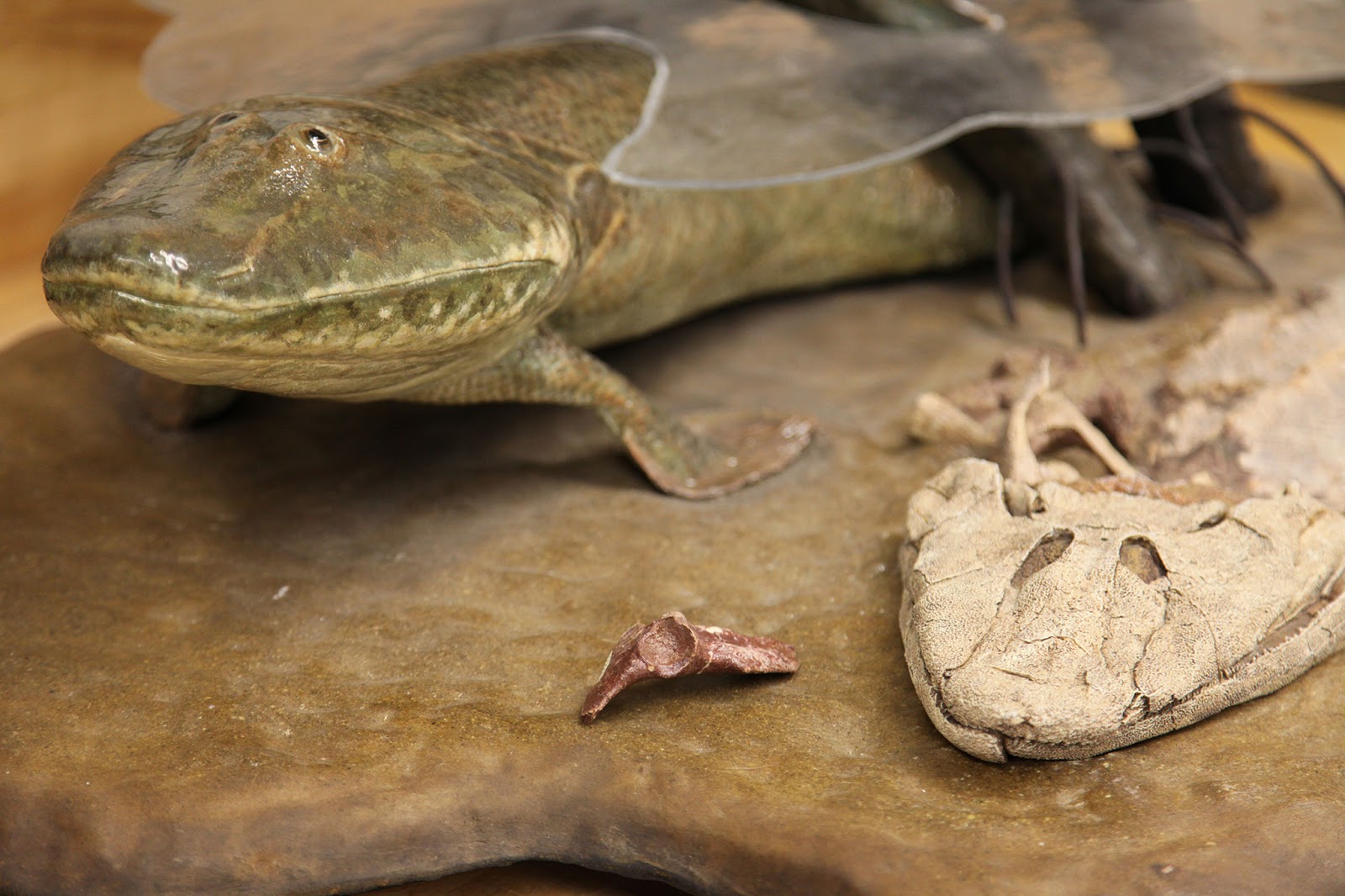
It is rare in palaeontology that transitional fossils are found - these are the fossils which show how organisms evolve over time. Among some of the famous ones include the Archaeopteryx, which showed how dinosaurs evolved into birds, and Darwinius, which helped show where apes branched off from lemurs. For a long time scientists have known that there must be transitional animals between fish and amphibians, but the question was what would they look like? Then, in 2004, one transitional fossil was found: Tiktaalik

Discovery and Fossils
Tiktaalik was first discovered in 2004 way in the frozen north of Canada on Ellesmere Island. Modern day Ellesmere Island is not a place you would imagine to find a transitional fish fossil - the geomagnetic north pole can be found on the island. However, a group of palaeontologists discovered this important fossil and fully described it in 2006. This group, (comprising of Neil Shubin, Edward Daeschler, and Farish Jenkins), named it Tiktaalik roseae; Tiktaalik comes from an Inuktitut word roughly meaning 'large freshwater fish', and was actually suggested by elders from the local Inuit Council, and roseae was chosen to honour an anonymous donor. After the initial discovery this alerted palaeontologists to the importance of Ellesmere Island, and successive digs have found other Tiktaalik remains allowing this strange animal to be better understood.

Biology
This animal has been described as a mixture of a salamander and a fish. Although gills do not fossilise the bony structures which support them do, and on the crocodile-like head of the Tiktaalik they took the form of holes called 'spiracles'. This gives us the indication that it could live underwater, but the layout of the ribs, and a secondary use of the spiracles, gives an indication that it also had lungs. Fish have a swim bladder which is full of air to keep them buoyant, but these swim bladders can evolve to become larger becoming a lung over millions of years. Modern day lungfish have this adaptation - they can exist a long time out of water thanks to their swim bladders evolving to become more like a lung which land vertebrates (tetrapods) have. Tiktaalik could then go on land and the water, and its fins helped it do so. Unlike the fish we know today fish of the Devonian, when Tiktaalik lived, had bones in their fins which form a 'hand' you might see in modern whales or the mosasaurs. These were the lobe-finned fish, today there are only eight species of them - the two coelacanths and the eight lungfish species.
A West Indian coelacanth
These lobe-fins will help answer why the Tiktaalik could move onto land. Later fossil finds have managed to unveil the fish's pelvis and tail, unlike its other fish cousins Tiktaalik had a larger pelvis and tail allowing greater movement. This allowed it to move onto land, but the pelvis was not too strong, so it was largely confined to the water side. Shubin, Daeschler, and Jenkins have advocated for a 'front wheel drive hypothesis' - like modern mudskippers it would use its front fins as a way to prop itself up while on land. The ribs were strong for this reason as it required thicker ribs to support its organs outside of the water. Finally, we have the neck. The spiracles allowed Tiktaalik to lose the bony structure which normally protected the gills, so this gave the Tiktaalik a neck with the ability to look around without completely moving its entire body. Although primitive, Tiktaalik and similar animals, one similar fish can also be found in Poland, set the stage for the body plans of amphibians, reptiles, birds, and mammals. This could be used as a way for it to search for prey, or possibly spot predators. At a metre long it was sizeable but was dwarfed by other fish as seen below.
A seize chart from Prehistoric-Wildlife.com
When and Where
Ellesmere Island today
As we've already mentioned, Tiktaalik has so far only been found on Ellesmere Island in the very north of Canada. The North East of North America is well known for Devonian lobe-finned fish and the first amphibians. In Quebec there is the closely related Eusthenapteron, which possibly was an ancestor to Tiktaalik, in Pennsylvania there was the giant lobe-finned fish Hyneria and the salamander-like Hynerpeton, and in Greenland there was a possible descendant of Tiktaalik, another salamander-like amphibian called Icthyostega. Tiktaalik has currently been found from fossil sites dating to 375 million years ago during the Devonian period. During this time the first large plants grew on the land, and invertebrates had already conquered the land. The Devonian has been known as 'The Age of the Fishes' for the explosion in the diversity of fish: sharks became common, there were the lobe-finned fish, and armoured fish called placoderms. Oxygen was also a lot less compared to present-day air - possibly around 75% less than today. This possibly explains why Tiktaalik moved onto land. The diversity of plants on the land would die, get washed into the ocean, and start decomposing which increasingly stripped the oceans of oxygen. As a result, any fish which could breathe on land and in water had an advantage. Eusthenopteron had spiracles on the top of its head instead of on the side of its head like other fish (even today), so it could go to the surface and breathe. Consequently, Tiktaalik evolved from lobe-finned fish like Eusthenopteron to take advantage of this.

Habitat
While it could go on land, the Tiktaalik was still very dependent on the water to survive. If you travelled back 375 million years to spot a Tiktaalik you would have to search riverbeds. Shubin and Daeschler have theorised that it would live in the first swamps, as well as streams and ponds, resting on edge of the water. Most of its time would be spent in the water - quite possibly it would be an ambush predator. Like crocodiles, it would lay on the water's surface, or the riverbed, waiting for prey, and then lunge with its powerful tail and pelvis after an unfortunate fish or bug. As other, larger fish were constrained to the water Tiktaalik would have gone to the shore as a way of effortlessly hiding from them. This fish's ancestors, such as Icthyostega, would start evolving to be more and more on land until the Carboniferous period when the first reptiles would permanently leave the water.

The sources I have used are as follows:
-'Tiktaalik', Prehistoric-Wildlife.com, [Accessed 20/02/2020]
-Dan Vergano, 'Our Fishy Ancestors Had Fins made for Walking', National Geographic, (14/01/2014), [Accessed 20/02/2020]
-Jason P. Downs, Edward B. Daeschler, Farish A. Jenkins, Jr. and Neil H. Shubin, 'The Cranial Endoskeleton of Tiktaalik roseae', Nature, 455/7215, (2008)
-Jennifer Clack, 'The Fish-Tetrapod Transition: New Fossils and Interpretations', Evolution: Education and Outreach, 2, (2009), 213-223
-Neil Shubin, Your Inner Fish: A Journey Into the 3.5-Billion-Year History of the Human Body, (New York: 2008)
-Neil H. Shubin, Edward B. Daeschler, and Farish A. Jenkins Jr, 'Pelvic girdle and fin of Tiktaalik roseae', PNAS, 111:3, (2014), 893-899
-PBS Eons, 'When Fish First Breathed Air', YouTube.com, (19/06/2018), [Accessed 20/02/2020]

Thank you for reading, for our other Paleo Profiles we have a list here. For other blog updates please see our Facebook or catch me on Twitter @LewisTwiby.

Sunday, 2 February 2020

Paleo Profiles: Elasmotherium

Reconstruction by W.S. van der Merwe
The Ice Age has become synonymous with larger than life woolly animals ranging from the Megaloceros, a deer with antlers the same length as a human is high, the woolly rhino Coelodonta, and the famous woolly mammoth. However, another woolly rhino roamed the plains of Ice Age Eurasia - the Elasmotherium. Often called the 'Siberian Unicorn' for its long horn the Elasmotherium is one of the many unique animals to roam the Ice Age world.

Discovery and Fossils
A skeleton at Azov History, Archaeology and Paleontology Museum-Reserve
The Elasmotherium was first described at the start of the 1800s by a Russian/German palaeontologist called Gotthelf Fischer von Waldheim. The fossil had been owned by a close friend of Catherine the Great, Yekaterina Dashkova, who donated it to the Moscow University in 1807, so Waldheim described it the following year. He named the fossil Elasmotherium sibericum - Thin Plate Beast from Siberia. Since then, many more fossils of this extinct rhino have been found across Eurasia, ranging from Siberia and China in east Asia all the way up to Ukraine in eastern Europe. A second species of Elasmotherium was discovered in 1914 by another Russian palaeontologist Aleksei Borissiak in the Caucasus region along the Black Sea - this new species was far older and was named Elasmotherium caucasicum. Research in the early-2000s found that some of the fossils assigned to the Caucasus species was in fact that of a different species of Elasmotherium - this new species was named Elasmotherium chaprovicum. As the Elasmotherium went extinct relatively recently in the history of the planet palaeontologists have recently managed to take DNA samples from fossils, something which allows us to know that Elasmotherium was on the rhino evolutionary tree, and we may even have cave art. Art by our ancestors can give palaeontologists good insights into how prehistoric animals looked and acted. Rouffignac Cave in France depicts a wide range of now extinct animals, mostly mammoths, but one has puzzled archaeologists. One seemed to be a one-horned rhino, but the Coelodonta, known to live in the area and alongside humans, had two horns. Although it can easily be a Coelodonta with artistic licensing, it could also be an Elasmotherium possibly showing that people in France somewhat knew about the Elasmotherium.

When and Where
The distribution of fossils by Schvyreva
The genus of Elasmotherium first appeared in the Pliocene about 2.5 million years ago - these fossils were from the caucasicum and chaprovicum species. Eventually these two species would go extinct, and they evolved into the better known Elasmotherium sibericum. Recent research has revealed an interesting aspect of when the Elasmotherium went extinct. Traditionally, it has been believed that the Elasmotherium went extinct sometime between 200,000 and 100,000 years ago during an epoch known as the Pleistocene. As this was many thousands of years before the large-scale Pleistocene Extinction, caused through a mixture of climate change and human activity, for sometime it was believed that it was a victim of 'natural extinction'. This is when a species naturally goes extinct, and a new species evolves to fill the vacant ecological role left behind. However, research done on 23 fossils in 2018 found that Elasmotherium managed to survive until a long time after this date. Through radiocarbon dating it has been found that they managed to survive in what is now Kazakhstan until as recent as 39,000 years ago. Elasmotherium was found from eastern Europe all the way up to Siberia at their height, so this Central Asian population represented the last of the rhinos. 

Biology
A possible depiction in Rouffignac Cave
Unlike the better known woolly rhino, there has been many debates about the biology of the Elasmotherium. The big issue is its horn. You will often see this rhino recreated with one big horn, earning it the nickname of 'the Siberian unicorn'. However, there is an issue with this - we don't actually know if it had a horn. Rhino horn is made of keratin, the same material which our nails and hair is made of, which does not preserve as easily as bone, so few Elasmotherium horn has been preserved. It is more than likely that it did have a horn, especially as other Pleistocene rhinos had horns. Now that DNA analysis has found that Elasmotherium is indeed in the same family as modern rhinos, it is certain that they had a horn. Another question then arises, what did the horn look like? Rhino horns can look very different species to species, and one hypothesis is that each Elasmotherium species had a horn looking different to others. This is especially the case as the early species lived alongside one another; the shape of the horns could be a quick way to differentiate between the two species. All of them likely would have thick muscles around the shoulders so they could lift up their heads.

Another debate is whether Elasmotherium had thick fur. A paper from 1878 has claimed that they did comparing them to 'contemporary rhinoceros and mammoth'. However, this is based on an idea that the Ice Age was a continuous period of icy coldness - instead there were glacial periods which moved between periods of warmth and bitter cold. It is quite likely that during the warmer periods they would have had thinner layers of fur, which gave way to thick shaggy fur during the cold periods. The Siberian cold was also dry, so a thick layer of fur could better trap in the heat. Unlike other rhinos, the Elasmotherium had quite long legs, so it is quite possible that they stood more upright, similar to horses, than other rhinos. This has led to some off reconstructions like the one below:
The reconstruction by Heinrich Harder, c.1920
It is likely that Elasmotherium moved like a modern bison. Its head close to the earth grazing, with long legs allowing it to run fast. For this reason, it is possible that it could gallop at quite fast speeds.

Diet and Habitat
Isotope analysis has allowed us to know what the Elasmotherium ate. High levels of certain compounds indicate that they would have eaten tough grasses, and this is further shown by their teeth. Their teeth have deep roots, and fossilised teeth show indication of continuous wear. If you see how a modern white rhino eats this is how the Elasmotherium would also eat. They were perfectly adapted to their particular environment. Just like today, large areas of Ukraine, Siberia, and Central Asia are grasslands with nothing to see for miles, something which gets covered in snow during the winter. Elasmotherium had wide feet which would allow them to wade through snow, and their big horn would also be useful to move snow so they could access the grass beneath. Due to the low nutrition in tough grasses, and based on how rhinos claim wide areas as their territory, an Elasmotherium would actually be a fairly rare sight. A solitary life to monopolise access to grass, only meeting up to mate. Other animals would have lived alongside this rhino. Looking at fossils from eastern Europe dating from around 200,000 years ago, A.K. Schyreva has shown that they would have lived alongside now extinct camel and bison species, early mammoths, saiga antelope, and the giant antlered Megaloceros. The later ones would have also lived alongside the famous woolly mammoth, and most likely humans. Some fossils have been found in Italy, and possible presence in cave art meant that humans could have also lived alongside them.

Extinction
Skeleton Reconstruction, photo can be found here
Now that we know that Elasmotherium went extinct around 39,000 years ago we can put them as one of the casualties of the Quaternary extinction event. Beginning around 130,000 years ago the peak of the extinctions occurred between 12-8,000 years ago, but it is important to remember that the Elasmotherium was limited to a smaller area by 39,000 years ago. At this time cooler temperatures started chaging the environment, and the grasses which the rhinos grazed on gave way to lichens and mosses. Especially as more herbivores could eat these plants, it meant that the rhinos suddenly had far more competition, on top of their primary food source becoming depleted. As expected, humanity sealed the deal. As humans started moving into areas inhabited by Elasmotherium they would start hunting them. Consequently, the struggling pockets of rhinos would be pushed into extinction - a tale unfortunately all too common.

The sources I have used are as follows:
-A.K. Schyreva, 'On the importance of the representatives of the genus Elasmotherium (Rhinocerotidae, Mammalia) in the biochronology of the Pleistocene of Eastern Europe', Quaternary International, 379, (2015), 128-134
-'The Elasmotherium', Nature, 18:458, (1878), 387-389
-Pavel Kosintsev, Kieren J. Mitchell, Thibaut Devièse, Johannes van der Plicht, Margot Kuitems, Ekaterina Petrova, Alexei Tikhonov, Thomas Higham, Daniel Comeskey, Chris Turney, Alan Cooper, Thijs van Kolfschoten, Anthony J. Stuart, and Adrian M. Lister, 'Evolution and Extinction of the giant rhinoceros Elasmotherium sibiricum sheds light on the late Quaternary megafaunal extinctions', Nature, 3, (2019), 31-38
-'Elasmotherium', Prehistoric-Wildlife.com, [Accessed 31/01/2020]
-Josh Davis, 'The Siberian unicorn lived at the same time as modern humans', Natural History Museum, (26/11/2018), [Accessed 31/01/2020]

Thank you for reading. For other Paleo Profiles we have a list here. For other blog posts please see our Facebook or catch me on Twitter @LewisTwiby.

Sunday, 1 September 2019

Paleo Profiles: Nasutoceratops

A reconstructed skull in the Arizona History of Natural History
Recently, the video game Jurassic World: Evolution announced that it would be introducing the not very well known herbivorous dinosaur Nasutoceratops. The Nasutoceratops was a car-sized dinosaur, and is often shadowed, alongside many of its other relatives, by one particular dinosaur which it's related to: Triceratops. Today we'll look at the Nasutoceratops, how it lived, and how it might have behaved.

Discovery and Fossils
Parts of the holotype
Nasutoceratops is a very recent discovery being first found in 2006, and its official description only took until 2013 - quite often fossils can be studied for over a decade before being officially described. A team from the University of Utah found most of a skull and several leg bones in the Kaiparowits Formation, Utah. The amount of well-preserved bones from a specimen, especially the skull, allowed palaeontologists to feel confident enough to name the dinosaur very quickly. As early as 2010 one of the discoverers, Eric Lund, named the dinosaur, but it took until 2013 for the official description to happen. It was named Nasutoceratops titusi meaning 'Large Nosed Horned Face'. A relative of the Triceratops ('Three Horned Face') they thought it was fitting to give it a similar name, especially as the Nasutoceratops had a very distinct nose just like Triceratops.

Biology

The Nasutoceratops belonged to a family of dinosaurs called the Ceratopsidae, or Ceratopsids. These were a family of quadrupedal herbivorous dinosaurs characterised by beaked jaws and elaborate nasal horns. The ceratopsids a further split between two subfamilies - the chasmosaurids and centrosaurids. The chasmosaurids, including Triceratops, were characterised by their large brow horns and elaborate triangular frills; whereas the centrosaurids, which Nasutoceratops belonged to, had elaborate nasal horns, short rectangular frills, but had elaborate spines on the frills. Although Nasutoceratops is classed as a centrosaurid it shares several features of chasmosaurids, such as lacking elaborate spines on the frill and having long brow horns, but the group who described the dinosaur stated that possible convergent evolution was due to this. This is when two or more species, or groups, evolve independently but similarly to suit similar environments - such as how bats and birds are not related but both evolved powered flight for a specific environment. The skull of a Nasutoceratops is a blend of centrosaurid and chasmosaurid skulls as a result. If you looked at a Nasutoceratops head on you would notice how the horns resemble that of cattle and not like Triceratops. Instead of being relatively straight, like that of Triceratops, they curve horizontally so they resemble cattle horns. These horns were very long, the longest among centrosaurids, covering 40% of the 1.5 metre (4.9 ft) long skull - they stretches from the brow to just before the snout. The snout itself is very interesting. Centrosaurids are renowned for their unusual snouts, and Nasutoceratops keeps this precedent by exhibiting a large bony nasal snout, shown below.
A Nasutoceratops skull, from Sampson, Lund, Loewen, Farke and Clayton
Based on the skull size and the preserved front leg bones palaeontologists have estimated that Nasutoceratops was just under 5 metres long. Based on bone texture, the specimen which we have was likely a sub-adult or adult, so it was close to either its full size or close to it. What would a living Nasutoceratops look like? Unfortunately, no skin has been preserved from Nasutoceratops, but based on other species we can make some realistic assumptions. Scott Sampson has suggested that sexual dimorphism may have occurred in ceratopsians. Only a few early ceratopsians, like Protoceratops, show skeletal differences, so Sampson suggested that if there was dimorphism it would be based on the frills. Males would likely have brightly coloured frills to attract mates or scare of rivals - only in a last resort would they use their horns to fight like modern bighorn sheep. Horns could snap, fights could leave deep wounds, and with predators about it was often too risky. There have been debates about whether they would live in herds - traditionally reconstructions have presented ceratopsids as living in herds like modern African buffalo or white rhino. Sampson has suggested that they lived in 'socially complex' herds, while others have suggested that, when herds have been found, that they could be seasonal or herds of young dinosaurs. Modern Indian rhinos form 'bachelor' herds for protection, as an example. Unfortunately, this does not have a simple answer. Finally, Nasutoceratops likely had some feathers. As we have regularly discussed, every year palaeontologists uncover new revolutionary discoveries opening greater insight into the life of the dinosaurs. The discovery of feathers, ranging from hair-like filaments to modern feathers, on dinosaurs is one example. Although no feathers have been found on large ceratopsians, but a primitive ancestor to the ceratopsians have been found with quill-like follicles. A Psittacosaurus found in the Yixian Formation, China was found with these bristles. What they were used for has been debated: display? defence? thermoregulation? It is likely that larger species, like Nasutoceratops, likely had these bristles, which can be seen on a reconstruction of Psittacosaurus below:
Diet
Ceratopsids had leaf-shaped teeth in a beaked mouth, and Nasutoceratops had this design as well. This was perfect for slicing apart tough vegetation close to the ground. Nasutoceratops lived alongside many other species of herbivorous dinosaurs, so an adaptation to low-lying plants would help prevent interspecies competition. The thick beak could slice through tough vegetation which their leaf-shaped teeth could easily slice into smaller pieces. Due to the high fibrous foliage which they ate Nasutoceratops likely had some form of fermentation in its stomach to further break down the vegetation, as modern elephants and rhinos do, to increase nutrient extraction from what they eat. It has been suggested recently that ceratopsids could have scavenged from the kills of carnivores or would eat abandoned eggs in nests for extra protein. This is not unheard of in nature. Deer have regularly been caught eating dead squirrels or scavenging from carcasses, and hippos have even been reported eating other dead hippos! Herbivores have to eat a lot to have enough energy, so scavenging meat would be a quick way to regain lost protein. Meat and eggs would supplement their diet when needed.

When and Where
The Western Interior Seaway
As mentioned earlier Nasutoceratops was discovered in the Kaiparowits Formation in what is now Utah. This is quite unusual for centrosaurids, as most American centrosaurids are found in the North-East US and Canada, meanwhile Nasutoceratops is one of two to be known from outside this region - the other being Diabloceratops. The 'when' answers why this is. Ceratopsians are known from the Late Cretaceous, around 83 to 66 million years ago, and Nasutoceratops lived in a specific time called the Campanian, around 75 million years ago. At this time the United States was split in two by a great inland sea called the Western Interior Seaway. This isolated small pockets of dinosaurs where certain groups were located in only certain locations. Nasutoceratops was descended from a small population of earlier ceratopsians separated from larger populations by the seaway. It also created a warm, wet and humid jungle which Nasutoceratops could be found in. Floodplains and swamps provided ample plant diversity to sustain a wide range of prehistoric life. The Kaiparowits Formation is one of the best fossil sites in the US and has revealed a thriving Cretaceous ecosystem. Two other ceratopsids lived alongside Nasutoceratops, including the elaborately-frilled chasmosaurid Kosmoceratops, and the duckbilled hadrosaurs, including the famous Parasaurolophus. There were threats to Nasutoceratops; the young could fall victim to the raptor Talos and a fully grown adult could potentially be taken down by a tyrannosaurid called Teratophoneous. Although, in the water there was a crocodilian that could eat dinosaurs called Deinosuchus.

The sources I have used are as follows:
-Gregory S. Paul, The Princeton Field Guide to Dinosaurs, Second Edition, (Princeton: Princeton University Press, 2016)
-Eric Lund, Scott Sampson, and Mark Loewen, 'Nasutoceratops titusi (Ornithischia, Ceratopsidae), a basal centrosaurine ceratopsid from the Kaiparowits Formation, southern Utah', Journal of Vertebrate History, 36:2, (2016)
-'Nasutoceratops', Prehistoric-Wildlife.com, [Accessed 31/08/2019]
-Scott Sampson, Eric Lund, Mark Loewen, Andrew Farke, and Katherine Clayton, 'A remarkable short-snouted horned dinosaur from the Late Cretaceous (late Campanian) of southern Laramidia', Proceedings: Biological Sciences, 280:1766, (2013), 1-7
-Peter Dodson, The Horned Dinosaurs: A Natural History, (Princeton: Princeton University Press, 1996/2017) 

Thank you for reading and I hope you found it interesting. For other Paleo Profiles we have a list here. For future blog updates please see our Facebook or catch me on Twitter @LewisTwiby.

Sunday, 23 June 2019

Paleo Profiles: Meganeura

Meganeura monyi
A common feature of media depicting prehistoric environments is the presence of giant insects or other arthropods. In reality, the truly giant invertebrates were not as common as they are often depicted, but that does not mean that they did not exist. They exist even today - the goliath beetles can reach over 11 centimetres in length (about 4.3 inches). However, during the Carboniferous period (358-298 million years ago) arthropods got to truly staggering sizes - a millipede called Arthropleura could grow to as long as a human is high. One of these giants was the Meganeura - a giant relative of today's dragonflies. 

Discovery and Fossils
The Meganeura was discovered in 1880 in among coal in Commentry, France, and five years later a palaeontologist called Charles Brongniart. He would become one of the pioneering palaeontologists in the study of insect evolution; he would often return to the coal sites in Commentry which regularly offer new and interesting insects from the Late Carboniferous. In 1885, Brongniart would look at the fossil and name it Meganeura, (Large-Nerved), for the perfectly preserved network of veins in the wings of the dragonfly-like insect. Luckily, palaeontologists have managed to unearth many specimens from Commentry, and in 1979 another well-preserved specimen was discovered in Derbyshire, northern England. We have discovered so many specimens that it is possible to identify three different species: M. brongniarti, M. monyi, and M. vischerae.

Biology
Meganeura size, Prehistoric-Wildlife.com
Despite their appearance Meganeura were not actually dragonflies. Instead, they belonged to a now extinct order called Meganisoptera, but better known as griffinflies. Griffinflies are currently classed in the same order as contemporary dragonflies and damselflies, so they are closely related to the insects which we recognise today. Meganeura and other griffinflies, like the even larger Meganeuropsis, were far larger than any current living dragonfly. The largest member of the odonta family, a damselfly from Central and South America called Megaloprepus caerulatus, has a wingspan of 19 cm (7.5 inches) whereas the smallest Meganeura specimens had a wingspan of 65 cm (25 inches)! Meganeura was a true giant of the Carboniferous skies. The largest species, M. monyi, could have a wingspan of up to 75 cm. This is about the same size as a pigeon, so the next time you see someone throwing seed at them just imagine a dragonfly that size. Insects share several body parts which are present in Meganeura. One of these is how the Meganeura got so massive. Across the body of insects and other arthropods are holes called spiracles, which can be seen on the moth larva below:
The spiracles of an Indian moon moth larva, wikipedia.org
Spiracles lead to a series of tubes called trachae, and smaller ones called tracheoles, which allows the arthropods to breathe through a process called diffusion. Substances move from an area of high concentration to low concentration, so oxygen moves from the air to the tissues through the trachae and tracheoles while carbon dioxide moves the other way. When we look at the atmosphere of the Carboniferous this will explain why the spiracles and trachae allowed the Meganeura to grow so large.

To imagine what a Meganeura looked and lived in life just look at today's damselflies and dragonflies. Meganeura would start life in the water as a nymph preying on other aquatic life, including other nymphs, until they grew large enough to take to the air. Brightly coloured and very fast they would dart through the air of the Carboniferous swamps catching smaller insects on the fly. Dragonflies and damselflies are predators rapidly striking and catching prey so Meganeura would do the same. As modern dragonflies are territorial, to have the best perches to lunge from after food, so would the Meganeura. It takes a lot of energy to keep up the rapid wing beats needed to sustain fast and agile flight, so dragonflies need a monopoly on possible prey in their vicinity. With the smallest Meganeura being three times larger than the largest of modern dragonflies or damselflies it required a lot more energy - luckily its prey was also fairly large. Dragonflies and damselflies have a unique mating system forming a circle or heart shape with the ends of their abdomens, as well as seeing males fighting over females. Imagine seeing that with dragonflies the size of pigeons!

When and Where
Meganeura in the BBC documentary Walking with Monsters
The Meganeura lived at the end of the Carboniferous period between 305 and 299 million years ago. This was during the Paleozoic, and many forms of life we recognise today did not exist - at least on the land. The first reptiles had arrived, but they small, being able to easily fit in the palm of your hand. If you wanted to look for large vertebrates you would have to look in the water - amphibians like Proterogyrinus resembling crocodiles or monitor lizards would roam the shorelines. Meganeura has been found in the coal rich regions of Western Europe - particularly northern England, Commentry in France, and some remains in Scotland. The swamps which existed during the Carboniferous over millions of years fossilised and formed coal - the Industrial Revolution relied on the burning of plants from millions of years before the first dinosaur evolved. The Carboniferous was wetter, hotter, and richer in oxygen compared to today's atmosphere. Today, the air we breathe is roughly 21% oxygen (unfortunately that is rapidly changing due to carbon emissions), but in the Carboniferous it was around 35%. Plants and trees were the reason for this. The bacteria which decomposes foliage and release carbon dioxide into the atmosphere had yet to evolve to fully breakdown plant matter. As a result, more carbon dioxide was taken in by plants but not released through decomposition creating an atmosphere with greater oxygen content. Hotter and wetter environments not only created swamps across the world, but it also allowed more forests to flourish. This was the perfect environment for griffinflies. Lots of water to lay eggs, and flourishing plant life allowed more animal life to eat. It also allowed arthropods to grow to giant sizes.

As we discussed earlier, insects breathe using spiracles leading to tracheoles. They are also used for thermoregulation - water can exit and enter the spiracles, so arthropods can close the spiracles to stop water loss. An atmosphere rich in oxygen gave arthropods the opportunity to grow larger - more oxygen allows larger bodies without compromising diffusion. This is why the Carboniferous forests became coal after millions of years; humans are now releasing their carbon. The humidity affected this as well. Larger bodies mean larger spiracles, and a larger surface area to lose water from; a humid environment heavily reduced the amount of water lost. Carboniferous swamps allowed Meganeura to grow large without suffocating or dehydrating. We see this today - the largest damselfly is found in the rainforests of Central and South America, and the goliath beetles are found in the rainforests of central Africa. Scientists at Arizona State University raised insects in controlled oxygen rich environments, and found that, over just a few generations, their size rapidly increased. Another theory has emerged which also explains the size of Meganeura and other arthropods. Unlike adults, larva cannot control their oxygen intake, and oxygen can be dangerous in high quantities - that is why you get light headed when you breathe directly from oxygen canisters. In an oxygen rich environment regular sized larva could potentially be killed from too much oxygen. However, a larger size means that larva can safely take in oxygen without posing a health risk, this leads to larger adults. Finally, palaeontologists have also stated that Meganeura could grow to such large sizes as they had few large predators. The only fully terrestrial animals were either invertebrates and small reptiles, so Meganeura could become large thanks to lack of competition.

Extinction
Why then did the Meganeura go extinct? The same thing which is currently driving thousands to millions of species to extinction now: climate change. While we know what is causing contemporary climate change (our own actions), we still are unsure of what caused the Carboniferous climate shift. From around 305 to 300 million years ago the planet became both warmer and drier. This devastated the swamps which covered particular Europe and North America. As swamps started disappearing this put increased pressure on the habitats of Meganeura and other large invertebrates, like the 2 m long millipede Arthropleura. Swamps also trap carbon dioxide, so as swamps vanished the levels of carbon dioxide in the atmosphere rose. The bacteria which decomposed foliage and trees also began to evolve, and decompose dead trees in higher numbers releasing carbon dioxide which otherwise would not have been released. Between shrinking forests and bacteria releasing more carbon dioxide the Meganeura could not adapt. A small mass extinction event happened - the Arthropleura went extinct around 300 million years ago and the last Meganeura followed it 299 million years ago. Griffinflies continued to exist until the early Permain with the even larger Meganeuropsis existing until 283 million years ago. The drop in oxygen levels and disappearance of giant swamps meant that griffinflies could not compete, especially as reptiles bounced back quickly from the Carboniferous extinction event. The Age of Invertebrates soon gave way to the Age of Reptiles.

The sources I have used are as follows:
-Robert Dudley, 'Atmosphere Oxygen, Giant Paleozoic Insects, and the Evolution of Aerial Locomotor Performance', The Journal of Experimental Biology, 201, (1998), 1043-1050
-'Meganeura', Prehistoric-Wildlife.com, [Accessed 22/06/2019]
-Alan Cannell, 'The Engineering of the Giant Dragonflies of the Permian: Revised body mass, power, air supply, thermoregulation, and the role of air density', Journal of Experimental Biology, 221, (2018), 1-7
-Michael May, 'Heat Exchange and Endothermy in Protodonata', Evolution, 36:5, (1982), 1051-1058
-PBS Eons, 'The Age of Giant Insects', YouTube, 18/09/2017, [Accessed 22/06/2019]
-Gauthier Chapelle and Lloyd Peck, 'Polar Gigantism dictated by Oxygen Availability', Nature, 399, (1999), 114-115
-'Reptile's Beginnings', Walking with Monsters, (2005), BBC, 15 December

Thank you for reading and I hope you found it interesting. For other Paleo Profiles we have a list here. For future blog updates please see our Facebook or catch me on Twitter @LewisTwiby.

Sunday, 31 March 2019

Paleo Profiles: Yi qi

A reconstruction of the Yi qi. From Emily Willoughby, emilywilloughby.com, (May 2015)
Today on Paleo Profiles we will be looking at a very unique dinosaur from Jurassic China: the Yi qi (Strange Wing). This bat like dinosaur is a recent discovery and shows us how diverse dinosaurs were. So let's look at China's bat-like 'Strange Wing'.

Discovery and Fossils

Currently, we only have own partial specimen of Yi and it was only formally described in 2015. It was initially discovered by a farmer called Wang Jianrong in Qinglong County back in 2007; he recognised it as a possible dinosaur fossil so he sold it to the Shandong Tianyu Museum of Nature. As often with fossil discoveries, it remained in storage until someone could formally describe the fossil in 2015. A group of ten palaeontologists evaluated the fossil including Xu Xing - Xu is one of China's most prominent palaeontologists describing, or co-describing, many major discoveries including the bird-like Microraptor and the fossil which showed tyrannosaurs were feathered, Yutyrannus. In 2015 their findings were published in Nature and the little dinosaur was named Yi. Although partial, major sections of the Yi has been preserved including the majority of the pigeon-sized body, parts of the skull, and imprints from a membrane which made up the animal's wings.

Biology
Examples of the Yi qi soft tissue
Yi was in a family known as Scansoriopterygids - a family which was closely related to the ancestors to modern birds. Three genera, including Yi, made up the Scansoriopterygids which are all biologically similar and lived alongside one another. The largest, and best known before 2015, was the Epidexipteryx due to it being the best preserved. However, for years it had been reconstructed incorrectly. Yi was the first Scansoriopterygid to be discovered with preserved membranes which connected the long fingers together, and palaeontologists, and paleo-artists, at times have a general fault of 'skin-wrapping' fossils. This means that non-mammalian fossils are regularly reconstructed with the skin tracing the skeletons - features like muscles, filaments, or extra skin are often overlooked. As a result Epidexipteryx was reconstructed without membranes leading to palaeontologists believing that it lived similar to a species of lemur called the aye-aye. The BBC documentary Planet Dinosaur reconstructed Epidexipteryx in this way as well:


The discovery of the Yi showed that Scansoriopterygids were not like aye-ayes, but really bats or more likely flying squirrels. This had been suggested before the discovery of Yi - most notably by Andrea Cau. Although we have the membrane of the Yi it is not fully preserved so there are several different reconstructions of the wing - the discoverers stated that 'the flight apparatus of Yi cannot be confidently reconstructed...However, the range of possible flight apparatus configurations can be explored by considering different reconstructions'. When first discovered the media reported it as being a 'dinosaur bat' but the paper itself disagreed with that interpretation - Yi just vaguely resembled one. They argued that based on realistic membrane placement it would be a glider. Yi and other Scansoriopterygids had long tail feathers which have traditionally been seen as being for display. Likely that it still true, possibly brightly coloured it could be used to assert dominance or attract a mate, like with the feathers of a male peafowl. With the Scansoriopterygids they were also possibly used to help the dinosaurs glide - like the tail on a flying squirrel it could act as a rudder to steer. It did not have the exact body for relying solely on gliding so it could possibly rely on short bursts of powered flight.

One of the key discoveries associated with Yi and other Scansoriopterygids are the presence of feathers covering the body. They were closely related to the ancestors of modern birds, just instead being an evolutionary dead end, so it would be natural for them to be covered in feathers - albeit these were simple feathers, not something you would expect to see on a fully grown modern bird. Nevertheless, by use of an electron microscope it is possible to know, vaguely, what colour the feathers were. Preserved pigments leads us to believe that Yi had black feathers except on the head which was a yellow-brown hue. Yi and its cousins were perfectly adapted to life in the trees with flattened bodies and long fingers which allowed it to grip hold of tree trunks. The diet of Yi is still unknown but reasonable guesses can be made. Teeth and the presence of pterosaurs in the area with similar teeth would suggest that Scansoriopterygids were primarily insectivores, although their diet could include berries.

When and Where
Yi and other Scansoriopterygids lived during the Jurassic period, in particular the Callovian or Oxfordian, around 160 million years ago. During this time the world was warmer, wetter, and richer in oxygen. Where Yi came from was no exception. The Tiaojishan Formation in Northeast China has been believed to be either a sub-tropical or temperate climate, as well as being both warm and humid based on fossilised tree rings. As a result, the Yi would never experience the cold. Based on its arboreal lifestyle, and limited ability to undertake powered flight, this would mean that the Yi would be limited to forests. The region was very volcanic. Tiaojishan Formation has many layers showing occasional ash fall from volcanic eruptions - something that many Chinese fossil sights experienced. This is why Chinese dinosaurs are so well preserved that they regularly show evidence of feathers. Ash buries and preserves those unfortunate enough to be caught in the cloud - just think of how well-preserved the unfortunate victims of Pompeii are. Consequently, Chinese fossil sites every year gives us more and more well-preserved dinosaur remains - Yi is far from the only dinosaur that we know what colour they were due to their pigments being preserved.

Neighbours
A Jeholopterus, a pterosaur which lived alongside Yi
Yi had a wide variety of animal life living alongside it. Among these included the other two Scansoriopterygids genera, Scansoriopteryx and Epidexipteryx, but both were a lot smaller than the Yi. In fact, three of the smallest dinosaurs lived at the same time in the same place - Scansoriopteryx, Epidexipteryx, and Aurornis. Other arboreal dinosaurs resembled modern birds - such as Anchiornis - and likely competed with Yi. Pterosaurs were common in the region with around fifteen species being known to live alongside Yi. The Scansoriopterygids were not the only gliding animals - the flying squirrel like Volaticotherium could be found in the Tiaojishan forests. What about terrestrial dinosaurs? There are a few including a heterodontosaurid called Tianyulong and a few dinosaurs, including Anchiornis, lived alongside them. From other Chinese fossil sights around the same time we do know larger dinosaurs were roaming Jurassic China - such as Sinraptor, actually a relative of Allosaurus and not raptors. There is a possibility that a large carnivore related to Sinraptor stalked the land.

Thank you for reading. The sources I have used are as follows:
-Xing Xu, Xiaoting Zheng, Corwin Sullivan, Xiaoli Wang, Lida Xing, Yan Wang, Xiaomei Zhang, Jingmai K. O’Connor, Fucheng Zhang, & Yanhong Pan, 'A Bizarre Maniraptoran theropod with preserved evidence of membranous wings', Nature, 521:7550, (2015), 70-73
-'Yi', prehistoric-wildlife.com, [Accessed 20/03/2019]
-'Epidexipteryx', prehistoric-wildlife.com, [Accessed 20/03/2019]
-Gregory S. Paul, The Princeton Field Guide to Dinosaurs, Second Edition, (Princeton: Princeton University Press, 2016)
-Trey the Explainer, 'Paleo Profile - Yi qi', Youtube, (29/04/2015), [Accessed 20/03/2019]
-Wang Yongdong, Saiki Ken'ichi, Zhang Wu, and Zheng Shaeolin, 'Biodiversity and palaeoclimate of the Middle Jurassic floras from the Tiaojishan Formation in western Liaoning, China', Progress in Natural Science, 16:9, (2006), 222-230