Search This Blog

Showing posts with label anarchism. Show all posts

Sunday, 1 March 2020

Left-Wing and the 'Other' History: The Internationale

The Internationale, or L'Internationale with its original French title, has remained one of the most important and widespread left-wing anthems since its creation close to 150 years ago. If you have not heard the song this video below will be helpful:

This is just one of the several versions of the song in English alone. Originating as a French song, L'Internationale has been translated into languages across the world ranging from Czech to Esperanto to Zulu to Bengali reflecting the international ideal of the socialist movement. Especially among Marxists and anarchists, although there are exceptions, there has been a desire to build an international movement; borders were, and still argued to be, another way to exploit the working-class. It can be argued that internationalism is coded into the DNA of modern socialism - Karl Marx, Friedrich Engels, and Mikhail Bakunin were all political exiles so had to rely on international support. L'Internationale emerged as part of this socialist internationalism.

The Origins of the Song
Eugene Pottier
The song was written by French socialist Eugene Pottier during the aftermath of the ill-fated Paris Commune of 1871. Following defeat in the Franco-Prussian War, and the declaration of the newly founded German Empire in the Palace of Versailles, French emperor Louis Napoleon, (the nephew of Napoleon Bonaparte), fled and a shaky Third Republic was formed. In Paris, and a few other cities, the working-classes seized control and formed communes with the intention of radically changing society. Despite being called the 'Paris Commune' it always had an international trend to it - many of its leaders were Polish and Russian exiles, and workers from Britain, Germany, and Algeria helped construct the commune. However, the Paris Commune was brutally crushed by the French army, and it caused a rift in the first attempt to create an international movement of socialist - the First International. To summarise this rift, bear in mind this is a very simplified explanation, the followers of Karl Marx argued that it failed as the Commune was to ready to remove the state, while the followers of Mikhail Bakunin argued that they had left too much of the state intact which caused its failure. This rift has never been healed, and is why we have two main branches of socialist thought: Marxism and anarchism. It was this background that Pottier wrote the song. Pottier was a member of both the Commune and the Internationale, and his song became its anthem until it was dissolved in 1876.

Debout, les damnés de la terre
Debout, les forçats de la faim
La raison tonne en son cratère
C'est l'éruption de la fin
Du passé faisons table rase
Foule esclave, debout, debout
Le monde va changer de base
Nous ne sommes rien, soyons tout
Chorus
C'est la lutte finale
Groupons-nous, et demain
L'Internationale
Sera le genre humain.
Il n'est pas de sauveurs suprêmes
Ni Dieu, ni César, ni tribun
Producteurs, sauvons-nous nous-mêmes
Décrétons le salut commun
Pour que le voleur rende gorge
Pour tirer l'esprit du cachot
Soufflons nous-mêmes notre forge
Battons le fer quand il est chaud.
Chorus
L'État comprime et la loi triche
L'impôt saigne le malheureux
Nul devoir ne s'impose au riche
Le droit du pauvre est un mot creux
C'est assez, languir en tutelle
L'égalité veut d'autres lois
Pas de droits sans devoirs dit-elle
Égaux, pas de devoirs sans droits.
Chorus
Hideux dans leur apothéose
Les rois de la mine et du rail
Ont-ils jamais fait autre chose
Que dévaliser le travail ?
Dans les coffres-forts de la bande
Ce qu'il a créé s'est fondu
En décrétant qu'on le lui rende
Le peuple ne veut que son dû.
Chorus
Les rois nous saoulaient de fumées
Paix entre nous, guerre aux tyrans
Appliquons la grève aux armées
Crosse en l'air, et rompons les rangs
S'ils s'obstinent, ces cannibales
À faire de nous des héros
Ils sauront bientôt que nos balles
Sont pour nos propres généraux.
Chorus
Ouvriers, paysans, nous sommes
Le grand parti des travailleurs
La terre n'appartient qu'aux hommes
L'oisif ira loger ailleurs
Combien de nos chairs se repaissent
Mais si les corbeaux, les vautours
Un de ces matins disparaissent
Le soleil brillera toujours.
Chorus
As Pottier became exiled in New York following the aftermath of the Paris Commune he translated it into English:
 
Arise, ye workers from your slumber,
Arise, ye prisoners of want.
For reason in revolt now thunders,
and at last ends the age of cant!
Away with all your superstitions,
Servile masses, arise, arise!
We'll change henceforth the old tradition,
And spurn the dust to win the prize!
Chorus
So comrades, come rally,
And the last fight let us face.
The Internationale
Unites the human race.
 No more deluded by reaction,
On tyrants only we'll make war!
The soldiers too will take strike action,
They'll break ranks and fight no more!
And if those cannibals keep trying,
To sacrifice us to their pride,
They soon shall hear the bullets flying,
We'll shoot the generals on our own side.
Chorus
No saviour from on high delivers,
No faith have we in prince or peer.
Our own right hand the chains must shiver,
Chains of hatred, greed and fear.
E'er the thieves will out with their booty,
And to all give a happier lot.
Each at his forge must do their duty,
And we'll strike the iron while it's hot.
Chorus
The tune we now sing L'Internationale to now was not the original tune. Instead, it was originally sang to the tune of the famous anthem of the French Revolution, La Marseillaise. Even after L'Internationale became popular, La Marseillaise was still sung - in his account of the Russian Revolution Leon Trotsky argued that Russian workers sang both. In 1888 Belgian socialist Pierre De Geyter changed the tune to the one we now know, although the lateness of his evolution of the song would explain why Russian workers sang both songs. Russia's isolation likely meant that De Geyter's update was not widely known by the time of the outbreak of revolution in 1905 and 1917. 
Pierre De Geyter

L'Internationale becomes International
After De Geyter updated the tune, and thanks to the arrival of an internationalist anarchist and Marxist labour movement, allowed the lyrics to become international. The United States got its own lyrics by Charles Hope Kerr, which became the established lyrics in the USA thanks to its inclusion into the Little Red Book released by the Industrial Workers of the World. In 1902 Arkady Kots made the first Russian translation, in 1910 Emil Luckhardt made the first German translation, 1923 Qu Qiubai made the first Mandarin translation, and during the last decades of British rule in India until the 1950s it was translated into Bengali, Malayalam, Assamese, and Urdu. Although new translations were also made for various reasons. To celebrate the fifty-fifth anniversary of the Paris Commune leftists in the Koumintang's army made a new Mandarin translation in 1926, and to honour the first decade of Maoist rule in China Shen Baoji made a third translation. Billy Bragg in 1989 controversially made a new English version, the one shown at the top of this post, as he thought the lyrics required updating - something other socialists like left-wing Labour politician Tony Benn disagreed with. Bragg's version still remains controversial as it does flow much better, but the lyrics are much less explicitly socialist compared to the original or Kerr's version. 
                                                                      One of Jiang Qing's operas

L'Internationale has had a long and varied history on the Left. Until 1944 it was the national anthem of the Soviet Union when it was replaced by the Hymn of the Soviet Union, possibly as Stalin hoped to use the hymn to further bolster his image. While states have tried to co-opt L'Internationale the masses used it themselves. During the Cultural Revolution in China the state played the song on the radio, but tried to silence it when the Red Guards and communes began using the song themselves. One of the key figures in the radical Shanghai Commune, Jiang Qing, regularly used the song in her operas which would be banned by the counter-revolutionary government under Deng Xiaoping which emerged in the post-Mao era. Similarly, the anti-state, but still left-wing, protesters during the 1953 Berlin Uprising, 1968 Prague Spring, and 1989 protests in China and East Germany all used the song. By using it they wished to show their own radicalism, and also protest the state claiming to be radical. Even now, the song remains a key protest song, and represents the long history of leftist internationalism, something deeply needed in a growing climate of intolerance.

Thank you for reading, and for other Left-Wing and the 'Other' history posts please see our list here. For other blog updates please see our Facebook or catch me on Twitter @LewisTwiby.

Sunday, 9 June 2019

World History: Capitalism and Socialism


Today we're looking at two ideas which have shaped the world today: capitalism and socialism. We looked briefly at these ideas when we looked at the Industrial Revolution, but we will expand on them today. Some form of capitalism and socialism have existed for centuries across the world: Joyce Appleby joked that historians of capitalism have stated that it started repeatedly since the Roman Empire; Peter Marshall has stressed how ancient Daoism and Buddhism can anachronistically be described as leading themselves into being anarchist; and the Zapatistas in contemporary Chiapas, Mexico have stated that their socialist policies are in continuation with indigenous practices. This is important to bear in mind as today we'll largely be looking at the development of modern capitalism and socialism - this leads us to a focus on Europe and North America. However, when I can, I want to expand this to look at developments in capitalism and socialism outside the Euro-American world. Before we begin, I also want to preface this post by stating that I am a socialist, so I will likely be more critical of capitalism than some other histories which you might read - such as Appleby's history of capitalism referenced in this post.

From Mercantilism to Modern Capitalism
A French seaport in 1638 during the height of French mercantilism
A basic definition of capitalism is an economic and political system where trade and the way goods are produced, the means of production, are in the hands of private owners. This is a broad definition and describes many societies throughout history, and one of the main forms which this took was mercantilism and merchant capitalism. Merchant capitalism, in particular, we have seen throughout the World History series, and could be found in most regions of the world - especially India, China, and Japan. Mercantilism, meanwhile, is a form of capitalism which aims to see the maximisation of a state's exports - trade and consumption was seen as finite, so it was believed that to survive you needed a monopoly on trade. This led to the formation of large companies, as it was a safer investment for wealthier individuals to own shares in a company than entirely rely on your own capital as in the past. A major mercantilist in England, Thomas Mun, was influential in the formation of the English East India Company (EIC), and similar ventures opened with the Dutch East India Company (VOC) and the Hudson Bay Company in Canada to name two prominent ones. Mercantilism required state intervention in order to protect trade, so in the seventeenth and eighteenth centuries protectionist policies were implemented to edge out competitors, and there were even wars - especially between the English and Dutch. However, by the late-eighteenth century mercantilism started becoming routinely criticised. The best known critic is that of Adam Smith. Smith was a Scottish economist and philosopher, and was highly influenced by the Scottish Enlightenment which led him in 1776 to write An Inquiry into the Nature and Causes of the Wealth of Nations. Smith did not live in a vacuum: it is no coincidence that his ideas of liberty were being repeated by other economists as American revolutionaries and Thomas Paine were calling for political liberty. In Wealth of Nations Smith broke from traditional narratives that humans were unpredictable and capricious, instead he argued that 'principle which prompts to save is the desire of bettering our condition, a desire which though generally calm and dispassionate, comes with us from the womb, and never leaves us till we go into the grave'. Smith argued that the 'invisible hand' of the free market should govern economics; states should take a backseat and allow the supply/demand generated by markets, caused by human purchasing power, to govern economies. It was human nature to naturally lead to productivity and the best market solutions.
Adam Smith
Smith based his writings on economic developments in Britain since the 1600s, and this leads us back to a discussion we had when we looked at the Industrial Revolution, why did modern capitalism emerge in Europe? Max Weber argued that it was due to the 'Protestant work ethic' - this falls apart when we look at the rapid industrialisation of Japan in the 1870s. Modern, industrial capitalism primarily emerged in Britain and the Netherlands for several reasons. The first is weakened monarchical power - the long history of republicanism in the Netherlands and the Wars of the Three Kingdoms in Britain resulting in the execution of Charles I gave their respective parliaments more power. This prevented possible restrictive laws on markets from being passed, and gave non-royals the ability to forge legislation - it is no coincidence that the UK and US quickly adopted aspects of Wealth of Nations. Changes in the countryside played a great influence - crop rotation and new crops from the Americas, like potatoes, allowed more crop production and population growth. Due to increasing crop yields this drove down the price of food which allowed people to have greater ability to purchase goods. In England, the Enclosure Acts, which Karl Marx placed great emphasis on for the formation of modern capitalism, placed common land in the hands of private owners which, in turn, forced tenant farmers off of land and into urban areas. Britain's easy access to coal, and the high numbers of waterways in the Netherlands and Britain allowing for easier transport, allowed for industrialisation to take place. The first chapter of Marx's Kapital explains well how this promoted the origins of industrial capitalism. He uses the example of a coat being made of 20 yards of linen, but is worth double due to the value of labour. As the factory owner owns the means of producing the coat they keep the profit after the value of the goods and labour has been taken out. To maximise profit you have to reduce the value of labour without overproducing - he uses diamonds in this case, they are valuable as they are hard to get, but if they were common their price would decrease. Mechanisation made the production of commodities faster and easier reducing the hours needed to produce our coat, so factories emerged to house the machinery and increasing urban populations created a workforce to work in the factories. Finally, modern capitalism could not exist without the exploitation of colonised peoples - as argued by David Landes, industry needed slavery. Britain and the Netherlands were deeply involved in the Atlantic Slave Trade and imperialism through the EIC and VOC. Raw materials could be produced abundantly and cheaply in India, Indonesia, and the Caribbean, and the colonised regions opened up markets for the selling of finished products.

The Capital Revolution

In 1848 Marx and Friedrich Engels wrote that the new capitalist, bourgeoisie class 'has put an end to all feudal, patriarchal, idyllic relations...It has been the first to show what man's activity can bring about. It has accomplished wonders far surpassing Egyptian pyramids, Roman aqueducts, and Gothic cathedrals; it has conducted expeditions that put in the shade all former Exoduses of nations and crusades'. Wherever capitalism touched it greatly changed. The most notable example is the impact on the environment. Lands completely changed as they were uprooted for mining and construction - the construction of the Suez Canal managed to link two of the major seas. The burning of fossil fuels warmed global temperatures putting us, unfortunately, on the current path to climate catastrophe - smoggy cityscapes became common in late-nineteenth century art. Before 1811 the peppered moth in England was white, but soot from chimneys in northern England made the trees appear darker so they rapidly evolved to be black. Thanks to deindustrialisation since the 1970s these same moths are returning to their whiter colouration as trees are less sooty. Capitalism created new industries and made older ones more profitable creating demographic shifts. In Britain, cities like Glasgow, Birmingham, and Manchester dwarfed older seats of power, so much so, that several acts had to be passed in parliament redistributing where parliamentary seats were. Gold rushes in South Africa, California, and Australia saw booms in population as people rushed to make a fortune from gold, or from miners. In Australia 'bushrangers' preyed upon prospective gold miners, and some have become subject to folk legend, like Nat Kelly. These regions saw other demographic changes. California saw an influx of immigrants from China and Mexico, and Australia from Germany and China which today influences the demographics of the regions. Africans started moving to the cities, and in the South African gold mines different ethnic groups started interacting, and new ideas of sexuality even emerged. New groups, the bourgeoisie, started supplanting traditional elites. Although new capitalists in Japan were often from poorer samurai families, and intermarriage between poor samurais and wealthy merchants had happened before 1868, Japanese conservatives in the 1870s and 1880s feared capitalism believing it was disrupting the Confucian order of the country. There was a push and pull between old elites and the new: Prussian Junkers in Germany remained influential until World War Two but ceded ground to new industrialists; and while British aristocrats balked at the idea of allowing steel magnate Andrew Carnegie into their 'circle' they had to begrudgingly marry their children to American industrialists and allowing a Jewish banker, Lionel de Rothschild, into the House of Lords in 1858. However, this did not stop the Rothschilds from being subjected to intense antisemitic attacks - a topic for when we look at racism in a future post.
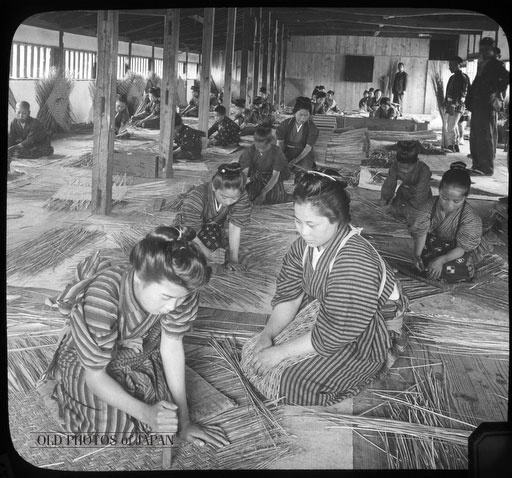
Japanese women in a basket weaving factory
The bourgeoisie were not the only class to emerge thanks to capitalism - there was also the working class. We see different cultures and identities emerge consequently. Prior to industrialisation, women could find some form of emancipation thanks to textile works - they could make their own textiles in their home. The factory saw the means of production taken out of their hands which limited their agency. We will explore the idea of 'separate spheres' more when we look at the origins of feminism in a future post, but it is important to reference it here. This was an idea, primarily in Europe and the US but it was also adopted in Japan, that there were two spheres: the public, of work and politics dominated by men, and the private, of the home and family dominated by women. This was less the case for working class women - working class women, and children, regularly worked in factories or other industries. In 1882, women comprised three-quarters of textile workers in Japan, and these figures were replicated across industrial societies. Factory life was hard regardless of age and gender - to save costs owners allowed poor and dangerous conditions to flourish. Injury and death was common, and reformers largely focused on child and female labour when criticising poor working conditions. In 1911 the Triangle Shirtwaist Factory in New York burnt down killing 146 garment workers, of which 123 were women, which caused outrage and the laws passed in order to improve work conditions. Women were not passive in this. E. Patricia Tsurumi has discussed how women resisted sexual abuse and poor work conditions through go-slows, strikes, running away (over 60% of Kanebo mill workers between 1905 and 1915 did so), and singing insulting songs: The owner and I are like spinning machine thread/ Easily tied, but easily broken. 

New Cultural Worlds
Carnegie Hall in 1910
An emergence of a new class with purchasing power created a new and exciting world. As argued by Eric Hobsbawm, the home 'was the quintessential bourgeois world, for in it...could the problems and contradictions of his society be forgotten or artificially eliminated'. The domestic sphere emerged to ensure that the home remained central in society - this is especially prevalent in Japan when Meiji reformers after 1868 cast the nation as one family. In Britain, Christmas was redeveloped to be about family just as much as Christ; Christmas trees, songs, and dinners were meant to symbolise the warmth of the family. The public, both bourgeois and working, looked to Queen Victoria - firmly out of political life the royals served as something to emulate, so the German Prince Albert introducing the German tradition of Christmas trees to his family was adopted by everyone. Wealthier women could work before marriage in clerical employment, but they were expected to give this up when they got married. It is notable that these women also became reformers. City life was seen as breeding sin, vice, and poverty, so they formed organisations to tackle this. The Women's Christian Temperance Movement in the US is a good example. The first suffragettes, like Emmeline Pankhurst in the UK, were also moneyed women, and they aimed to use their position to gain the vote. Clothing has always been used to signify class, and capitalism continued this trend. However, new consumption allowed those who could afford it to dress like the wealthy. This was even the case at the fringes of capitalism. Jean and John Comaroff have discussed how, before colonial rule, Tswana royals in southern Africa controlled access to European clothing and wore it to meet with Europeans. Entertainment could now be purchased. Poor and wealthy went to shows, sometimes together to the scandal of society, and holidays emerged. The Rokumeikan in Japan became a scene where elite could sip drinks and do the waltz combining European and Japanese formal wear. New and old elites started making contacts for the first time - aristocrats had to allow nouveau riche into their circles, and they became the patrons of culture. Andrew Carnegie sponsored the construction of venues, like Carnegie Hall, and even expeditions to discover dinosaurs. 1916 saw oil tycoon John Rockefeller become the first billionaire, and financier J.P. Morgan, supposedly, joked that, when asked how much it costs to own a yacht, replied 'if you have to ask, you can't afford it'.

Empire and Capitalism
Khama III, Chief of the Bamangwato and Sir Albert Spicer, London Missionary Society Treasurer
Russian revolutionary Vladimir Lenin famously stated that imperialism was the final stage of capitalism, Hannah Arendt argued they marched hand in hand. Regardless, empire and capitalism were intrinsically linked. Colonial rule saw the economies of colonised societies to geared towards the export of raw materials and the import of finished goods - as late as the 1950s Britain tried to make nut production the crop of Tanganyika in east Africa. Although it is an exaggeration to say that Britain broke the thumbs of Bengali textile weavers, Britain did break Bengal's textile production to prevent competition. As we saw when we looked at British rule in India, key parts of the Indian continent was converted to the production of raw materials, primarily cotton, in what Romesh Chandra Dutt in 1902 described as the 'drain theory'. Britain had prevented the development of an Indian economy 'draining' it of resources. This had devastating direct consequences. When crops failed, as they were prevented from growing crops on land for cotton or saffron, it created devastating famines - a tenth of Orissa's population died in the 1865-6 famine, 3.5 million died in Madras and a million in Mysore in the devastating 1876-8 famine. While capitalism prevented famines during crop failure in Europe, it made it far worse in India. Capitalism was often used as a way for colonial expansion - Britain used opium to edge its way into China, and Britain and France used loans to Egypt in order to enforce their hegemony, and the US used companies to oust governments in Central America. Meanwhile, Leopold II of Belgium formed a company to rule the Congo for him. Today's Democratic Republic of the Congo has its shape due to traders setting up stations along rivers to best monopolise rubber and ivory. The Congo Free State, similarly, saw some of the worst atrocities in colonialism where Congolese were brutally enslaved, beaten, and killed in order to extract resources. A leather whip, the viboko, became the symbol of Belgian rule as Congolese were forced to work over 80 hours a week in poor conditions. Elsewhere, there were hopes to bring the colonised into a capitalist market. The work of the Comaroffs is especially interesting in this regards. The London Missionary Society (LMS) in southern Africa particularly tried to introduce consumerism, linking consumerism to Christian faith. Tswana were encouraged to buy European clothing as a sign of faith, and Tswana, in turn, adapted it for themselves - children and unmarried women wore pre-Christian clothing and wore European later. I want to discuss this more in our next World History post as we've just scratched the surface of colonialism and imperialism here.

The Origins of Modern Socialism
Marx and Engels
Conditions created by capitalism, although it brought benefits, it also brought intense suffering. Poverty, disease, and alcoholism were just some of the problems which capitalism either caused or accentuated. There were reformers who hoped to relieve the poor, such as York confectioner Seebohm Rowntree, but others rejected socialism entirely. Instead of private individuals owning means of production workers should own it - this was socialism. As we've already mentioned, some form of socialism have existed in some form across the world and history - Peruvian Marxists have argued that the Inca were 'feudal communists' as they did not use markets. Regardless, the first of the modern socialists emerged with the 'Utopian socialists' like Charles Fourier, Robert Owen, and Henri de Saint-Simon, although George Lichtheim describes them as 'doctrinaires' instead. These socialists argued that self-governing communities should be formed based on egalitarian ideas - Fourier is believed to have coined the term 'feminism' and advocated for homosexual emancipation. However, utopian socialists were later criticised by a new generation of socialists for being utopian. The most notable of these were the 'scientific socialists' of Karl Marx and Friedrich Engels. Engels in particular in Socialism: Utopian and Scientific (1880) argued that utopians created new ideas with no practical way in achieving them, whereas 'scientific socialists' looked at real world conditions and developed theory from there. Marx was born into a German Jewish family (which converted to Christianity to avoid antisemitic laws), and had a long history of radical politics. He was influenced by philosopher Georg Wilhelm Hegel and adapted his ideas of dialectical materialism. Human history was a conflict of classes driven by ideas, a thesis combats and antithesis before reaching a synthesis which, in turn, forms its own antithesis. Engels was the son of a German factory owner, and became upon seeing the horrific conditions of his father's Manchester factory became radicalised. Mary Burns, an Irish worker in his father's factory, greatly influenced his views, and in 1845 wrote The Condition of the Working Class in England. Marx and Engels became close friends and regularly worked together joining the Communist League. Inspired by the 1848 revolts Marx and Engels wrote their most influential piece - The Communist Manifesto - setting out their ideas in a way for workers to easily access.

In France, a different theorist emerged called Pierre-Joseph Proudhon who rejected the idea of the state entirely - Marx and Engels had advocated the proletariat, the producing class, seizing the state in order to bring about socialism. In 1840 his text What is Property? declared that 'Property is Theft', and that rejecting property and state could the proletariat be liberated. He declared, as well, that he was an 'anarchist', but, unlike later anarchists, he believed that markets could exist under socialism. Also, he was very antisemitic and sexist, so much so that he was denounced by many other anarchists, although he did state that 'In my ideal society I would be guillotined as a conservative'. Meanwhile, a Russian theorist, who became involved in the 1848 Czech Rebellion, made his way to France - Mikhail Bukanin. Bukanin was influenced by Proudhon but rejected the idea of having a market in any form. Louis Blanqui, meanwhile, controversially argued that a small cabal should take control of the state to aid the working peoples. Despite their clashes, Marx and Bukanin helped form the International Workingmen's Association, better known as the First International, in 1864 uniting all socialists and trade unions in order to plan out revolution. However, it was deeply divided and women were barred until 1865. In 1867 Harriet Law became the first female member, but she remained its only female member.

The Paris Commune

1871 proved to be the most important year in leftist history. Louis Napoleon declared war on Prussia but was roundly defeated and abdicated leaving France in disarray. The peoples of Paris rose up, and a crowd of women marched upon the local barracks seizing cannons and weapons. Leftist journalist Louis Delescluze and Polish officer Jaroslaw Dabrowski were elected to lead the newly formed Paris Commune. Proudhonists, Blanquists, libertarian socialists, and scientific socialists made up the ideology of the Paris Commune, and this is shown by their policies. Guillotines were symbolically burnt to show a break with the violent French Revolution, the Church and state were declared to be separate, the Louvre was turned into a arms factory, the Vendome Column depicting Napoleon was torn down, and workers given control over companies. Women were integral to the Commune where Louise Michel became one of the most influential figures in the revolt, and the Union des femmes pour la défense de Paris et les soins aux blessés was formed by socialist bookbinder Nathalie Lemel and Russian exile Elisabeth Demitrieff. The Women's Union demanded women's education, divorce, suffrage, and an end to capitalism. The Commune was very international - French, German, Russian, Spanish, and even Algerian individuals joined together in protecting the Commune. However, when the French Third Republic got together intense street fighting began and the Commune was brutally crushed. Afterwards, the First International became heavily divided over why the Paris Commune failed. Marx in The Civil War in France (1871) argued that the communards were too quick to dismantle the state, if they had taken it over they could have better defended themselves. Meanwhile, anarchists like Bukanin argued that it failed as they left too much of the state intact - no one took over the Bank of France which then funded the French army. Marx kicked the anarchists out of the First International, and since then the left has been divided between Marxists and anarchists. Prussian chancellor Otto von Bismarck commented that 'Crowned heads, wealth and privilege may well tremble should ever again the Black and Red unite!'

Developments with Socialism after 1871
A collection of Japanese anarchists including Osugi Sekae and Ito Noe
Anarchism and what would become Marxism would continue to develop after 1871. Marx and Engels continued expanding their ideas - Engels released his Socialism: Utopian and Scientific and Marx would eventually release his very influential Das Kapital. Marx's ideas were always changing and he rejected the term 'Marxism' as it implied that he had the answers - he believed people should start with his ideas. Marx and Engels were also keen to dispel cult of personalities which occasionally cropped up. However, the rift with the anarchists was never healed and anarchists were barred from the Second International when it was formed in 1889. Anarchism similarly developed - a Russian aristocrat Peter Kropotkin - would become the most influential anarchist thinker helping influence anarcho-communism, and Italian anarchist Errico Malatesta helped influence anarcho-syndicalism. Marxism and anarchism went beyond their roots with European male thinkers as new thinkers and activists applied their ideas to new situations. For example, Russian Marxist Alexandra Kollontai blended Marxism and feminism, and is seen as the founder of Scandinavian feminism for her activism in the region during World War One. Similarly, Rosa Luxemburg and Clara Zetkin in Germany would try and combat sexism in the labour movement, and try to apply class emancipation to the suffrage movement. Across the world activists blended local ideas with new ideas - Peter Marshall has argued that Mohandas Gandhi was even inspired by anarchism. Swami Vivekananda reinterpreted the Bhagavad Gita to craft it as a libertarian text which future anarchists, like Aurobindo Ghose, would build upon. Japanese censors prevented the translation of Marxist texts, but Kotuku Shusui managed to escape censors by translating anarchist texts - it took until the 1920s for Lenin to be translated into Japanese! Kotuku asserted that anarchism fit with Daoism and Zen Buddhism helping form the paper Heimin. Feminist Ito Noe was an influential writer for the paper Bluestockings calling for female and class emancipation. In the 1920s the anarchist movement was brutally crushed, Ito was strangled in prison, so Marxism replaced anarchism, but, even today, the Japanese Communist Party has strong anarchist leanings. In 1905 the influential 'One Big Union' the International Workers of the World (IWW) was formed in Chicago. Founded by figures like Irish socialist James Connolly, Jewish thinker Emma Goldman, and 'Big Bill' Haywood, among others, it was inspired by anarchist thought to unite the labour movement. Russia was a site of both Marxist and anarchist movements, but the most significant figure to come from this was Vladimir Lenin. A history of secret societies due to state repression influenced what would become Marxist-Leninism. Lenin argued that the workers had to be guided by a revolutionary vanguardist party, as Lenin would succeed in establishing the Soviet Union Marxist-Leninism would become the dominant Marxist thought among twentieth-century communist parties.

Conclusion
The nineteenth and twentieth centuries have been greatly shaped by the clash between capitalism and socialism. Capitalism broke the old feudal world and forged a new revolutionary system, but, in doing so, created suffering for the masses. Socialism emerged as a force to resist and liberate the masses. Joyce Appleby argued that capitalism was a cultural system just as much as an economic one - as we have seen this is accurate. Capitalism formed new identities and cultural practices, as argued also by Marx and Engels the means of production forms a superstructure which all things in society comes from. Equally, socialism developed its own culture - as seen in the Paris Commune egalitarian and emancipatory ideas influenced a desire to emancipate workers and women. The anarchist-Marxist divide continues to divide the left - they even fought one another during the Russian and Spanish Civil Wars. These ideas continue to shape our lives today, and many of the debates we have now have been argued for the last century and a half. When we see a pop-up ad on the internet its origin lies back with Adam Smith in 1776, and the means to critique it with Marx.

The sources I have used are as follows:
-Eric Hobsbawm, The Age of Capital, 1848-1875, (London: Abacus, 1975)
-Joyce Appleby, The Relentless Revolution: A History of Capitalism, (New York, NY: W.W. Norton & Company, 2010)
-Adam Smith, An Inquiry into the Nature and Causes of the Wealth of Nations, (New York, NY: MetaLibri, 1776/2007)
-Karl Marx and Friedrich Engels, The Communist Manifesto, (London: Penguin, 1848/2015)
-Karl Marx, Das Kapital, Volume 1, (London: Redwood Press, 1887/1971)
-Friedrich Engels, Socialism: Utopian and Scientific, (London: Progress Publishers, 1880/1970)
-John and Jean Comaroff, Of Revelation and Revolution, Volume 2: The Dialectics of Modernity on a South African Frontier, (Chicago, IL: University of Chicago Press, 1997)
-George Lichtheim, A Short History of Socialism, (London: Weidenfeld & Nicolson, 1970)
-Colin Campbell, The Romantic Ethic and the Spirit of Modern Consumerism, (Oxford: Basil Blackwell, 1987)
-T.C.W. Blanning, 'The Commercialization and Sacralization of European Culture in the Nineteenth Century', in T.C.W. Blanning, (ed.), The Oxford Illustrated History of Modern Europe, (Oxford: Oxford University Press, 1996), 120-147
-E. Patricia Tsurumi, 'Female Textile Workers and the Failure of Early Trade Unionism in Japan', History Workshop, 18, (1984), 3-27
-Peter Marshall, Demanding the Impossible: A History of Anarchism, (London: Fontana Press, 1993)
-Kristin Ross, Communal Luxury: The Political Imaginary of the Paris Commune, (London: Verso, 2015)

Thank you for reading. Next time we will look at imperialism and colonialism, and how that affected colonised peoples. For other World History posts we have a list here. For future blog updates please see our Facebook or catch me on Twitter @LewisTwiby.

Sunday, 5 May 2019

Left-Wing and the 'Other' History: The Haymarket Affair


The Haymarket Affair was one of the major turning points in labour and leftist history in the United States. An explosion at a labour rally in Chicago killing seven police officers and four civilians led to a red scare, and a deep lasting impact on the labour movement. Today we shall look at the Haymarket Affair, the background to the Affair, and the impact that it had on the American labour movement.

American Labour before 1886
The Knights of Labor's logo
Industrialisation in the United States resembled industrialisation elsewhere - workers had to work long hours in dangerous conditions in return for little pay. By 1890 12% of the American population owned 80% of the country's wealth; in contrast, during the 1880s 45% of workers earned barely enough to keep themselves above the poverty line. A fifty-nine hour work week was common for many industrial labourers, and the periodic economic depression, such as the devastating 'Panic of 1873', could cause instant unemployment. At a drop of a hat in the 1880s just under a third of workers faced the risk of unemployment. Labour leader Samuel Gompers once claimed that a manufacturer had once declared that, 'I regard my employés as I do a machine, to be used to my advantage, and when they are old and of no further use I cast them in the street'. It is hard to verify this claim, Gompers never stated which manufacturer stated this, but it is easy to see why these statement's may have been made. Following the end of the US Civil War in 1865 industrial production in the north boomed: 1874-1882 Bessemer steel ingot production jumped from 191,933 tons to 1,696,450; in Pennsylvania from 1875-1885 steel production rose from 148,374 to 1,109,034 tons; and the production of iron and steel rails doubled from 1874 to 1880. This expansion, when times were good, meant that jobs were in high demand - if you quit or could not keep up there was someone to take your place. Fairly often exploitation was incorrectly blamed on immigration. Factory owners hired desperate labourers from China, Europe, and Mexico who were willing to work for lower wages and longer hours in poorer working conditions; instead of blaming exploitative industrialists nativist workers, and labour organisers, blamed immigrants. Sections of the movement could be very antisemitic - August Spies blamed 'Jewish capital' on exploitation.

However, groups started emerging, primarily trade unions, to resist exploitation. As argued by Bruce Nelson, the American labour movement had no real history of labour agitation as their counterparts in Europe had. In 1878 a leftist publication named The Socialist argued that, 'With us there is no necessity for an appeal to arms involving a bloody revolution. We have a Declaration of Independence and a Constitution, and under them we have the right, now enjoyed for a century, of promolgating [sic] our ideas and of establishing a party in support of them'. US labour, consequently, had nativist and conservative streaks, and radical anarchist and Marxist streaks. While the International Workers of the World (IWW), formed in 1905, was co-founded by figures including Irish women, Jewish eastern Europeans, and a mixed-race woman, the Knights of Labor (KOL) supported the Chinese Exclusion Act. This diversity of ideology largely existed due to the diversity and size of the labour movement. The KOL had managed to get 700,000 members by the Haymarket Affair in 1886, the Great Railroad Strike of 1877 managed to cripple several states, and the Molly Maguires (an Irish union) in Pennsylvania terrorised mine overseers. One thing that united all unions was the desire for an eight-hour work day, and that became the focus of the movement before 1886.

Chicago and Anarchism
In the industrial Chicago the labour movement naturally flourished. A multi-ethnic and polyglot crowd between 20,000 and 40,000 people came to the Exhibition Building in March 1879 to celebrate the anniversary of the Paris Commune. In 1880 40.7% of the population was foreign born - the overwhelming majority being German making up a third of the populace. Employment was also divided along nativity; white-collar jobs were dominated by those who were native-born whereas immigrants dominated blue-collar work. There was often little interaction between communities, the German-republican Illinois Staats-Zeitung in 1871 stated, 'Between the Germans and the Irish, the Germans and the Americans there is, on the whole, little social intercourse'. Following the crushing of the 1848 Revolution German radicals had fled to the US, and they brought with them their ideas. As early as 1854 Chicago's first socialist paper was founded, the German-language Der Proletarier, and by 1865 the First International had its own section in the city. Throughout the 1870s openly socialist parties had been formed in Chicago, and in 1883 the major socialist party, the Revolutionary Socialist Party, joined the anarchist International Working Peoples' Association (IWPA). The campaigns for an eight-hour work day were particularly strong in Chicago due to the vibrancy of the labour movement. 
Albert and Lucy Parsons
Anarchists were particularly prevalent in Chicago. We'll briefly look at some of the leading anarchists here. Two key figures was the husband and wife pair of Albert and Lucy Parsons. We know more about Albert's upbringing than Lucy - born in 1848 he was the youngest of a family of ten, and surprisingly he originally served as a Confederate soldier. Returning to civilian life he started criticising slavery, white supremacy, and secession after seeing Confederate general James Longstreet start supporting Reconstruction, his studies at Waco University, and the violence of the Ku Klux Klan. Opening a Radical Republican paper, The Spectator, he began campaigning for equality for whites and African-Americans. Meanwhile, Lucy Gonzalez was an orphan at the age of three, and took pride in her Mexican-Creek indigenous heritage - she once stated that 'I am one whose ancestors are indigenous to the soil of America' to a crowd of London socialists. However, she was regularly described as 'Negro' or 'mulatto' by papers in Waco and Chicago - her biographer Carolyn Ashbaugh concluded that Lucy was born a Texan slave. Regardless, Albert and Lucy rebelled against post-war white supremacy and married in Austin in 1872 - due to Lucy's indigenous ancestry they could marry. However, due to their politics they were forced to leave Texas for the north in 1873 - Albert's brother stated that 'He was practically a political exile. He had either to fight every day or leave'. Moving to Chicago they became heavily involved with the local labour movement.
August Spies
The Parsons were not the only important anarchists in 1880s Chicago. August Spies was born in Germany in 1855 but migrated to New York in 1872 when his father died. Working alongside other immigrants he realised that the 'Land of Opportunity' was severely flawed, and seeing police brutality against police meant that he fully embraced socialism. While in Chicago he became one of the major editors of the Chicago Arbeiter-Zeitung, and his disappointment with the Socialist Labor Party drew him to anarchism. Spies was not the only German to be active in the Chicago anarchist scene - Adolph Fischer from Bremen became one of Arbeiter-Zeitung's major contributors, Michael Schwab became the paper's deputy editor, Louis Lingg was an active union member, and, after his release from British prison in 1882, leading anarchist Johann Most arrived in the US. Although operating from New York Most built up ties with radical German emigres, such as Spies, in Chicago. Germans were not the only migrants to become active in the movement. English migrants weren't discriminated against as other migrants, but that did not prevent Samuel Fielden from engaging in workers' liberation. A Methodist pastor he became the treasurer for the International Working Men's Association, and wrote for the Arbeiter-Zeitung.

The Haymarket Affair
The Arbeiter-Zeitung's call to the rally
In 1885 the powerful iron moulders union had threatened a strike at the McCormick plant; the plant owners brought in private police and strikebreakers, including the infamous Pinkertons, to clash with the union. Fearing a costly clash, the mayor and major business leaders got the company to settle on the union's terms - this peace lasted until February when the introduction of new machinery weakened the union. This emboldened the company to announce that the factory would operate on a nonunion basis causing a new strike. On May 3, 1886 four strikers were killed by police enraging the labour movement. Already the unions were emboldened thanks to May Day. Two years prior it was decided that on May 1 a general strike would occur across the country to protest for an eight-hour workday - in Chicago Albert and Lucy Parsons had led a march of 80,000 in favour of this. The strike and protests had been peaceful, so August Spies was disgusted upon seeing the one-sided violence. He published a leaflet denouncing the murder, but his compositor, Hermann Pudewa, added 'Revenge' to the text without consulting Spies. Published in English and German (although not the other major language Czech) it read:
Revenge! Workingmen to Arms!!! Your masters sent out their bloodhounds - the police... They killed them to show you, 'Free American Citizens', that you must be satisfied and contented with whatever your bosses condescend to allow you, or you will get killed!
The German edition was even more direct calling for 'Slaves... avenge the atrocious murder that has been committed upon your brothers today and which will likely be committed upon you tomorrow'. Schwab in Arbeiter-Zeitung wrote that 'The war of the classes is at hand. Yesterday workingmen were shot down in front of McCormick's factory, whose blood cries out for revenge!'. The next day, May 4, at 8.15 PM at the Haymarket several speakers arrived to speak for a crowd of over 2,000, however, the speakers believed a lot more would come. Spies gave the first speech, in English, saying 'There seems to prevail the opinion in certain quarters that this meeting has been called for the purpose of inaugurating a riot, hence these warlike preparations on the part of so-called "law and order". However, let me tell you at the beginning that this meeting has not been called for any such purpose. The object of this meeting is to explain the general situation of the eight-hour movement and to throw light upon various incidents in connection with it'. Despite starting radical Spies' speech toned down his rhetoric, and Albert Parsons followed him declaring that the only hope of workers was with socialism. The Haymarket rally remained peaceful. Even the mayor, Carter Harrison, felt safe enough to be in the crowd; this may have been as he was more pro-union compared to past mayors. Parsons, in his speech, even denounced attacking individuals. When he mentioned railway speculator Jay Gould causing someone to yell 'Hang Him!' Parsons responded by stating, 'This is not a conflict between individuals, but for a change of system, and socialism is designed to remove the causes which produce the pauper and the millionaire, but does not aim at the life of the individual...Kill Jay Gould, and like a jack-in-a-box another or a hundred others like him will come up in his place under the existing social conditions'.
The type of bomb used at Haymarket
Shortly after 10 PM when Parsons finished his speech Samuel Fielden started his own speech, and the mayor started to head home with other members of the crowd. Parsons, Lucy, their children, and French anarchist Lizzie Holmes even started backing out of the limelight. As Fielden's speech was seen as being more inflammatory, the police decided to close the rally down. However, disaster struck. As Fielden stepped down from the stand a bomb flew over their heads and into the ranks of the police. The bomb was so powerful that windows were shattered for blocks around. Henry Spies reportedly asked 'What's that?' for August to reply 'A cannon, I believe'. Mayor Harrison had been getting ready for bed when the bomb went off and he originally thought a thunder storm had broken out. The startled police started firing their pistols adding to the casualties. Sixty-seven casualties came from the Haymarket Affair - seven officers were killed (most died of their wounds days later), four civilians were killed, and the rest were injured. According to Paul Avrich, most of the injuries had been thanks to the shots fired by frightened police officers. The Chicago Tribune had even stated that the police had been 'Goaded to madness' and were 'unable to distinguish between the peaceable citizen and the Nihilist assassin'. Despite the bomb, in the words of Avrich, 'it was the police and not the anarchists who were the perpetrators of the violence at Haymarket'.

After the Bomb
Drawings of the seven sentenced to death
A red scare erupted after the Haymarket 'Riot'. It was made worse thanks to nativist, anti-immigrant hysteria - ironic considering that the same year the Statue of Liberty was erected in New York. Germans and Bohemians were directly blamed for the violence and subjected to increased police repression. Of the eight who were arrested for the bombing seven were immigrants - showing anti-German hysteria six of them were German. We still do not know who was behind the bomb. Parsons and the Workmen's Advocate believed an agent provocateur was behind the bomb in order to destroy the eight-hour movement, the Advocate proclaimed 'that the bomb was thrown by a Pinkerton'. The police, and recently historian Timothy Messer-Kruse, blamed anarchist Rudolph Schnaubelt, the brother-in-law of Michael Schwab, who later fled to avoid arrest. Meanwhile, the police was arresting anarchists and raiding pro-eight-hour movement offices. The Arbeiter-Zeitung was one such to be raided. Eight anarchists were put on trial for being accessories to the murder. They were: Albert Parsons, Samuel Fielden, Adolph Fischer, Michael Schwab, August Spies, militant radical George Engel, Arbeiter-Zeitung writer Oscar Neebe, and known bomb-maker Louis Lingg. Of those put on trial, only two were present at Haymarket that night, and Neebe was even having a cards game night when the bomb went off. Their trial was done in an atmosphere of prejudice where the judge showed open hostility, and the media whipped up anti-immigrant frenzies. 

All eight anarchists were declared guilty, where seven were sentenced to death, and Neebe to fifteen years. This outraged the labour movement worldwide drawing condemnation from figures as widespread as the writer Oscar Wilde to playwright George Bernard Shaw. Appeals were made and the governor decided to reduce Fielden's and Schwab's executions to life imprisonment, and Lingg commit suicide on November 10 via a smuggled explosive. On 'Black Friday', November 11 1887, the four remaining individuals - after saying bye to their families and singing Marseillaise - were executed via hanging. In 1893 the progressive German-born John Peter Altgeld was elected governor of Illinois, and he was very sympathetic to the labour movement. According to leading anarchist Mother Jones, Altgeld 'committed political suicide by his brave action' of pardoning the three remaining Haymarket anarchists. In his own words, he described them as victims of 'hysteria, packed juries, and a biased judge'

Aftermath and Legacy
Parsons in later life
Thanks to the Haymarket Affair the eight men were martyred, the 'Haymarket Martyrs', and they became the symbols of the labour movement. The Haymarket Affair initially weakened the labour movement. Middle-class support for workers and anarchism started to diminish as it was seen as being by foreign, violent, radicals. Police captain Michael Schaak, who had been in charge of the investigation of the bomb-throwing, in 1889 wrote Anarchy and Anarchists accusing anarchists of being as bloodthirsty and foreign to generate hatred to both anarchists and immigrants. The somewhat conservative KOL saw most of its members leave, so much so that the Panic of 1893 resulted in the destruction of the union. However, the blatant abandonment of judicial process divided American society and enabled the martyrdom of the eight. Lucy Parsons remained a very significant figure in the labour movement, and she joined with other leading leftists, including James Connolly whom we saw when we looked at the Easter Rising, to form the IWW. Unions managed to shake the nation during the 1892 Homestead Strike and the 1894 Pullman Strike, however, Altgeld's support of both the Pullman strikers and the Haymarket martyrs made conservative opponents smear him. Future president Theodore Roosevelt said that he 'condones and encourages the most infamous of murderers' and 'would substitute for the government of Washington and Lincoln a red welter of lawlessness and dishonesty as fantastic and vicious as the Paris Commune'. Regardless, the Haymarket Affair remained a key point of reference for the American Left. Lucy Parsons ensured that the labour movement continued, and through the twentieth century Chicago has continued its history of radical politics.

The sources I have used are as follows:
-Paul Avrich, The Haymarket Tragedy, (Princeton, NJ: Princeton University Press, 1984)
-Bruce Nelson, Beyond the Martyrs: A Social History of Chicago's Anarchists, 1870-1900, (New Brunswick, NJ: Rutgers University Press, 1988)
-Leon Stein and Philip Taft, (eds.), The Accused and the Accusers: The Famous Speeches of the Eight Anarchists in Court, (New York, NY: Arno Press, 1970)
-'The Haymarket Tragedy', in Mother Mary Jones, The Autobiography of Mother Jones, 1925, Marxists.org
-Philip Foner, (ed.), The Autobiographies of the Haymarket Martyrs, (New York, NY: Humanities Press, 1969)
-Henry David, The History of the Haymarket Affair: A Study in the American Social-Revolutionary and Labor Movements, (New York, NY: Russell and Russell, 1936)

Thank you for reading, and I hope you found it interesting. For other Left-Wing and 'Other' posts please see our list. For future blog updates please see our Facebook or catch me on Twitter @LewisTwiby.