Search This Blog

Sunday, 23 February 2020

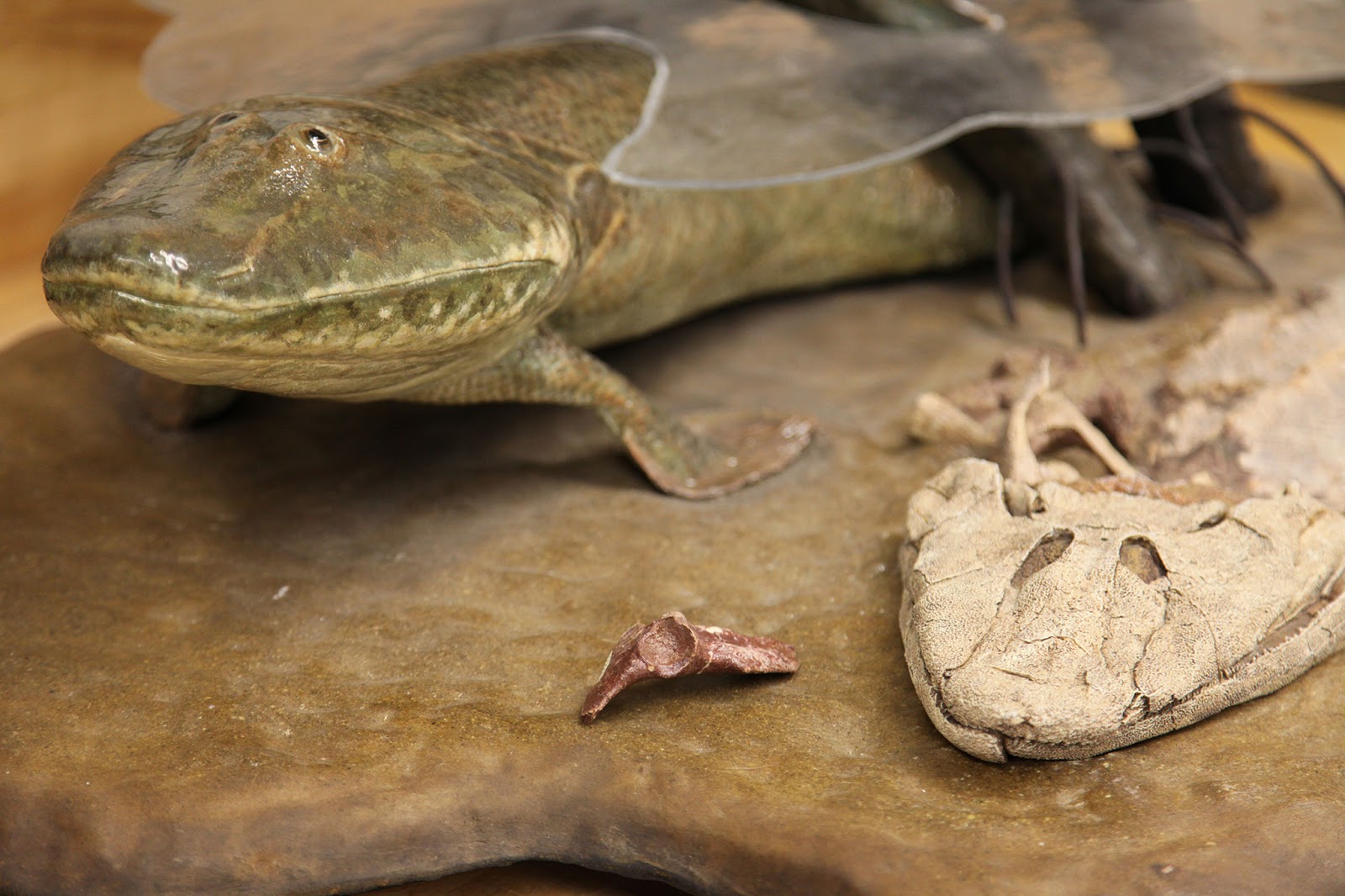
Paleo Profiles: Tiktaalik

A reconstruction and skull, from National Geographic
It is rare in palaeontology that transitional fossils are found - these are the fossils which show how organisms evolve over time. Among some of the famous ones include the Archaeopteryx, which showed how dinosaurs evolved into birds, and Darwinius, which helped show where apes branched off from lemurs. For a long time scientists have known that there must be transitional animals between fish and amphibians, but the question was what would they look like? Then, in 2004, one transitional fossil was found: Tiktaalik

Discovery and Fossils
Tiktaalik was first discovered in 2004 way in the frozen north of Canada on Ellesmere Island. Modern day Ellesmere Island is not a place you would imagine to find a transitional fish fossil - the geomagnetic north pole can be found on the island. However, a group of palaeontologists discovered this important fossil and fully described it in 2006. This group, (comprising of Neil Shubin, Edward Daeschler, and Farish Jenkins), named it Tiktaalik roseae; Tiktaalik comes from an Inuktitut word roughly meaning 'large freshwater fish', and was actually suggested by elders from the local Inuit Council, and roseae was chosen to honour an anonymous donor. After the initial discovery this alerted palaeontologists to the importance of Ellesmere Island, and successive digs have found other Tiktaalik remains allowing this strange animal to be better understood.

Biology
This animal has been described as a mixture of a salamander and a fish. Although gills do not fossilise the bony structures which support them do, and on the crocodile-like head of the Tiktaalik they took the form of holes called 'spiracles'. This gives us the indication that it could live underwater, but the layout of the ribs, and a secondary use of the spiracles, gives an indication that it also had lungs. Fish have a swim bladder which is full of air to keep them buoyant, but these swim bladders can evolve to become larger becoming a lung over millions of years. Modern day lungfish have this adaptation - they can exist a long time out of water thanks to their swim bladders evolving to become more like a lung which land vertebrates (tetrapods) have. Tiktaalik could then go on land and the water, and its fins helped it do so. Unlike the fish we know today fish of the Devonian, when Tiktaalik lived, had bones in their fins which form a 'hand' you might see in modern whales or the mosasaurs. These were the lobe-finned fish, today there are only eight species of them - the two coelacanths and the eight lungfish species.
A West Indian coelacanth
These lobe-fins will help answer why the Tiktaalik could move onto land. Later fossil finds have managed to unveil the fish's pelvis and tail, unlike its other fish cousins Tiktaalik had a larger pelvis and tail allowing greater movement. This allowed it to move onto land, but the pelvis was not too strong, so it was largely confined to the water side. Shubin, Daeschler, and Jenkins have advocated for a 'front wheel drive hypothesis' - like modern mudskippers it would use its front fins as a way to prop itself up while on land. The ribs were strong for this reason as it required thicker ribs to support its organs outside of the water. Finally, we have the neck. The spiracles allowed Tiktaalik to lose the bony structure which normally protected the gills, so this gave the Tiktaalik a neck with the ability to look around without completely moving its entire body. Although primitive, Tiktaalik and similar animals, one similar fish can also be found in Poland, set the stage for the body plans of amphibians, reptiles, birds, and mammals. This could be used as a way for it to search for prey, or possibly spot predators. At a metre long it was sizeable but was dwarfed by other fish as seen below.
A seize chart from Prehistoric-Wildlife.com
When and Where
Ellesmere Island today
As we've already mentioned, Tiktaalik has so far only been found on Ellesmere Island in the very north of Canada. The North East of North America is well known for Devonian lobe-finned fish and the first amphibians. In Quebec there is the closely related Eusthenapteron, which possibly was an ancestor to Tiktaalik, in Pennsylvania there was the giant lobe-finned fish Hyneria and the salamander-like Hynerpeton, and in Greenland there was a possible descendant of Tiktaalik, another salamander-like amphibian called Icthyostega. Tiktaalik has currently been found from fossil sites dating to 375 million years ago during the Devonian period. During this time the first large plants grew on the land, and invertebrates had already conquered the land. The Devonian has been known as 'The Age of the Fishes' for the explosion in the diversity of fish: sharks became common, there were the lobe-finned fish, and armoured fish called placoderms. Oxygen was also a lot less compared to present-day air - possibly around 75% less than today. This possibly explains why Tiktaalik moved onto land. The diversity of plants on the land would die, get washed into the ocean, and start decomposing which increasingly stripped the oceans of oxygen. As a result, any fish which could breathe on land and in water had an advantage. Eusthenopteron had spiracles on the top of its head instead of on the side of its head like other fish (even today), so it could go to the surface and breathe. Consequently, Tiktaalik evolved from lobe-finned fish like Eusthenopteron to take advantage of this.

Habitat
While it could go on land, the Tiktaalik was still very dependent on the water to survive. If you travelled back 375 million years to spot a Tiktaalik you would have to search riverbeds. Shubin and Daeschler have theorised that it would live in the first swamps, as well as streams and ponds, resting on edge of the water. Most of its time would be spent in the water - quite possibly it would be an ambush predator. Like crocodiles, it would lay on the water's surface, or the riverbed, waiting for prey, and then lunge with its powerful tail and pelvis after an unfortunate fish or bug. As other, larger fish were constrained to the water Tiktaalik would have gone to the shore as a way of effortlessly hiding from them. This fish's ancestors, such as Icthyostega, would start evolving to be more and more on land until the Carboniferous period when the first reptiles would permanently leave the water.

The sources I have used are as follows:
-'Tiktaalik', Prehistoric-Wildlife.com, [Accessed 20/02/2020]
-Dan Vergano, 'Our Fishy Ancestors Had Fins made for Walking', National Geographic, (14/01/2014), [Accessed 20/02/2020]
-Jason P. Downs, Edward B. Daeschler, Farish A. Jenkins, Jr. and Neil H. Shubin, 'The Cranial Endoskeleton of Tiktaalik roseae', Nature, 455/7215, (2008)
-Jennifer Clack, 'The Fish-Tetrapod Transition: New Fossils and Interpretations', Evolution: Education and Outreach, 2, (2009), 213-223
-Neil Shubin, Your Inner Fish: A Journey Into the 3.5-Billion-Year History of the Human Body, (New York: 2008)
-Neil H. Shubin, Edward B. Daeschler, and Farish A. Jenkins Jr, 'Pelvic girdle and fin of Tiktaalik roseae', PNAS, 111:3, (2014), 893-899
-PBS Eons, 'When Fish First Breathed Air', YouTube.com, (19/06/2018), [Accessed 20/02/2020]

Thank you for reading, for our other Paleo Profiles we have a list here. For other blog updates please see our Facebook or catch me on Twitter @LewisTwiby.

Sunday, 16 February 2020

World History: Australia and New Zealand

Australian Gold Diggers
Throughout the nineteenth century, and last time when we looked at colonialism, new forms of states emerged, including the new settler colonies of Aotearoa/New Zealand and Australia. Coming after the older settler colonies in the Americas new settler colonies emerged in Oceania, and Kenya and Zimbabwe. Despite being colonised by Britain around the same time we will see the major differences which emerged in these colonies. This occurred through various reasons ranging from geography to the conditions of the pre-colonial regions. A hint at a possible World History 2 I aim to look at these pre-colonial societies, but that is another discussion for a long time in the future. Instead we'll go over a basic summary here.

Australia and Aotearoa before Europe

The landmass which we now call Australia has been inhabited by people for over 30,000 years, and possibly as far back as 65,000 years - we discussed this all the way back in my first year of university with our first World History post. The site of Lake Mungo, from around 40,000 years ago, exhibits burials and some of the oldest cremations indicating that prehistoric indigenous Australians had by then developed religious rituals. It is difficult to write a history of pre-colonial Aboriginal Australians in just this short section, as it is impossible to understand the complexity and diversity of life over such a large period of time, and over a geographic area. There are over 900 ethnic groups, and just before European colonisation they were organised in over 250 'nations', which were then divided into smaller and localised units, speaking over 250 languages. Unfortunately, through genocide only 50 of these languages remain. Through oral tradition, and outdated ethnographies, we can piece together life and culture just before European colonisation - Nancy Williams and Lesley Jolly have discussed how Arrernte men and women lived in 'separate but intersecting spheres' of activity.

Meanwhile, it is easier to understand the pre-colonial history of Aotearoa/New Zealand. For one, Aotearoa is the Maori name for New Zealand, and in this post I will refer to the islands as 'Aotearoa' until European colonisation became 'complete' which is when that I'll switch to 'New Zealand'. Despite theories that alleged that before the Maori there were Egyptian, Indo-Aryans, Celtic, or Phoenician colonisation of Aotearoa, it was Polynesians (the ancestors of the Maori) who first settled on the islands. Aotearoa is one of the most isolated regions in the world, so it would make sense that the Polynesian linguistic group - who are one of the most geographically diverse peoples - were the ones to settle there. Unlike Australia, having tens of thousands of years of inhabitation, the first people to permanently settle on Aotearoa only arrived in the thirteenth century. As a result, Maori and Moriori religion, language, and culture contains similarities with other Polynesian groups. Due to the recent nature of their settlement, and the smaller geographic area, the indigenous peoples of Aotearoa have a more homogenous set of beliefs and cultures compared to Australian Aboriginals. Society was organised into various competing networks of alliances or rivalries called iwi, and this was further divided into a smaller, intimate unit called hapu. Of course, these models were often changing and various events could change the structure of the iwi and hapu. There was a further hierarchical system among these units with the rangatira (often seen as aristocrats) and tutua (commoners). Rangatira based their prestige on mana - power and influence which derived from your genealogy and your physical resources.

Contact and Invasion
A depiction of Captain Cook
It should be noted that Australian Aboriginals, Maori, and Moriori did not live in 'isolation' from the rest of the world - after initial settlement of Aotearoa there were other waves of settlement, and Aboriginals in the north traded for centuries with the Makassans in modern Indonesia. In fact, through this trade some Aboriginal groups had access to European goods before they even made 'contact' with Europeans! Oceania became known to Europe during the so-called 'Age of Discovery' - which you can read about here - but its existence had been theorised for centuries. Since the time of the ancient Greeks a Terra Australis Incognito (Unknown Land of the South) had been theorised, and in the 1540s 'Java La Grande' first appeared on French maps. While Portugal was likely the first European state to spot Australia, it was the Dutch who first landed in 1616 when Dirk Hartog arrived by accident. The Dutch would continue mapping the region, eventually calling it New Holland, and in 1642 Dutch East Indian Company governor-general Anthoine Van Diemen got Abel Tasman to map a route to the Spanish colonies in Latin America. During this time he mapped what is now Tasmania and eventually Aotearoa. These islands got their name from the explorations - Tasmania came from Tasman, but it was originally called Van Diemen's Land, and New Zealand is named after Zeeland in the Netherlands. No settlements were formed until the voyages of Captain James Cook in the late-1700s. Originally sent to help improve navigation, and using Venus as his guide to do so, his ship, the Endeavour, travelled across the Pacific - from Tahiti to Australia to Aotearoa to Hawai'i. Motivated by both capital accumulation and Enlightenment scientific inquiry Cook carefully documented and even met the inhabitants of the places he explored using Tahtian aid. His description of Aboriginals is loaded with the stereotypical 'Noble Savage' tropes, saying they were in 'a pure state of nature', but he does acknowledge that they had adapted to a land where European-style farming could not exist. This was in Botany Bay, an area which Cook would call initially Stingray Bay because of its stingrays. While some encounters were peaceful, others were not. At Botany Bay Aboriginals tried to scare them off, and Cook himself would later get into a fight with Hawaiians leading to his death on Valentine's Day in 1779.
A depiction of the First Fleet
Thanks to the cartographic mapping and diaries left by Cook and other explorers Britain started to have the Pacific in mind. Why Australia, then renamed New South Wales, was first chosen for colonisation is still up for debate. The first answer is obvious - penal colonies. Britain had been using the Americas as penal colonies, but the American Revolution had closed that off so they needed a new place for prisoners. However, only a third of the population of the 'First Fleet' which ended up founding Sydney were convicts. In 1952 Ken Dallas first challenged this idea and the debate continues to rage on. He, and later historians, argued that although Botany Bay was always intended as a penal colony, it was not the only, or possibly even primary, reason. The creation of Sydney could open a way to challenge the Spanish and French, as well as economic ventures. When the First Fleet was dropped off the ships made their way to Indonesia and China hoping to trade, and the Second Fleet were converted into whaling ships. Regardless, on 18 January 1788, now known as Australia Day or Invasion Day, the First Fleet arrived at Botany Bay with naval officer Arthur Phillip as the first governor of the new colony. There was an issue for the new settlers. Despite being rich in life the climate was not good for European style farming, and the fact that people already lived there, so other colonies were made to supply goods to the newly emerging Sydney. Timber was especially needed, something plentiful in Aotearoa, so Phillips ordered it to be collected from Aotearoa. This would pave the way for the colonisation of Aotearoa. The first settlers, called Pakeha by the Maori, were actually seamen and convicts escaping despotic captains and poor conditions on ships becoming the 'Pakeha Maori'. It would be sealing, not timber, which would create the first Pakeha settlement in 1792. Constructing European-houses at Dusky Sound in 1792 they returned to Sydney with 4500 seal skins. 

Trade and Conflict along the Frontier

In both Australia and Aotearoa initial contacts between settlers and indigenous peoples can be considered a mixture of cooperation and conflict. As was the case with all the other European empires, the settlers were initially reliant on the local peoples - for trade and so they wouldn't attack them. In 1828, for example, one entrepreneur called John Rodolphus Kent married Tiria, the daughter of the first 'Maori King' and chief Te Wherowhero, to secure access to resources and labour. Not mentioned till now was the devastating impact disease had on both Maori and Aboriginal populations - smallpox especially wiped out many communities. Christian missions were opened in both colonies to convert the local peoples, and also to make sure the settlers did not sin too much. This had a devastating impact on indigenous culture as Christianity was forced onto them. From religion to identity was changed by colonial evangelising - the Maori had a third gender concept called wakawahine which missionaries tried to cast as sinful and to be cast out. Most famously, however, guns and potatoes were traded to the Maori which revolutionised their society. Potato, being such an easy to grow crop, became a staple in their diet, but muskets radicalised warfare. The Musket Wars waged from 1807 to 1837 in something which Michael King describes as a time of 'Guns and God'. As muskets gave iwi an advantage over their opponents this caused a boom in trade as Pakeha exploited the growing need for iwi to defend themselves. A genocide also occurred. The Moriori on Chatham Island had long abandoned violence; when Europeans had shot one the community blamed themselves showing this aversion to violence. Due to displacement caused by the Musket Wars the Ngati Mutunga and Ngati Tama invaded in 1835 and commit a genocide. Many Moriori were killed, the rest were enslaved, their language forbidden, and holy sites destroyed. From around 2,000 individuals in 1835 by the time they were freed only around 101 remained. 

Meanwhile, similar actions were taking place in Australia. The initial years were hard due to the land - while it created allowed for a diversity of life it was not suited for European style farming. In a standard ironic twist in history Governor Phillips viewed the Aboriginals as being squatters on the land with no actual ties to it, but the land which proved to be most fertile happened to be the areas which had seen Aboriginal farming techniques being used. Instead, animal farming was more prosperous - within fifteen years the sheep population rose from 29 to 20,000. Experiments in selective breeding allowed sheep and cattle to become adapted to the Australian climate, and soon enough Australia became known for its lamb and beef. Landowners started emerging due to close connections with the governor, 'British democracy' did not exist in Australia for many decades to come. Close allies to governors allowed them to have large holdings, with over 80,000 acres, which opened the door for them to prosper through pastoralism. Not only did this push out smaller farmers it also created conflict with Aboriginal peoples. Not only around Sydney - other settlements started emerging across the eastern half of Australia including Newcastle, Adelaide, and Melbourne. The British government, not wanting to be drawn into costly colonial wars, called for the settlers to not disturb the Aboriginals, but this was easier said than done. For one, Aboriginal communities were not happy that their land was being taken from them - it is widely believed that John Batman's 1835 treaty with the Kulin, which founded Melbourne, was only a 'treaty' as the Kulin did not understand that they were permanently giving up their land. Different concepts of land ownership meant that they thought that they would be sharing the land. It was also not uncommon for settlers to initiate violence in order to move into Aboriginal land. In May 1804 panicking soldiers in Van Diemen's Land shot 40 people on a kangaroo hunt thinking they were a war party. This would be a standard throughout the 1800s.

Life and Culture in the 'Frontier'
An Australian bush hut used by settlers
A wide range of people came to Australia and Aotearoa for various reasons, ranging from convicts to farmers wanting a new life. The farms were ran by forced convict labour, and many of the newly emerging economies relied on convicts. A significant percentage of those on the whaling ships which arrived with the Second Fleet happened to be convicts. Economic pressures meant that many convicts were soon declared free, especially coming towards the 1850s, so they could fully partake in the new economies. As described by David Day, although the land of New South Wales was not fertile, 'the women certainly were'. Of the convicts which arrived with the First Fleet 188 were women, and as they were settler colonies there were no bars on women coming to the colonies. Australia and New Zealand gave women the vote a long time before they did in Europe, and this is a similar trend as seen in the US West. To 'tame' the land women were given a lot more agency compared to those in the metropole which allowed an easier fight for rights. However, there was an expectation to be a model of the virtuous housewife. As argued by Ann Stoler, there was colonial anxiety over white women and non-white men having sex and 'transgressing the colour line'. Transposing their own ideas of gender onto indigenous peoples white men argued that Aboriginal men exploited and made women their slaves. As argued by Mary Anne Jacobs and Anna Haebich, 'White men stole Aboriginal women's labour and sexuality much as they usurped their land and resources.' In rural areas white settlers fathered mixed-race children, whether they accepted their children was another matter. Syphilis became endemic thanks to Europeans introducing the disease. Cultural changes deeply impacted indigenous peoples, colonialism created a cultural genocide as missionary activity tried to enforce Christianity and European culture. Some were caught in the middle. Bennelong was captured by Arthur Philips, used as an interpreter, and even went to Britain. Due to him being indigenous meant that he was rejected by the settlers, while his adoption of European cultural practices made him a pariah among indigenous peoples.

Colonial Wars 
A depiction of the Flagstaff War
Land expropriation and clashes meant that wars broke out. In 1840 Pakeha hoped to avoid further conflict with the Maori, but this decision would prove contentious and problematic. The Treaty of Waitangi, written in both English and Maori, was forged between iwi and New South Wales Lieutenant-Governor William Hobson, Aotearoa was then still seen as being part of New South Wales. There were three articles: first, 'Chiefs of the Confederation of the United Tribes of New Zealand...cede to Her Majesty the Queen of England absolutely and without reservation all the rights and powers of Sovereignty...over their respective Territories'; second, guarantees that chiefs and tribes had access to land; and third, that all Maori would become British citizens. There were naturally issues - these words and concepts emerged through British thought which did not map onto Maori thought. For one, sovereignty was translated as kawanatanga which in Maori implied that they still had some form of governorship. Similarly, the translation over land had a wider meaning, this also included cultural resources, not just material. Furthermore, not all iwi accepted the Treaty, and it did not take long for Pakeha to directly ignore it themselves. A 1846 Native Land Purchase Act which tightened government hold over Maori land. From the 1840s to the 1870s was a period known as the 'Maori' or 'New Zealand Wars'. These were a series of wars between Pakeha and their allies, and iwi over the Treaty. One such one, the Flagstaff War, sparked when Maori in 1845 cut down a British flag seeing it as encroaching on their sovereignty. The Maori managed to fight so well, incidentally, because of the British selling them muskets decades earlier - the Musket Wars had changed Maori community structures to better resist attack. However, they could not resist entirely, and by the 1870s the Pakeha had broke the back of the Maori resistance.

Australia similarly saw a colonial war against Aboriginal peoples. Before we discuss this we need to quickly go over the 'History Wars'. From the 1960s historians started having a look again at colonial Australia, and began writing histories of colonial Australia and the genocidal wars. However, from the 1990s conservative historians, under the guise of objectivity, that 'leftists' were re-writing Australian history. In particular, the 'Black War' was singled out, largely as it has been seen as leading to the near-extinction of the Tasmanians. However, this debate was not about 'objectivity', but really about trying to make Australia's colonial history less drenched in blood. Evidence speaks otherwise. As argued by Lyndall Ryan, the Black War emerged as a way to solidify settler rule by massacring communities. The 'Black Line' was even formed as a way to systematically corner communities - Batman got into his position to form 'Batmania', later Melbourne, through his participation in the Black War. Estimations have put that for every settler killed, five Aboriginals were killed - due to a small population this seemingly drove them to extinction. The 'Frontier Wars' across Australia were not as genocidal as the Black War, but the mixture of violence and disease 'subdued the frontier'.

Mining and Migration
Bushrangers
The economies of Australia and New Zealand stagnated until the discovery of gold and minerals in the 1850s. Thus started the Australian and Otago Gold Rush. A big reason why the Maori Wars took place was due to the discovery of gold in Maori lands. Suddenly, Australia, in particular, went from a farming colony to an industrial one. Emigration to Australia rose from 20,000 a year to 90,000 a year in just a year! People came from Britain, Germany, the US, and China looking to make a fortune in the new gold mines, and the mine owners replaced the landowners as the wealthiest in society. The gold mines, naturally, were far from the cities, and with colonial power weaker there it allowed crime to proliferate. Missionaries decried the 'depravity' of the mining settlements where prostitution, alcoholism, and violence seemed to rule. In reality, each community formed their own structures and cooperated with each other, but with it being excluded from traditional power structures, and what it looked like, it was demonised. That does not mean that crime did not exist. Weak crime enforcement allowed the rise of the 'bushrangers'. Why mine when you can just steal the profits others made? While demonised at the time, in later years they became a point of pride for Australian national identity. Ned Kelly became the most famous for his raids and wearing of metal, knight-like armour earned him fame, and his execution in 1880 led him to become a folk hero like Billy the Kid. The bushrangers eventually vanished when the periphery of the nation became closer to the metropole. Cities expanded and to create a congruent nation railways and telegraphs made Australia more connected. This allowed both Australia and New Zealand to start developing their own identities.

The Rise of Democracy and National Identity
A depiction of the Eureka Rebellion
Australia and New Zealand have become famous for more progressive politics, for years Australia has been known as 'the Working Man's Nation'. This was largely thanks to the industrialisation and migration. Britain was still sending convicts well into the late-nineteenth century, including many political radicals. Similarly, European and American migrants brought new ideas like socialism and liberalism to the colonies very quickly. A spark for Australian democracy emerged in the gold mines with the 1854 Eureka Rebellion. Wanting a more democratic nation with workers' rights miners took control of the fields of Eureka, and, despite it being crushed, it proved to be a radical alternative for Australians. Mark Twain in 1890 described it as one of the most important events in the history of the colony, and left-wing activists even suggested using the Eureka flag flown by the rebels as an alternate flag of Australia. It is unsurprising that feminist and trade union movements quickly emerged in this context, and at times they were the same movement. In the early-1900s women engaged in unions in order to pressure the government into bringing equal pay for women. In 1884 Henrietta Dugdale formed the first suffrage society, and in 1897 the 'Grandmother of Australia' Catherine Helen Spence became the first woman to run for parliament. 

This surge in political activity allowed the two colonies to move towards becoming quasi-independent from Britain. How they would look as dominions was an alternate question. Originally, it was decided that they would form one big state, Australia's constitution still claims New Zealand showing this. Although New Zealand is as close to Sydney as Sydney is to Western Australia to divide by sea made them appear as two very separate states - while Western Australia reluctantly became part of the Federation of Australia, New Zealand solidly held fast. Instead New Zealand tried to build on different aspects to differentiate itself from Australia - ironically using its indigenous populace. The Treaty of Waitangi and Maori resistance to complete cultural domination gave New Zealand a false sense that it treats its native populace well. It is true that Australia had certainly treated its indigenous peoples badly - the looting of Aboriginal art and boom in anthropological accounts about them in the 1890s occurred as there was a belief that Aboriginals would soon go extinct. Furthermore, shortly after independence Australia began the 'Lost Generation' where Aboriginal children were taken from their families and placed into schools to 'civilise' them, a destructive policy which lasted well into the 1900s and solidified a cultural genocide. This gave New Zealand an easy difference to exaggerate - becoming part of the Australian Federation would infringe the rights of Maori. A cartoon from 1900 in the New Zealand Graphic shows a personified New Zealand, hand-in-hand with a Maori, rejecting the Australian ogre with its arms in chains, a likely reference to the convict past which could 'stain' New Zealand. However, both states positioned themselves as being 'white'. With the exception of the IWW, which emerged from anarco-syndicalist politics, trade unions were horrifically racist, and shortly after independence Australia passed the 'White Australia Policy' barring emigration from Asia and Melanesia. 

Conclusion
New Zealand and Australian troops at Gallipoli
As we have seen New Zealand and Australia had very similar but also very different histories. Through the legacies of settler colonialism and working-class agitation the modern states which we now know emerged. However, upon independence in 1901 (Australia) and 1907 (New Zealand) there were still debates about what they would look like; merging the two colonies was still not an unlikely scenario. Although a radical movement wanted to bring about a republic there was still an urge to remain part of the British Empire - both states immediately jumped into the First World War. As we will soon see it was this war which firmly set out their own national identity. The baptism of fire at Gallipoli would firmly set out their own identities. These shifts we have discussed today would shape the two countries up until now, and likely will continue to do so.

The sources I have used are as follows:
-Michael King, The Penguin History of New Zealand, (London: 2003)
-David Day, Claiming a Continent: A New History of Australia, (Sydney: 1997)
-Denis McLean, The Prickly Pair: Making Nationalism in Australia and New Zealand, (Dunedin: 2003)
-Kay Saunders and Raymond Evans, (eds.), Gender Relations in Australia: Domination and Negotiation, (Sydney: 1992)
-Eric Hobsbawm, The Age of Capital, 1848-1875, (London: 1975)
-Vincent O'Malley, Bruce Stirling, and Wally Penetito, (eds.), The Treaty of Waitangi Companion: Maori and Pakeha from Tasman to Today, (Auckland: 2010)
-Lyndall Ryan, 'Massacre in the Black War in Tasmania 1823-34: A Case Study of the Meander River Region, June 1827', Journal of Genocide Research, 10:4, (2008), 479-499

Thank you for reading, and next time we will be looking at the First World War. For other World History posts please see our list. For other blog posts please see our Facebook or catch me on Twitter @LewisTwiby.

Sunday, 9 February 2020

Comics Explained: Harley Quinn


Harley Quinn is by far one of DC's most popular characters despite only debuting in the 1990s. Within that short amount of time she's managed to evolve from a one-off henchmen of the Joker, that didn't actually originate in the comics, to one of the major antiheroes of DC. As she is the star of Birds of Prey movie, as played by the fantastic Margot Robbie, it is the perfect time to discuss her character. We can't go over each of her appearances, in just thirty years she's appeared in DC a lot, so we'll be doing an overview of her instead.

Creation

Harley Quinn did not actually debut in the comics, instead she debuted on TV. It is not uncommon for characters to emerge outside of comics to become big inside the comics. Mr Freeze, Agent Coulson, X-23, Batgirl, Krypton, and kryptonite all made their debuts outside the comics. Harley Quinn debuted in the critically acclaimed Batman: The Animated Series in the episode 'Joker's Favor' as originally a walk-on role, and she was created by the show-creators Paul Dini and Bruce Timm. After watching Arleen Sorkin in the soap opera Days of Our Lives, and because Dini was friends with Sorkin, they modelled Harley off of Sorkin - she would even voice Harley in the series. The animated series had a spin-off comic in 1994 called The Batman Adventures: Mad Love which more or less has remained her origin story, but it took until 1999 for her to fully debut in the mainstream DC universe. As part of the No Man's Land event - when an earthquake isolates Gotham and the villains carve up the city between them - a tie-in graphic novel was released called Batman: Harley Quinn. This graphic novel mostly kept her origins from the animated series. 

Origins
Her origin story has had some tweaks thanks to the rebooting of the timelines after the Flashpoint event. Born in Brooklyn she had a long interest in criminal psychology, and she was a genius in regards to psychology. In the new timeline, explained in Suicide Squad Vol. 4, her interest was sparked by her teenage boyfriend committing a murder - to signify her interest in criminal psychology she stole a taxidermied beaver from her boyfriend's father. In the original timeline, a jealous professor spiked her boyfriend's drink with diluted Joker Venom sending him insane - not knowing this Harley thought this was due to the same mental problem which the Joker suffered from. As her boyfriend eventually was cured, she was determined to cure the Joker. In both timelines she began studying the Joker, but she did not expect to find how charming he could be. His split personalities allowed him to put on a charming, friendlier facade just for her - she enjoyed the nickname he gave her. As her name was Harleen Quinzel, he called her 'Harly Quinn' from harlequin. However, through all this, the Joker was slowly chipping away at her sanity and through this she fell in love with him. Eventually, she had been broken and secretly started freeing the Joker from his cell. Depending on the timeline she was either committed and later freed by the Joker (the original), or was kidnapped by the Joker and thrown in a chemical vat to replicate how the Joker came into being (the new timeline). Thus, Harley Quinn was born.

The Joker and Harley

Calling the Joker 'Mister J' or 'Puddin'' Harley became one of the most closest people to the Joker. Just like in the Animated Series it was not a true relationship as Harley envisioned it. Joker's callous nature meant that he regularly toyed with her emotions, and regularly saw her as expendable. In Batman #663, for example, the duo set out to kill all of the Joker's former henchmen, but it turned out that this was a set up for the 'punchline' - killing Harley herself. It was one of the examples of Harley fighting back against the Joker where she shot him in the shoulder in rage for his betrayal. In 2001, she got her own title called Harley Quinn where, tired of the Joker's abuse, she leaves to go on her own. Part of the story, which ran for 38 issues, saw her forming her own gang called the Quintets, although they too would also betray her. Meanwhile, she adopted two spotted hyenas called Bud and Lou, named after Abbott and Costello, and moved in with Poison Ivy. This would spark a long relationship between the two, which also happened in the Animated Series, and recently has blossomed into a romantic relationship. At the end of her series she handed herself into Arkham Asylum realising that she needs help. 

Throughout the 2000s she would have various appearances, some big and some small. For example, in Detective Comics #831 she could have had the chance of parole from Arkham, but she was kidnapped by the new Ventriloquist, Peyton Riley. The Ventriloquist was a gangster who appeared to act under the orders of his puppet Scarface, but he died and Peyton took over the role. Harley didn't want to work for her, especially as she disliked Peyton taking on the Ventriloquist's identity as the original cheered her up in Arkham, and teamed up with Batman to take her down. Eventually, she teamed up with Poison Ivy and Catwoman to form the Gotham Sirens, in the series Gotham City Sirens, where the trio agreed to live and fight together. Among their adventures included fighting the criminal mastermind, and childhood friend of Bruce Wayne, Hush; fighting a Joker impersonator; and Harley opting to spend Christmas with the Sirens after a 'horrible' time with her family. The team almost break up thanks to the events over issues 20 to 25. Wanting revenge for years of torment Harley breaks into Arkham to kill the Joker, but ends up joining with him to take over the asylum. While Catwoman teams up with Batman to defeat them, Poison Ivy attempts to kill the re-incarcerated Harley. Then she has a change of heart, wanting revenge on Catwoman for abandoning them for Batman. In the end Catwoman chose to let them escape instead of getting them arrested.

New 52 and Rebirth

The post-Flashpoint universe is referred to as the 'New 52', and was generally seen as a new start for DC. In this Harley's origins were slightly altered, but, due to Batman's popularity, most of the pre-Flashpoint timeline was kept intact. Harley was brought into the Suicide Squad - this was basically a supervillain team used by the government to go on suicide missions. It was part of her new run with Suicide Squad that her best known design comes from. However, the Joker still had an influence of her. When it was rumoured that the Joker was dead, and that his face had been cut off, she broke into the Gotham City Police Department to get the mask - in a particularly dark scene she straps the face onto a tied up Deadshot to have one last 'conversation'. It turned out the Joker was alive, and in Death of the Family he managed to coax her into pretending to be his original moniker of the Red Hood - it was then that she realised that she could never go back to him. In 2013 she get her own comic title again, called Harley Quinn, by Jimmy Palmiotti and Amanda Conner where she developed into an anti-hero, and started formally dating Poison Ivy. This was a well-received series - except for when DC ran the really stupid design competition where they asked fans to draw Harley in suicide scenarios. Naturally many artists and writers, especially Palmiotti and Conner, were infuriated by this. Regardless, the actual stories were well-received, something helped by their eccentric stories. In one, it turns out Harley has a crush on Bruce Wayne and wins a competition to go on a date with him - it quickly turns into a story where she teams up with Batman to fight supervillains. 

In 2016 DC released Rebirth to fix many of the problems caused by the recent rebooting of the universe. In the new Suicide Squad series she has gone to be more of a darker character and refuses to take the title of 'hero', but still has a carefree attitude. She even managed to lead a team of the Suicide Squad which also comprises of Enchantress, Killer Croc, Captain Boomerang, Katana, and Deadshot - it is not coincidence that this was also the roster of the Suicide Squad movie. Despite rejecting the title of a hero, she is still seen as a hero. In 2018 the Heroes in Crisis story revealed that the Justice League has the 'Sanctuary', basically a place where heroes and former villains can undergo therapy. Harley was invited, and one day all the patients were found murdered - only Harley Quinn and Booster Gold, with no memory of the event, were found alive. In a murder mystery, which ended up spanning time itself, Harley helped clear of name of the murders.

Thank you for reading and I hope you found it interesting. For future blog updates please see our Facebook or catch me on Twitter @LewisTwiby.

Sunday, 2 February 2020

Paleo Profiles: Elasmotherium

Reconstruction by W.S. van der Merwe
The Ice Age has become synonymous with larger than life woolly animals ranging from the Megaloceros, a deer with antlers the same length as a human is high, the woolly rhino Coelodonta, and the famous woolly mammoth. However, another woolly rhino roamed the plains of Ice Age Eurasia - the Elasmotherium. Often called the 'Siberian Unicorn' for its long horn the Elasmotherium is one of the many unique animals to roam the Ice Age world.

Discovery and Fossils
A skeleton at Azov History, Archaeology and Paleontology Museum-Reserve
The Elasmotherium was first described at the start of the 1800s by a Russian/German palaeontologist called Gotthelf Fischer von Waldheim. The fossil had been owned by a close friend of Catherine the Great, Yekaterina Dashkova, who donated it to the Moscow University in 1807, so Waldheim described it the following year. He named the fossil Elasmotherium sibericum - Thin Plate Beast from Siberia. Since then, many more fossils of this extinct rhino have been found across Eurasia, ranging from Siberia and China in east Asia all the way up to Ukraine in eastern Europe. A second species of Elasmotherium was discovered in 1914 by another Russian palaeontologist Aleksei Borissiak in the Caucasus region along the Black Sea - this new species was far older and was named Elasmotherium caucasicum. Research in the early-2000s found that some of the fossils assigned to the Caucasus species was in fact that of a different species of Elasmotherium - this new species was named Elasmotherium chaprovicum. As the Elasmotherium went extinct relatively recently in the history of the planet palaeontologists have recently managed to take DNA samples from fossils, something which allows us to know that Elasmotherium was on the rhino evolutionary tree, and we may even have cave art. Art by our ancestors can give palaeontologists good insights into how prehistoric animals looked and acted. Rouffignac Cave in France depicts a wide range of now extinct animals, mostly mammoths, but one has puzzled archaeologists. One seemed to be a one-horned rhino, but the Coelodonta, known to live in the area and alongside humans, had two horns. Although it can easily be a Coelodonta with artistic licensing, it could also be an Elasmotherium possibly showing that people in France somewhat knew about the Elasmotherium.

When and Where
The distribution of fossils by Schvyreva
The genus of Elasmotherium first appeared in the Pliocene about 2.5 million years ago - these fossils were from the caucasicum and chaprovicum species. Eventually these two species would go extinct, and they evolved into the better known Elasmotherium sibericum. Recent research has revealed an interesting aspect of when the Elasmotherium went extinct. Traditionally, it has been believed that the Elasmotherium went extinct sometime between 200,000 and 100,000 years ago during an epoch known as the Pleistocene. As this was many thousands of years before the large-scale Pleistocene Extinction, caused through a mixture of climate change and human activity, for sometime it was believed that it was a victim of 'natural extinction'. This is when a species naturally goes extinct, and a new species evolves to fill the vacant ecological role left behind. However, research done on 23 fossils in 2018 found that Elasmotherium managed to survive until a long time after this date. Through radiocarbon dating it has been found that they managed to survive in what is now Kazakhstan until as recent as 39,000 years ago. Elasmotherium was found from eastern Europe all the way up to Siberia at their height, so this Central Asian population represented the last of the rhinos. 

Biology
A possible depiction in Rouffignac Cave
Unlike the better known woolly rhino, there has been many debates about the biology of the Elasmotherium. The big issue is its horn. You will often see this rhino recreated with one big horn, earning it the nickname of 'the Siberian unicorn'. However, there is an issue with this - we don't actually know if it had a horn. Rhino horn is made of keratin, the same material which our nails and hair is made of, which does not preserve as easily as bone, so few Elasmotherium horn has been preserved. It is more than likely that it did have a horn, especially as other Pleistocene rhinos had horns. Now that DNA analysis has found that Elasmotherium is indeed in the same family as modern rhinos, it is certain that they had a horn. Another question then arises, what did the horn look like? Rhino horns can look very different species to species, and one hypothesis is that each Elasmotherium species had a horn looking different to others. This is especially the case as the early species lived alongside one another; the shape of the horns could be a quick way to differentiate between the two species. All of them likely would have thick muscles around the shoulders so they could lift up their heads.

Another debate is whether Elasmotherium had thick fur. A paper from 1878 has claimed that they did comparing them to 'contemporary rhinoceros and mammoth'. However, this is based on an idea that the Ice Age was a continuous period of icy coldness - instead there were glacial periods which moved between periods of warmth and bitter cold. It is quite likely that during the warmer periods they would have had thinner layers of fur, which gave way to thick shaggy fur during the cold periods. The Siberian cold was also dry, so a thick layer of fur could better trap in the heat. Unlike other rhinos, the Elasmotherium had quite long legs, so it is quite possible that they stood more upright, similar to horses, than other rhinos. This has led to some off reconstructions like the one below:
The reconstruction by Heinrich Harder, c.1920
It is likely that Elasmotherium moved like a modern bison. Its head close to the earth grazing, with long legs allowing it to run fast. For this reason, it is possible that it could gallop at quite fast speeds.

Diet and Habitat
Isotope analysis has allowed us to know what the Elasmotherium ate. High levels of certain compounds indicate that they would have eaten tough grasses, and this is further shown by their teeth. Their teeth have deep roots, and fossilised teeth show indication of continuous wear. If you see how a modern white rhino eats this is how the Elasmotherium would also eat. They were perfectly adapted to their particular environment. Just like today, large areas of Ukraine, Siberia, and Central Asia are grasslands with nothing to see for miles, something which gets covered in snow during the winter. Elasmotherium had wide feet which would allow them to wade through snow, and their big horn would also be useful to move snow so they could access the grass beneath. Due to the low nutrition in tough grasses, and based on how rhinos claim wide areas as their territory, an Elasmotherium would actually be a fairly rare sight. A solitary life to monopolise access to grass, only meeting up to mate. Other animals would have lived alongside this rhino. Looking at fossils from eastern Europe dating from around 200,000 years ago, A.K. Schyreva has shown that they would have lived alongside now extinct camel and bison species, early mammoths, saiga antelope, and the giant antlered Megaloceros. The later ones would have also lived alongside the famous woolly mammoth, and most likely humans. Some fossils have been found in Italy, and possible presence in cave art meant that humans could have also lived alongside them.

Extinction
Skeleton Reconstruction, photo can be found here
Now that we know that Elasmotherium went extinct around 39,000 years ago we can put them as one of the casualties of the Quaternary extinction event. Beginning around 130,000 years ago the peak of the extinctions occurred between 12-8,000 years ago, but it is important to remember that the Elasmotherium was limited to a smaller area by 39,000 years ago. At this time cooler temperatures started chaging the environment, and the grasses which the rhinos grazed on gave way to lichens and mosses. Especially as more herbivores could eat these plants, it meant that the rhinos suddenly had far more competition, on top of their primary food source becoming depleted. As expected, humanity sealed the deal. As humans started moving into areas inhabited by Elasmotherium they would start hunting them. Consequently, the struggling pockets of rhinos would be pushed into extinction - a tale unfortunately all too common.

The sources I have used are as follows:
-A.K. Schyreva, 'On the importance of the representatives of the genus Elasmotherium (Rhinocerotidae, Mammalia) in the biochronology of the Pleistocene of Eastern Europe', Quaternary International, 379, (2015), 128-134
-'The Elasmotherium', Nature, 18:458, (1878), 387-389
-Pavel Kosintsev, Kieren J. Mitchell, Thibaut Devièse, Johannes van der Plicht, Margot Kuitems, Ekaterina Petrova, Alexei Tikhonov, Thomas Higham, Daniel Comeskey, Chris Turney, Alan Cooper, Thijs van Kolfschoten, Anthony J. Stuart, and Adrian M. Lister, 'Evolution and Extinction of the giant rhinoceros Elasmotherium sibiricum sheds light on the late Quaternary megafaunal extinctions', Nature, 3, (2019), 31-38
-'Elasmotherium', Prehistoric-Wildlife.com, [Accessed 31/01/2020]
-Josh Davis, 'The Siberian unicorn lived at the same time as modern humans', Natural History Museum, (26/11/2018), [Accessed 31/01/2020]

Thank you for reading. For other Paleo Profiles we have a list here. For other blog posts please see our Facebook or catch me on Twitter @LewisTwiby.

Sunday, 26 January 2020

Comics Explained: Morbius, the Living Vampire


Recently, the movie trailer for Morbius has been released, so we'll be seeing the live-action debut of Morbius the Living Vampire. One of Spider-Man's foes, and an anti-hero as well, he has been an interesting character in the Marvel Universe. Although vampires do exist in the Marvel Universe, Blade being the most famous of Marvel's vampire, Morbius isn't really a vampire - that's why he's the 'Living Vampire'. 

Creation
Morbius debuted in the early-1970s when the now infamous Comics Code Authority started amending their draconian rules; fearing that the big publishers would abandon the Code, something which happened anyway, they started reforming some of their rules. One of the rules they amended was lifting the ban on featuring the walking dead, vampires, ghouls, zombies, and werewolves. Marvel decided to jump straight into the supernatural genre - after all, Stan Lee had worked on the supernatural comics of the 1940s and 1950s which were killed off by the Code. As Lee was working on a movie screenplay, and Spider-Man creator Steve Ditko had moved on by the 1970s, the task of creating a vampire antagonist for Spider-Man fell to one of Marvel's biggest writers - Roy Thomas. Years later, Thomas would be quoted as saying 'We were talking about doing Dracula, but Stan wanted a costumed villain. Other than that, he didn't specify what we should do'. Teaming up with artist Gil Kane they ended up creating Morbius the Living Vampire. Thomas was inspired by a movie he had watched years ago, and Kane modelled their living vampire off of actor Jack Palance. As a result, Morbius made his debut in The Amazing Spider-Man #101 in 1971 becoming one of the earliest vampiric characters in comics for decades.

Origins

Morbius debuted in The Amazing Spider-Man #101, but his origin was explained in the next issue through flashbacks. Dr. Michael Morbius was a Greek scientist specialising in biochemistry; he was such an expert in his field that he even won the Nobel Prize. However, he began developing a blood disorder which was slowly wasting him away. Not wanting to slowly die he began trying to find a cure, and he relied on a mixture of vampire bat DNA and electroshock therapy - if you notice a similarity between Batman's Man-Bat it is no coincidence. DC similarly wanted to take advantage of the Code's reforms, so also introduced their vampire-like villain in the comics of one of their most popular characters. Just like DC's Kirk Langstrom, Morbius's experiments went wrong and made his situation worse. Although he no longer suffered from his debilitating disease, his body underwent changes. He gained the ability to 'psionic glide', rapid health regeneration, super-speed, super-agility, and super-strength. However, at the same time, he became reliant on drinking fresh blood to survive, became injured by sunlight, became pale, grew sharp canines, and his nose flattened to resemble of bat's. Unlike actual vampires, he was a 'living vampire'. Morbius was still alive and lacked some of their weaknesses - he is unaffected by garlic, religious icons, and he cannot be killed by sunlight. When he does bite someone, and doesn't kill them, he too can create other living vampires - he can control these new vampires and he is far stronger than they are.

Now to his debut - in typical Spider-Man and Marvel fashion it is over-the-top. In The Amazing Spider-Man #100 Spider-Man grew four extra arms - finally he was a 'Spider-Man' having eight limbs. Wanting to reverse this he tried to find the Lizard - a scientist who, just like Morbius, tried to use animal DNA to help his body, but ended up turning him into an anthropomorphic lizard. Morbius moved to New York hoping that it could offer a place for him to research a cure for his condition. However, in his blood thirst, he slaughtered the crew of the ship which brought him to New York - just like Dracula slaughtering the crew which brought him to Britain. Unlike Dracula, with his blood thirst cured he is guilt-ridden, so tries, and fails, to kill himself. Secluding himself in what he thinks is an abandoned building, it is actually where Spider-Man and Curt Connors (the human form of the Lizard) are working on the cure for their conditions. When it fails, a frustrated Spider-Man smashes their test tubes waking up Morbius. Powered by blood-lust he attacked and almost killed Spider-Man unlike Connors, now transformed into Lizard, stopped him. During the battle Morbius bites Lizard partially transforming him back to Connors. Realising that Morbius holds the cure the duo track him across New York, and eventually extract his blood curing him - Spider-Man permanently, Connors wasn't as lucky.

Other Appearances

Since his debut Morbius has periodically appeared in a wide range of comics - sometimes as a villain and sometimes as an anti-hero. In Marvel Team-Up #3 his fiance Martine Bancroft tracked Morbius to the United States. One of the reasons why he travelled across continents was through the fear that he could lose control and kill Martine. She was adament that she could help Morbius, in fact she would be one of the regular occurring characters associated with Morbius. Naturally, she knew the smartest people around could help the vampire, so she tracked down the Fantastic Four. Together the Human Torch and Spider-Man tried to capture Morbius, but he was too strong and managed to flee. In 1973, to get around the Comics Code Authority Marvel started publishing magazines with maturer content and one of these was Vampire Tales. Among the stories to find its way into the 11-issues were those including Blade, and an adaptation of one of the earliest vampire novels - The Vampyr. Morbius was featured in most of the issues, and this would pave the way for his regular appearance in Marvel's Adventure into Fear which began publishing in 1974. He would periodically appear until 1992 when he gained his own title which lasted for 32 issues. This was to tie into the Midnight Sons. Dr Strange regularly formed temporary teams to act as hit squads into the wider Multiverse - when a supernatural threat appeared he could send them to swiftly deal with it. The same year Morbius debuted, one of Strange's teams also debuted - The Defenders. The Midnight Sons were formed to stop demonic and supernatural threats seemingly by the Ghost Riders Johnny Blaze and Danny Ketch in Ghost Rider Vol.3 #28, but behind the scenes it was due to Dr Strange. Morbius fought alongside the Ghost Riders, Damien Hellstorm the Son of Satan, sorceress Jennifer Hale, and Werewolf-by-Night. Among their foes have included the Mother of Demons Lilith and zombies from the Marvel Zombies universe. Of course, Morbius has had run-ins with Blade - during Civil War he even registered with the government in an effort to get Blade to.

Morbius has had a sporadic history, and often with other bigger characters - most notably Blade or the Midnight Sons - so that's where we will leave it for today. I hope you found it interesting, and for future blog updates please see our Facebook or catch me on Twitter @LewisTwiby.

Sunday, 19 January 2020

World History: The Middle East and Imperialism

Egyptian Revolution of 1919
As we have seen in previous World History posts, the nineteenth and early-twentieth century saw European states becoming powerful and proceeding to colonise the rest of the world. The Middle East is often overlooked in this narrative, largely as formal European colonies, outside of North Africa that is, were not formed until after World War One. When they are discussed it is often viewed through the lens of decline, the famous Ottoman Empire, for example, became known as the 'Sick Man of Europe'. However, Middle Eastern states did not simply see exploitation; states tried to negotiate their power and tried to resist foreign exploitation. If we want to understand exactly why the Middle East has become what it is today, it is important to look at this time period. Today's events are either a direct response to the events which we'll discuss today, or the seeds of today's events were planted during this period. As the Middle East and North Africa were an incredibly diverse region split over several different states we'll largely look just at Turkey, Egypt, and Iran, but we will at times discuss other areas of the region - such as the Arabian peninsula.

The Shift - c.1800

The last decade of the eighteenth century and the first of the nineteenth saw a shift in the Middle East. The same year that the French Revolution broke out Selim III became Ottoman sultan, and he wanted the empire to change. Selim saw the height of the Ottoman empire being under Suleiman, and hoped that, through reform, the empire's strength could be resurrected. In a precursor to what will trouble his successors Selim opened embassies in Europe, and invited Europeans to help create a new military called the nizam-i jedid (new order). Previously, the military and bureaucracy had been controlled by the Janissaries who had become so powerful that they could appoint sultans. Selim's reforms proved short lived. Local landowners, who were taxed to fund the nizam-i jedid, and Janissaries were angered by the reforms and deposed Selim in 1806 to be executed the next year. Meanwhile, another great shock impacted another area of the empire - Egypt. Aiming to both cut British access to India and copy his idol of Alexander the Great, Napoleon Bonaparte invaded in 1798. Although welcomed by the more reform-minded elite and traders eager to do business with the French, Napoleon's forces quickly upset the locals. When the French forces were stranded after the British destroyed the fleet in Aboukir Bay they became increasingly willing to loot Egyptian cities, they even desecrated important mosques. In 1801 a joint British-Ottoman expedition wiped out the French forces, and in the ensuing power vacuum an Albanian commander called Muhammad Ali was appointed pasha, governor, of Egypt. Muhammad Ali would radically shape Egypt, but the Napoleonic invasion shattered an image of the secure, albeit decentralised, empire. The Ottoman holdings in the Balkans began breaking off - often with European help - with Greece waging a decade long war from 1821.

Meanwhile, a new power rose in Iran. Originally a Turkish tribe in Azerbaijan the Qajars began expanding across Iran - in 1786 the managed to declare Tehran their capital and in 1796 managed to declare the Qajar dynasty. Following the end of the Safavid dynasty in 1736 Iran had lacked a strong dynasty which allowed the Qajars to take control. The first shah, Agha Mohammad, had to give autonomy to many local rulers and institutions. As the Safavids emerged through a Shi'a religious movement this allowed them to have little opposition from the important religious institutions; the Qajars could not claim this and the Iranian mujtahids would offer an alternate source of power to the Qajar shahs. Agha Mohammad would not reign for long - he was assassinated in 1797. Unlike contemporaries in the Ottoman Empire and Egypt, the Qajars would never successfully establish some form of central authority.

Egypt - The First Reforms

Muhammad Ali would establish a dynasty which would rule Egypt, for better or for worse, until the 1950s. Similar to the Ottoman Empire, the Egyptian military and bureaucracy was ran by a class called the Mamluks; like the Janissaries they were the elite of Egyptian society, and became an entrenched class. Unlike Selim III Muhammad Ali would wait until after the dissolving of the Mamluks before creating the nizam-i jedid. After years of slowly chipping away their power, in March 1811 the leading Mamluks were invited for a banquet in Cairo where they were killed enabling Muhammad Ali to dissolve them. With the conservative Mamluks destroyed it allowed Muhammad Ali to reform education, administration, and the military. A European-inspired military and navy were implemented, and attempts to create new military ranks were done through authoritarian means. Expeditions to Sudan were made to enslave 20,000 people in order to create a slave army - brutal treatment and dehumanisation meant that most were killed. As a result, a nizam-i jedid was created in 1822 made out of conscripted peasants, and proved to be the backbone of Muhammad Ali's new army. Expeditions to Sudan were done for gold and slaves, they were sent to Greece in the War of Independence, and even against the Ottomans themselves when they invaded Syria in the 1830s as Muhammad Ali was angered that the sultan had gone back on the promise to award him Crete. Military reforms not the only ones which Muhammad Ali undertook.

Reforms in administration, land, industry, and education were all undertaken. New administrative divisions were created where Muhammad Ali appointed loyalists as governors to rule over Egyptian fellahin (peasants). Furthermore, new government departments were created in War, Navy, Finance, Industry, and Foreign Affairs with specialised schools being established to fill them. It was clear that Muhammad Ali viewed his role in a decentralised Ottoman Empire as being more than just a simple pasha. Similar to Japan and China during this period, students were sent to Europe in order to gain an education, and return to Egypt to serve as bureaucrats. During his rule 311 students were sent to France, Britain, Italy, and Austria in order to fill the new administration. This existed alongside the first Arabic newspaper to be produced in the 1820s, and a printing press to publish educational works in Arabic, Turkish, and Persian. This was to create a literate elite in order to guide Egypt to his idealised 'modern' state. The first tentative steps towards industrialisation also began in order to 'make Egypt part of Europe' - the first factories were made, canals and irrigation were repaired to encourage efficient crop production, and state monopolies were established to ensure the state could gain the profits. By the 1840s a third of the labour force were under state control, and 80% of agricultural produce was in state hands. However, Muhammad Ali's plans were hampered by a lack of resources, like coal, to power the heavy industry which he wanted, and the primarily rural nation meant there were few urban workers needed for industrial work. His invasion of Syria came to a crushing end when Britain helped the central Ottoman state the Egyptians, and the ensuing London Convention forced him to reduce the size of his military in return for having his own dynasty. This would begin European dictation of Egyptian affairs.

The Ottomans and Tanzimat
Fuad Pasha
Attempts to reform the Ottoman Empire did not end with Selim III's murder. A later sultan, Mahmud II, worked to slowly undermine the Janissaries so in 1826 he could wipe them out in the 'Auspicious Incident' of 1826. Under Mahmud a reformer called Mustafa Rashid Pasha became increasingly important, so when Mahmud died in 1839 he could greatly influence the new sultan Abdulaziz. Rashid's protegees Fuad and Ali further allowed the Tanzimat reforms to continue after the death of Rashid. In 1839 the two released the Edict of Gulhane beginning a period known as the 'Tanzimat' - reorganisation. The aim of the Tanzimat was to create a 'modern' Ottoman Empire by reorganising different aspects of society. Despite being a top-down reform movement it paved the way for bottom-up implementation of these ideas in later years. Just like in Egypt, new educational, administrative, and military reforms were implemented to placate both internal separatists and to show foreign powers that the Ottomans were modern. The earliest edicts, including equality before the law regardless of religion, guarantees to property, and a new tax system were possibly done to gain British support against the forces of Muhammad Ali. Later reforms involved simplifying taxation, abolishing the death penalty, developing consultative assemblies, and a wide range of new schools. From 1847 a series of new secular schools were created, and foreign religious schools were also opened to create ties between Europe and the Empire. Mainly, these were Protestant and Catholic mission schools, but there was also the Jewish Alliance Israelite Universelle. Although very conservative the first schools for women were opened in 1863 - like many other women's schools at the time it was created with the idea of creating good Muslim wives and mothers. Some upper-class women were able to study abroad, and religious minorities had access to some mission schools. Christians, for example, had access to the American College for Girls, first opened in 1871, until 1891 when it was opened to non-Christians. One of the major Turkish women's leaders, Halide Edip,  was the first Muslim woman to graduate from there. The traditional religious communities, the ulama, constantly criticised this, and proved to be one of the major undermining factors limiting the Tanzimat.
The aftermath of the 1860 Revolt
The Tanzimat also aimed to create a united Ottoman state. Although the millets, quasi-autonomous communities for minorities, still remained in existence the Tanzimat reduced their autonomy in order to create loyalty solely to the sultan. A key part of this was the rise of nationalism in the Ottoman lands - soon enough Romania and Bulgaria would also break off from the empire. There was also another issue that if Christian communities were attacked it would give foreign powers even more excuses to intervene. During the Tanzimat period the Crimean War broke out as France and Russia clashed over who could intervene in Ottoman affairs. This was particularly frightening for Ottoman officials when looking at Mount Lebanon. The region had long been a site of refuge for religious dissidents, especially Christian Maronites and the Druzes, and the Egyptian invasion would cause clashes. Muhammad Ali's son Ibrahim was placed in charge of Syria - back then a region consisting of modern Syria, Lebanon, Jordan, Israel and Palestine. The clashes caused resentment which spilled over during the Tanzimat. Maronites became increasingly wealthier thanks to new educational institutes and commercial ties with Europe. The resentment broke out into communal violence in 1860 and to avoid French involvement Fuad Pasha himself went to Mount Lebanon to see that Muslims who killed Maronites were punished. A new political system was made, a mutasarrifiyyah, that was partially guaranteed by European powers. This effectively showed the flaws of the Tanzimat. The reliance on foreign powers meant that the Ottomans became increasingly in their debt. The period came crashing down in 1876. When Abdulaziz tried to reassert his power a political crisis caused his resignation and the introduction of a new constitution, but his successor, Abdul Hamid, was firmly against reform.

Reformers and Radicals
Al-Afghani
Throughout the 1800s new ideas started being spread. In the Arabian peninsula the Wahhabi movement began emerging. Muhammad ibn 'Abd al-Wahhab was educated in Mecca and Medina during the 1700s, and began preaching that Muslims had to return to the teaching of Islam, in the words of Albert Hourani, 'understood by the followers of Ibn Hanbal: strict obedience to the Qu'ran and Hadith...and rejection of all that could be regarded as illegitimate innovations.' Local chieftain Muhammad ibn Sa'ud started supporting the Wahhabi thought, and his presence along key trade routes allowed the spreading of his polito-religious forces, so much so that in 1803 he captured Mecca. As Wahhabi thought declared that the Ottomans were not the protectors of Islam the sultan sent Muhammad Ali to destroy the movement. Although military defeated, Wahhabism became ingrained in the region, and set the stage for the modern Saudi state's religious ideology. Meanwhile, in Iran, emerged Jamal al-Din al-Afghani. Kumari Jayawardena has placed great emphasis on al-Afghani's rhetoric inspiring anti-imperialist and liberatory ideas in the Islamic world during this period. Living across states across Europe and Asia, largely as he kept on being exiled, he called for Pan-Islamic unity and anti-absolutism. In al-Urwah al-Wuthqa he said that Islam had fallen into decadence and stagnation, so they had to abandon superstition and unite with one another. Especially among young Muslims his advocacy against accepting the status quo was well received. An Egyptian student of his, Muhammad Abduh, became a key figure in Egyptian law arguing that modernity and Islam were not mutually exclusive.

There were secular movements to emerge as well. In Turkey a group of scholars, inspired by French writing, formed a group named the Young Ottomans. The key figures in this were Namik Kemal, Ibrahim Sinasi, and Ziya Pasha who all lived in France due to oppression back at home. Sinasi himself even took part in the Paris Revolution of 1848, and in 1862 began a Turkish journal criticising the regime. In particular, they said that all people, regardless of ethnicity and faith, should be welcomed as equal citizens into Ottoman society. The Young Ottomans themselves remained in exile for most of their lives, but their writings would inspire new generations of radicals and reformers. Among them was Fatima Aliye who in 1892 wrote the novel Muhadarat, (Womanhood), stating that traditional culture held women back, and she would help found A Newspaper for Ladies, one of the key early feminist regular publications. In 1889 the Committee of Union and Progress (CUP) was formed to resist the Ottoman sultan's repression. They are now better known as the Young Turks. Unlike earlier movements they were firmly secular, nationalist, and pro-West, so much so that some of their rhetoric shows the xenophobia Westerners had towards the Middle East. Ahmad Muhtar stated that 'Either we westernize, or we are destroyed', while Abdullah Cevdet would write 'There is no second civilization; civilization means European civilization and it must be imported with both its roses and thorns.' The Young Turks also proudly called themselves Turkish, something which had previously been used as an insult.

Egypt - Becoming a Colony
Opening the Suez Canal
Despite earlier defeats Egypt tried to rebuild itself, its rulers adopted the title 'khedive' - a distinguished title in Persian. One of the key rulers was Khedive Ismail who had the view that 'Egypt was part of Europe.' He began an expansive and ambitious project designed to bring Egypt closer to Europe, at times quite literally. Capitulations, something which also emerged in the Ottoman Empire and Iran, allowed foreign subjects to not exempt from Egyptian law, instead they answered to the laws of their own country. In order to enter the European market Ismail invested heavily in cotton production during the American Civil War, and it quickly collapsed after the end of the war. A series of new schools aimed to craft an elite along European lines. In 1872 the Dar al-Ulum was formed to retrain religious school graduates along European lines, in 1868 the School of Languages was reopened as a more elitist and European institution, and in 1873 Ismail's wife Jashem Afet Hanum formed the Suyfiyya Girls School which soon had 400 pupils. Most famously is the creation of the Suez Canal. In 1854 Ferdinand de Lesseps was given a concession to construct the canal, and when Ismail became khedive he invested a large fraction of Egypt's wealth into the construction. To much pomp and international celebrations the Suez Canal was opened in 1869, but Ismail had bankrupted the country. With over 60,000 being conscripted to work on the canal this reduced crop output, and taxes for peasants rose by 75% within three years. A negotiation for money with landowners gave him a quick reprieve, but weakened the state's leverage over the landlords. In 1875 he was forced to sell his 44% shares in the canal to Britain, but this didn't stop Egypt from being declared bankrupt in 1876. In 1879 the debts forced him to abdicate in favour of Tawfiq, and soon enough a rebellion broke out. Ahmad Urabi was a fellahin who became important in the army, and was seen as an authentic voice for the Egyptian people. In January 1881 Urabi led a mutiny against a law preventing Egyptians from rising in the army, but it soon evolved into a movement against autocracy and imperial domination. With popular support, 'Egypt for the Egyptians', Urabi was brought into government. Britain and France disliked such a popular nationalist being in power, and used a nationalist riot in June 1882 in Alexandria to invade. Urabi was exiled to Sri Lanka and Britain established the 'veiled protectorate' of Britain.
The Dinshaway Hangings
Lord Cromer was made 'counsel-general' of Egypt, a polite term for the governor as officially the Ottomans still ruled in Egypt. Cromer had a low view of the Islamic states, his diaries from his time in Iran are full of phrases such as 'Oriental despotism.' While some of Cromer's policies can be considered progressive - such as banning the usage of whips - only the wealthy benefited from British rule. Cotton mills were discouraged, as it could compete with British cotton production, but cotton growing was encouraged making fellahin increasingly indebted. Cromer had also been an official in the British Raj, and viewed education as a way that nationalists could be created. As a result he tried to limit the implementation of higher education, and cut funding to build new schools. Only after Cromer left his position was the Egyptian University in Cairo created in 1908. Cromer was further well known for his despotism. While he opposed the construction of schools he was in favour of building prisons, and eagerly used forced labour to enforce his building projects. In 1906 British officers went pigeon shooting, something very dangerous for local peoples who heavily relied on pigeons for their livelihoods. At the village of Dinshaway soldiers clashed with villagers and two soldiers were injured - one died later, largely from heat stroke. Cromer came down hard. The 52 villagers were tried, 34 were convicted, and four were hanged with the remaining 30 being flogged. This caused a national outrage so bad that Cromer was forced to resign. Mustafa Kamil, editor of the paper al-Liwa, formed the Watani Party, made mostly of urban men, to campaign for Egyptian freedom. Following the First World War, when Egyptian lawyer Sa'd Zaghlul formed the wafd, delegation, Egyptians hoped his presence at Versailles could allow the Allied powers to hear their plight. Britain responded by arresting the Wafd's leaders and exiling them to Malta. An uprising, largely led by women, then broke out in 1919 which only stopped when Zaghlul was allowed to attend Versailles.

Iran's Troubles
Rebels in the Constitutional War
The shah through most of the 1800s, Nasir al-Din (1848-1896), like his contemporaries tried to reform the state. However, this was hard for several reasons. Mainly, it was due to the Qajar dynasty having little formal power outside of Tehran. As stated earlier, tribes and religious institutes remained powerful politically and militarily. Through this it was also hard to make them pay taxes so there was a serious lack of funds. When taxes were paid it wasn't to the state. Instead the religious councils collected the zakat taxes, and instead they used it to fund schools. Early on the Cossack Brigade was created in 1879, but it was small at around 3,000 and was dominated by imported Russian officers. An institute of higher learning, the Dar al-Fun, was created in 1851 which was staffed by Europeans, but it remained an extremely elite institute. An observer in the 1870s reported that there were only 70 students. All this was not helped by Nasir al-Din himself - the public widely viewed him as doing nothing and living a life of luxury. Like elsewhere, Iran became a debtor state as foreign states, largely Britain and Russia, began extracting more and more concessions devastating local economies. The bazaaris, merchants, were especially affected as they now were pushed out by European companies. In 1890 Britain was given exclusive right to control Iran's tobacco crop. Al-Afghani, who was an adviser to the shah, resigned and nationalist protests broke out. In 1891 the religious bodies intervened when a Shiraz mujtahid declared that using tobacco went against the Hidden Imam, if anyone was reluctant to join the protests now enthusiastically did so. The shah rescinded the concession within the year, but it did not help him and in 1896 he was assassinated. The Qajars continued to face colonial exploitation; in something which will shape Iran's history William Knox D'Arcy in 1909 was granted oil concessions forming the Anglo-Persiab Oil Company, now called BP. Seeing revolution in 1905 break out in Russia protests broke out demanding economic equality, education, and democracy. From 1906 to 1911 a small scale civil war broke out over whether Iran would have a Madjles, a parliament. Throughout the First World War it would be occupied by the Allied powers to secure their access to the oilfields, and the second Madjles was dissolved. Within a decade the Qajar dynasty was ousted in favour of Reza Khan Pahlavi, a colonel in the Cossack Brigade.

Abdul Hamid and the Young Turks

The end of the Tanzimat was followed by decades of authoritarian rule by Sultan Abdul Hamid, known as 'the Butcher' or 'Red Sultan' for his cracking down on nationalist and reformist/republican movements. The cautious advocacy of secularism, 'Ottomanism' or 'laicism', of the Tanzimat was replaced by an advocacy of Pan-Islam to work for him domestically and internationally. The Ottoman sultan also claimed the title of caliph, so he emphasised this to ensure loyalty to him from his Muslim subjects and as a bargaining chip with foreign powers. There was an implication that, as caliph, he could encourage revolts in their Muslim-majority colonies, so they had to give him concessions. To show that he was a representative of Pan-Islam, but also continuing some Tanzimat policies, the Hijaz railway was constructed connecting Medina to Damascus, and 51 new secondary schools were constructed in the Asian provinces. However, there were subtle limits to this. The schools were taught along European lines and were centralised - this limited the impact religious institutions had on education. Railways were also constructed connecting Istanbul to Vienna creating the renowned 'Oriental Express', and ties were created with Germany. A Berlin-to-Baghdad railroad was formed as a result, and Kaiser Wilhelm II even performed two state visits. However, Abdul Hamid was not known for peaceful rule. Political opponents were often forced to go into exile to avoid repression, and the CUP were largely based elsewhere until the 1900s. Nationalism also resulted in brutality. Despite his advocacy for Pan-Islam, Arabs became distrustful of Ottoman rule when Abdul Hamid replaced influential Arabic families who were pro-Tanzimat with his own supporters - something seen as 'Turkifying' the Arabic areas. Throughout the 1890s Armenian nationalist uprisings resulted in Abdul Hamid massacring Armenian villages, and Greece declared war in 1897 thanks to the repression of an uprising on Crete. He was also almost assassinated in 1905 by Armenian nationalists. His repression led to the growth of nationalism across the empire - when the First World War broke out Arabs soon revolted to create their own state and Armenians also attempted to ally Russian troops.

Troops stationed in Salonika, the Third Army, were sympathetic to the CUP and opposed the sultan, so they staged a revolt in 1908 inspired by Ottomanism. Abdul Hamid won some support back for allowing elections, a demand of the troops, but a counterrevolution broke out to restore the sultan's power. The Third Army formally deposed him, and to keep with Ottomanism, sent a delegation consisting of two Turks, an Armenian, and Jewish officer were sent to inform the sultan of his deposition. However, the CUP was heavily divided between liberals and conservatives which was made worse when Balkan states in 1912 took over the European lands. In 1913, a triumvirate under Enver, Talat, and Jamal Pasha (they were unrelated, until the Ataturk era your job title was your family name), took control. They would move between authoritarianism and reformism which helps explain why it became to embrace a specifically Turkish identity. For example, Arabs saw the replacement of Hamidian era notable Arabic families as further attempts to Turkify the empire. Through this, we can see why in the First World War they began seeing the Armenian, Greek, and Assyrian population as a fifth column beginning a genocide - a topic for a later post.

Aftermath and Conclusion
Women in Egypt, 1919
The events which we have discussed today have set the stage for the Middle East's history up until today. Nationalism would lead to genocide of Armenians and the breaking up of the Ottoman Empire, however, the legacy of European intervention meant that many of the former parts of the empire became colonies. The aspirations of Arab nationalists to create a united Arabic nation was squashed by the Sykes-Picot Agreement dividing the area between British and French colonies - these colonies would later be further divided. The reformist movements would bring to power new movements which would shape today. The new Pahlavi dynasty in Iran would continue to grant foreign powers concessions spurring an anti-imperialist movement - from both Leftists and Islamic forces (sometimes they were the same). From the CUP emerged the reformist Mustafa Kemal, later known as Ataturk, and, according to Serif Mardin, would complete the ideas set forth in the Tanzimat. Since then the divide between Kemalism and its opponents have been a characteristic of Turkish thought. The Middle East as we know it began to take shape during this period, for better or for worse.

The sources I have used are as follows:
-William Cleveland and Martin Bunton, A History of the Modern Middle East, Sixth Edition, (Boulder, CO: 2016)
-Albert Hourani, A History of the Arab Peoples, (London: 1991)
-Kumari Jayawardena, Feminism and Nationalism in the Third World, (London: 1986)
-Betty Anderson, A History of the Modern Middle East: Rulers, Rebels and Rogues, (Stanford, CA: 2016)
-Timothy Mitchell, Colonising Egypt, (Berkeley, CA: 1988)
-Ervand Abrahamian, A History of Modern Iran, (Cambridge: 2008)
-Serif Mardin, 'Ideology and Religion in the Turkish Revolution', International Journal of Middle Eastern Studies, 2:2, (1971), 197-211
-Nicole Pope and Hugh Pope, Turkey Unveiled: A History of Modern Turkey, (Woodstock, NY: 2004)
-Yaseen Noorani, Culture and Hegemony in the Colonial Middle East, (New York, NY: 2010)
-John Galbraith and Afaf Latfi al-Sayyid-Marsat, 'The British Occupation of Egypt: Another View,' International Journal of Middle Eastern Studies, 9:4, (1978), 471-488
-A.G. Hopkins, 'The Victorians and Africa: A Reconsideration of the Occupation of Egypt, 1882,' The Journal of African History, 27:2, (1986), 363-391

Thank you for reading, and next time we'll be looking at settler colonialism in Australia and New Zealand. For other World History posts we have a list here, and for future blog updates please see our Facebook or catch me on Twitter @LewisTwiby.