Search This Blog

Showing posts with label Japan. Show all posts

Sunday, 22 March 2020

World History: The First World War


The First World War, the Great War, has earned itself as one of the darkest parts of modern history. It is estimated that 40 million people were killed by the First World War, both military and civilian, through a mixture of conflict, genocide, disease, and starvation. The First World War was not the first global war, nor was it the first total war, but it was the conflict which shaped how we view both global and total wars. This war broke the old world, and set the stage for a new one - however bleak. As the First World War has been so thoroughly discussed we cannot cover everything, and bear in mind what we will discuss today is more of an overview. The origins of the war are so hotly debated that the books written about it available in the University of Edinburgh's library cover at least three shelves. Also, as I am not a military historian, we will not focus as much on the battles and fighting, although we will discuss them regardless.

Origins
As already mentioned, the origins of the war has been hotly debated, and these debates range from who 'started' it, and are the long or short term factors more important in the outbreak. James Joll, for example, holds that more short term factors were more important, whereas Christopher Clark holds that the long term factors were more important. Regardless, we have to discuss both. Following the defeat of France by the Prussians in 1871 it left France isolated diplomatically, so they made an alliance with another diplomatically isolated state - the Russian Empire. This would begin the treaty system where European states made alliances with the intention of these alliances deterring war. By 1900 two alliance blocks had formed: the Entente, (consisting of France, Russia, and Britain), and the Central Powers, (Germany, Austria-Hungary, and Italy). Other alliances meant that when war broke out more states became involved. Britain's treaty with Japan and vow to protect Belgium, as well as Germany building ties with the Ottoman Empire, were just some examples. The rise of nationalism was spelling disaster for the multi-ethnic Austro-Hungarian Empire, something especially troubling with its neighbour Serbia adopting Pan-Slavic ideas, supported by Russia who saw itself as 'the defender of the Slavic peoples'. This was exacerbated by two events: in 1903 a coup in Serbia brought to power a more expansionist government, and in 1908 Austria-Hungary annexed Bosnia enraging nationalists. The crumbling Ottoman Empire led to two wars in the Balkans, the first in 1912-3 to kick the Ottomans out of the Balkans and the second in 1913 to reduce the size of Bulgaria. The Balkans were a powder keg, but it was not the only powder keg in Europe. Since coming to the throne in 1888 German emperor Wilhelm II wanted to put Germany on equal footing with the British and French Empires. Not only did Germany challenge France's claim to Morocco so Germany could get 'a place in the sun' there was also a rapid increase in naval power. Overseen by Alfred von Tirpiz Germany's navy greatly expanded influencing Britain to expand its navy in an arms race. Although ended by Chancellor Theobald von Bethmann-Hollweg in 1911, the arms race was decided in 1906 when the British launched HMS Dreadnought giving them the technological advantage.
Franz Ferdinand and Sophie
These long term factors then fed into one event, which Christopher Clark compared to 9/11 in its importance. On 28 June 1914, while visiting Bosnia's capital of Sarajevo, heir to the Austro-Hungarian throne Franz Ferdinand, and his pregnant wife, Sophie, was assassinated by Gavrilo Princip, a pan-Serbian nationalist part of the group Mlada Bosna. The assassination not only sparked anti-Serbian riots in Sarajevo, but also what is now known as the July Crisis. The July Crisis was the event which allowed war to break out, but it was all behind the scenes. This was such the case that Austria's main paper ran a headline about the growing conflict in Ireland the day before war broke out! Although Austrian Emperor Franz Joseph was glad that his more progressive nephew would now not inherit the throne, he could not stand that Serbian nationalists, likely supported by the Serbian government, had struck at Austria. At the start of July Wilhelm threw his support behind Austria stating that they would back whatever Austria did in the now infamous 'blank check', and Chief of General Staff Moltker wrote that 'Austria must beat the Serbs'. Meanwhile, states began mobilising their armies and navies as diplomats went to work. On July 23 Austria-Hungary issued an ultimatum to Serbia - accept all ten points or war will be declared. Serbia accepted all but one, that Austro-Hungarians would lead the investigation into the assassination, and even then it was very last minute. You can see on the ultimatum prime minister Nikola Pasic had ticked each demand, but hastily crossed out the investigation demand. Even Wilhelm conceded that Serbia's response 'eliminates any reason for war'. Regardless, July 28 Austria-Hungary declared war on Serbia starting a domino effect as European states became involved - by August 6 Britain (and the Empire), Russia, France, Serbia, Germany, and Austria-Hungary were at war. As British foreign secretary, Edward Grey, said 'The lamps are going out all over Europe. We shall not see them lit again in our lifetime'.

The War Begins
An army recruitment line in London, 1914
Fighting began quickly and, contrary to accusations that it was a European war until American entry, it was immediately global. British and German troops clashed first, not in Europe, but in Africa when the British and French invaded Togo and Kamerun on August 6. Japan allied with the Entente and began invading German territories in China and the Pacific, and New Zealand occupied what would become the Solomon Islands. German and British ships further fought one another off the coast of the Falkland Islands early in the war. Germany intended to use the Schlieffen Plan, first created in 1907, to solve the issue of fighting a war on two fronts; it was a bad plan, but it was their only usable plan. The Schlieffen Plan involved invading France through the Netherlands, Luxembourg, and Belgium to bypass French defenses; quickly knock out France by taking Paris before they could mobilise their forces and colonial strength; and then turn their attention to Russia, hopefully being pinned down by Austria in the meantime. Despite streamlining the plan by leaving the Netherlands neutral the plan failed. For one, Austria invaded Serbia leaving the Eastern front unguarded, and Germany was hoping that Britain would not want to defend Belgian neutrality, but they did. France and Russia further mobilised faster than expected, and British expeditionary forces managed to land in France by early-August. In what would come to characterise warfare in this period, the fronts soon became bogged down in trench warfare. However, France and Britain quickly hoped to strangle the economies of Austria and Germany, and successfully blockaded them with their navies. Frightening the powers was Ottoman entry on the side of the Central Powers - distrustful of Britain and France's exploitation of the empire, allying with their enemy Russia, and overtures from Wilhelm meant they sided with the Central Powers.
German troops on the way to Belgium
Although there was some resistance to the war, populations were positive towards it being swept along in nationalism and jingoism. Of course, there were splits in society. The Second International saw a split between the Marxists and democratic socialists over support for the war - while members of the German Social Democratic Party voted in favour of war credits, others in the party, like Karl Liebknecht, opposed this and were imprisoned. Generally, the mood was in favour of the war. Many suffragette movements dropped their militancy in favour of supporting the war effort - several in the Women's Social and Political Union advocated giving white feathers to men who weren't fighting in order to shame them into enlisting. Most states did not have to bring about conscription for several years due to the initial wave of support for the war - in British popular memory boys under the age of sixteen were told to have a walk around the street and come back older. Even minorities were willing to enlist, seeing that engagement in the war would prove their worthiness of rights. A 500-strong Maori Contingent, the Te Hokowhitu A Tu, originally tried to join, but were initially rebuked as 'the Maoris should not take part in the wars of the White Race against a White Race'. They were eventually shipped out to Europe in February 1915. The general consensus was that the war 'would be over by Christmas', largely as people looked to European wars over the last century which were short, such as the Franco-Prussian War and the Crimean War. As stated by Eric Hobsbawm, the American Civil War should have been the war which showed the face of modern warfare.

WW1 and Warfare
Entente troops at Gallipoli
The First World War can be seen as the first 'modern' war, and the last war of, what Hobsbawm describes as, the 'Long Nineteenth Century'. Although the often used phrase, 'lions led by lambs', to describe the leaders and soldiers is simplistic, and quite ahistorical, there is some truth to it. It took too long in many fronts of the war for tacticians to adapt to new warfare. New developments in the form of barbed wire and machine guns meant that tactics had to change, and this led to trench warfare. Particularly in Britain and France, trench warfare is what we think of when we think of the First World War, although it was prominent in other fronts. Guarded by barbed wire and machine gun nests it emerged as a way for Entente forces to hold the German lines as they took Amiens and started towards Paris, and for the Germans to hold the territory they took while being attacked. Trench warfare was brutal. Erich Maria Remarque in his famous novel All Quiet on the Western Front, based off of his own experiences in the Western front, shows the drudgery of trench warfare - stuck in squalid conditions and facing shelling from enemy artillery. Disease spread rapidly throughout the trenches - it is no surprise that disease killed more people than actual fighting. In 1915 First Lord of the Admiralty Winston Churchill hoped to avoid trench warfare and take the Central Powers from below. He hoped that landing at the Dardanelles allied forces could move up the Turkish coast and take Istanbul, hopefully knocking out the Ottoman Empire. The Gallipoli Campaign is most famous for the birth of Australian and New Zealand national identity as ANZAC first appeared, and the death of 8,000 Australians alone inspired a national myth to emerge. Indians also fought at Gallipoli, 3,000 fought and around half were killed. The Ottoman forces still had many casualties, again largely through disease, as trench warfare erupted instead of Churchill's desired push to Istanbul. Future Turkish president, and 'father of the Turks', Mustafa Kemal Bey made his mark at Gallipoli by fending off the Entente forces. In January 1916 the campaign was called off as the Entente forces were ravaged by war and disease. The Ottoman forces also suffered, but their connection to supply lines managed to mitigate some of the poor conditions. Although, the Gallipoli Campaign, and the promise of Austrian land, influenced Italian intervention on the side of the Entente - similarly trench warfare broke out on the Italian front.
Troops in German East Africa
The First World War was not simply a case of bringing in new weaponry and failing to adapt. We regularly see innovations being developed, and tacticians working around it. Although it is also due to these innovations that the First World War became so destructive. As early as 1914 tear gas was used to slow down enemy troops, the Germans tried and failed to use bromide against Russian forces outside of Warsaw in January 1915, and at the Third Battle of Ypres in 1917 mustard gas managed wreck havoc on soldiers. Similarly, tanks and planes were first utilised in the war - planes were first used for reconnaissance and later for battles. All Quiet on the Western Front depicts the characters betting on who would win a dog fight, and one of Germany's 'ace-of-war' with 80 confirmed victories was the pilot Manfred von Richthofen, the famous 'Red Baron'. Transport and communication meant that the line between the front and home, in areas unoccupied that is, became increasingly blurred. Soldiers could get access to newspapers and letters from home quickly, and mostly had access to a supply of food - often though at the expense of the civilian population. Even 'backwards' Russia managed to use railways to move around troops and send orders, although German and Austrian advances following the Battle of Tannenburg did hinder this by threatening the railway connections. Guerrilla warfare was even utilised. Although causing great casualties and inspiring his African forces to go AWOL, General Paul von Lettow-Vorbeck in German East Africa (modern Tanzania) led a guerrilla campaign hoping this would tie down Entente forces. Called 'Safari ya Bwana Lettow' by his troops, the East African Schutztruppe managed to last until 1918.

Domestic Fronts

With so many states taking part across the world we cannot talk about one singular domestic front. During the First World War we see the entire blurring of civilians and militaries as entire societies and economies went towards the fighting of the war. Propaganda was produced to bolster national unity and support the war effort - the image of Lord Kitchener saying 'We need you' became one of the most famous propaganda posters, which in turn inspired the Uncle Sam variant. Unfortunately, propaganda was also used to demonise minorities within the nation. German propaganda encouraged Germans to avoid Japanese businesses, and many were interned in Ruhleben camp outside of Berlin. Similarly, after US entry propaganda demonised its sizeable German population which, in turn, encouraged Prohibition - many breweries were German-owned so drinking alcohol became a way to help the enemy. Russian Tsar Nicholas II renamed St. Petersburg to Petrograd to make it sound less German, and the British monarchy changed their name to Windsor for this reason as well. Propaganda was also used to encourage buying war bonds, to fund the war effort, and even donate cutlery to be turned into bullets. Even Daylight Savings Time being implemented was a result of the war - states needed to maximise food production, especially Germany and Austria suffering thanks to the naval blockades.
Women in an artillery factory
Where you were in the world determined how the war affected you. If you lived in a German or Russian city you would experience famines due to food shortages as what little food was diverted to the frontline - these shortages were caused by blockades in Germany, and the loss of arable land to invading forces in Russia. Meanwhile, in Japan, life would largely go on unaffected, while you might be occupied by foreign forces in Belgium. The war further caused great demographic shifts. With men off to war suddenly huge areas of the economy became vacant, so women filled in the roles. Female employment skyrocketed during the First World War as many middle and upper class women entered positions which were traditionally barred women - this ranged from bus conductors to armament factory workers. Leading feminists, like Emmeline Pankhurst, encouraged women to enter the workforce and support the war effort based on a mixture of nationalism, and the hope that entering work would dispel notions of female inferiority. Similarly, with the industrial boom to fund the war effort, and racism in the South, encouraged African-Americans to begin moving to the North, which began the 'Great Migration' changing the demographics of American cities. This was not limited to the US. European powers relied heavily on colonial troops, and people rapidly moved across the world. Throughout the war the people of Flanders met troops from the German, American, British, French, Portuguese, and their own empire, and their accounts show bewilderment of the diversity of people from the empires. Jane de Launoy's diary presents a racist depiction of North African and Arabic troops. 

Brutality of War

In popular memory we are left with stories of how brutal the war was on all fronts, ranging from All Quiet on the Western Front to even The Lord of the Rings. J.R.R. Tolkien fought at the Somme, and the destruction he saw made him romantic for a pre-industrialised age where this level of destruction was impossible. It is no surprising, as shown by Irina Davidian, why so many Russian soldiers resorted to drink to cope with the war. To try and break the British naval blockade, and also to starve out the British, Germany would order its U-boats to undertake 'unrestricted naval warfare' which involved sinking all ships around Britain. Land battles were also brutal. We have already discussed Gallipoli, but it was just one of many drawn out battles to claim thousands of lives. The first day of the Battle of the Somme on July 1 1916 was the most devastating day for the British Army in all of its history where it sustained 57,470 casualties, of which 19,240 were killed. Most of those killed in the war were working-class, and a staple of the conflict was that colonial forces would more likely be killed. In Britain, the thousands killed became known as the 'Lost Generation'; and this legacy still impacts Britain today. Consequently, you often see the leaders of the armies - such as Alexander Haig, Erich von Ludendorff etc. - presented as bumbling fools leading thousands to their deaths.

The Enemy Within, and the War against Humanity
Sinking of the Lusitania
It is a myth that until recent wars that civilians were never considered a target, but the First World War meant that whether it was an intention or not, they would be affected. As stated by Eric Hobsbawm, during the Napoleonic Wars Jane Austen could write novels which make no reference to the conflict, but in World War One this was far from the case. Even though propaganda dramatised the 'Rape of Belgium' to turn America against Germany - former president Theodore Roosevelt said that for this the US had to seek justice for them - but there was a serious war against the population. In response to resistance German battalions responded by executing potential offenders. Famously, in 1915 German submarines sank the British cruise liner the Lusitania which caused outrage for the civilian casualties - especially in the US as 128 of those killed were American citizens. However, Germany was not the only state to commit atrocities. British Lieutenant Godfrey Herbert in 1915 had the survivors of the U-27 submarine summarily executed, and the blockade of German ports meant that vital food and medicine supplies were stropped. Somewhere between 400,000 and 700,000 people died of disease and starvation as a result of the blockade. All sides were willing to execute civilians deemed untrustworthy. States were further keen to watch 'the enemy within'. The earlier mentioned cases were just some examples. Minorities deemed to have 'foreign ties' were placed under surveillance, and even colonial forces were treated with distrust. For helping 200 soldiers escape German-occupied Belgium meant that British nurse Edith Cavell was shot by a German firing squad to international condemnation in 1915. Opponents of the war were also imprisoned internationally, many of whom were socialists. Among those arrested for advocating an end to the war including George Bernard Shaw in Britain, Eugene V. Debs in the US, and Rose Luxemburg in Germany.
An Armenian death march
A fear of betrayal and war against humanity intersected in the form of genocide against Armenians, Assyrians, and Greeks in the Ottoman Empire. The embracing of a particularly Turkish and Islamic identity in the 1800s meant that Christians within the Empire became increasingly mistrusted, and this became exacerbated by the outbreak of war. Due to Russian, with its Armenian populace, and Greek entry Christians were seen as having sympathies with those outside the Empire, and a domestic threat. The Young Turks themselves fought the Armenian armies raised by the Russian Empire, so this inspired the implementation of the Deportation Law following the Gallipoli Invasion. Armenians, Assyrians, and Greeks were uprooted from their homes, including 200 prominent Armenians in Istanbul from 15 April 1915, and marched to guarded villages in the Syrian desert. This soon became a death march with many being killed via abuse from their Ottoman guards, or they died thanks to a lack of food, water, rest, and medicine. Those who were lucky found refuge in the multi-religious and multi-ethnic Beirut and wider Lebanon, but most were not as lucky. It is estimated that over a million Armenians; 250,000 Assyrians; and over 350,000 Greeks were killed in these death marches. Even today, Turkey, the successor to the Ottoman Empire, denies that a genocide took place, arguing instead that it was simply a 'massacre'. Many Armenians fled to the United States thanks to the genocide where they still live today. Unfortunately, this would not be the last instance of ethnic cleansing to happen in the First World War.

The End of the War
The Arab Revolt
On the centenary of the end of the war we wrote a post about it which I highly recommend reading here. By 1917, all combatants were desperate, and the strain of war was taking its toll. In 1916 Irish revolutionaries rose up in Dublin in the Easter Rising tired of Britain's rule; the ensuing British brutal retaliation destroyed Dublin and started turning Ireland against Britain. With the amount of people volunteering to join the military drying up many states after 1916 started introducing conscription causing a public backlash - a railroad strike organised by the Industrial Workers of the World in Australia brought New South Wales to a standstill. Desertion became prominent, especially in Russia, and executions for desertion turned more people against the war; in April 1917 there was a wave of mutinies within the French army. Empires began crumbling. As early as 1915 the Amir of Mecca Sharif Husayn made contact with British high commissioner in Egypt Henry McMahon offering an alliance - for Ottoman Arabic land he would fight the Ottomans for the Entente. This was difficult because by 1917 the British and French had vowed to carve Ottoman possessions between the two of them, and also promising to open up Palestine to Jewish settlement. Regardless, in June 1916 Husayn's son Faysal attacked the Ottoman garrison at Mecca sparking the Arab Revolt. Aided by Captain T.E. Lawrence, 'Lawrence of Arabia', swept across the Arabian peninsula, through Gaza, and up to Damascus. Meanwhile, discontent following the death of the elderly Franz Joseph meant that the disparate parts of Austria-Hungary started becoming increasingly independent, and a Czech legion was even formed in France. Finally, a strike by women over bread in Petrograd spiralled into the February Revolution in 1917 which deposed Nicholas II, a topic for next time, and issued in a provisional government under Alexander Kerensky which tried to continue the war. German generals, who now ran the government, Erich von Ludendorff and Paul von Hindenburg wanted to see Russia out of the war thanks to the earlier success of the Brusilov Offensive, so they spirited Marxist revolutionary Vladimir Lenin into Russia. The ensuing October Revolution resulted in the Treaty of Brest-Litovsk taking Russia out of the war. However, a new power had just entered: the United States.
Signing the November Armistice
US president Woodrow Wilson had wanted to keep neutral, but German submarine warfare and Entente propaganda made the American public sympathetic to the Entente. A desperate Germany, wanting any ally they could find, sent a letter from Foreign Secretary Arthur Zimmerman to the Mexican government offering to help Mexico in a war against the US to seize lost Mexican land. British spies managed to get the Zimmerman Telegram, and leaked it. In reality, with Mexico having no clear way to fight the Entente, and being in the midst of a revolutionary period, it would not have sided with the Central Powers. However, it, and the resumption of unrestricted submarine warfare, infuriated the American population, and Wilson declared war. Wilson was hostile to European diplomacy, and was determined for a lasting peace so created his now famous 14 Points calling for an end to secret treaties, self-determination for (European) peoples, peace, free trade, freedom of the seas, and an association of nations. He thought this would make a stable world, and oppose Lenin's recently issued call for peace. Ludendorff and Hindenburg rightly feared that they would lose the war if America managed to mobilise their economy. In an effort to finally knock out the French, and managed to push their way through northern France. However, it did not have the desired consequences. The German supply lines were stretched, so that when the Entente undertook their 100 Days' Offensive their lines folded. Meanwhile, Faysal's forces swept up to Damascus and the Italian navy managed to wipe out the Austrians. In October German sailors mutinied at Kiel sparking the end of the German Empire. An armistice was signed on November 11 1918 bringing the war to an end.

Aftermath
Hitler on the far-right during WW1
The following peace treaties, including the Treaty of Versailles of 1919, shaped the world. From the aftermath of the war various new states came into being including Poland, Hungary, Czechoslovakia, and Finland. Wilson's desire for the 14 Points were cast aside at Versailles as the victorious Entente wished to punish Germany - France and Belgium both seized German land, Germany was forced to accept war guilt, and had to pay 132 billion gold marks in reparations. Much to the anger of Japan, and the young Vietnamese nationalist who would become Ho Chi Minh, imperialism and Wilson's own racism meant that racial equality was ignored. The remnants of the German and Ottoman Empires were annexed as 'mandates' - a euphemism for colonies. Wartime censorship, and the movement of peoples thanks to the war, allowed the spread of Spanish Influenza which killed up to three times as many people as the war did itself. Similarly, many states were dissatisfied with the aftermath of the war. The German far-right would claim that they were 'stabbed-in-the-back' by Jews and socialists, this myth would help propel Hitler to power in later years. Japan, angered at being treated as a secondary power, would also go down a path towards militarism. The seeds for the Second World War would be planted during the First. Erwin Rommel, Hitler, Tojo Hideki, Mussolini, Charles de Gaulle, Rudolph Hess, and Churchill were just some of the main figures of the Second World War who would fought in the First. A generation of writers and artists, including a key figure of the Harlem Renaissance Langston Hughes, would continue to reflect on their experiences of the war. Finally, in the aftermath of the war it was widely described as 'the war to end all wars', but, as we have seen, wars have continued to devastate lives over the last century. Echoing the somber words of Eric Hobsbawm, the First World War was not the end of wars, it was instead the beginning of the short and bloody Twentieth Century.

The sources I have used are as follows:
-Eric Hobsbawm, The Age of Extremes, 1914-1991, (London: 1994)
-Martin Gilbert, First World War, (London: 1995)
-Christopher Clark, The Sleepwalkers: How Europe went to War in 1914, (London: 2012)
-Santanu Das, (ed.), Race, Empire and First World War Writing, (Cambridge: 2011)
-Hugh Cecil and Peter Liddle, (eds.), Facing Armageddon: The First World War Experienced, (London: 1996)
-David Stevenson, 1914-1918: The History of the First World War, (London: 2004)
-James Joll, The Origins of the First World War, Second Edition, (London: 1992)
-Samuel Hynes, A War Imagined: The First World War and English Culture, (London: 1990)
-Eric Foner, Give Me Liberty! An American History, Fourth Edition, (New York: 2014)
-William Cleveland and Martin Bunton, A History of the Modern Middle East, Sixth Edition, (Boulder: 2016)
-Erich Maria Remarque, All Quiet on the Western Front, Trans. A.W. Wheen Fawcett Crest, (Berlin: 1929)

Next time, we will be looking at the Russian Revolution and the formation of the Soviet Union. Thank you for reading, and I hope you found it interesting. For other World History posts we have a list here, for other blog posts please check our Facebook or catch me on Twitter @LewisTwiby.

Sunday, 17 November 2019

World History: Meiji Japan


Throughout the nineteenth-century various states tried to 'modernise' themselves, but many looked to Japan for guidance. Within a space of a decade Japan turned itself from a primarily rural and feudal state, to a capitalist and industrialised one. A British observer called Basil Hall Chamberlain wrote that:
From Andrew Gordon


The last time we discussed Japan we looked at the Tokagawa Shogunate, the last samurai-led government, bakufu, to rule Japan. Even before the arrival of US Commodore Matthew Perry in 1853, which caused Japan to end its isolationist policy towards Europe the year after, the bakufu was facing serious challenges to its authority. The strict social system was becoming blurred with many samurai having to marry their daughters to wealthy merchants, the rise of money undermined the rice-based economy, and with the government in Edo becoming impoverished two hostile domains, Choshu and Satsuma, started to rise in power. Despite strict isolationist policies Choshu and Satsuma had been secretly trading with the Dutch outside of the official port in Nagasaki bolstering their wealth, and the two domains had never forgiven the Tokugawa for seizing power in 1600. Japanese nationalism started to emerge as European and American powers started signing with the bakufu, albeit through coercion, treaties granting them special privileges just as they had done in China, the subject for the next World History post. Angered Japanese nationalists, of various classes, attacked foreigners and those perceived to be aiding them, and issued the cry sonnō jōi (revere the emperor, expel the barbarian). This caused foreign powers to force the bakufu to sign more treaties, which, in turn, inspired more attacks. Meanwhile, the mismanaged economy led to widespread inflation, food shortages and unemployment causing riots countrywide. The people said Ed ja nai ka?, 'Who Cares Anymore?' Thus, this set the stage for the Meiji Restoration.

The Meiji Restoration, or Revolution?
Satsuma samurai during the Boshin War
The southern domains of Choshu and Satsuma had long standing grievances thanks to their defeat by the Tokugawa all the way back in 1600, and the political crisis brought them together in 1866. After decades of secret trading with Western merchants, most recently with Scottish merchant Thomas Blake Glover, they started to build up their force to resist Edo rule. Then in 1867 two major events happened changing the face of Japan forever. The first, the bakufu army was quickly defeated by Choshu; fires breaking out in Edo and Osaka took a portion of the government's army to try and put it out, so the remains were no match against the better equipped Choshu forces. That same year the emperor died bringing his 14-year old son, Mutsuhito, to the throne as the Meiji Emperor. With Satsuma, Choshu, and another domain Tosa putting pressure on the bakufu to grant the new emperor more power this forced the shogun, Tokugawa Yoshinobu, to resign. In early-1868, young samurai from these domains took control of Kyoto, where the emperor lived, and declared the 'Meiji Restoration.' They issued the Charter Oath declaring: the creation of assemblies, the seizure of Tokugawa lands, all classes being united in carrying out state affairs, the banning of 'evil customs', and 'knowledge shall be sought throughout the world so as to strengthen the foundation of imperial rule.' The shogunate and its supporters did not take this laying down - after the fall of the capital Edo they moved to the northernmost island of Ezo in what has been called the Boshin War. Meiji forces won, being supported by Britain, using an army combining samurai and European methods. While the generals wore British uniforms, rank-and-file soldiers wore their older samurai uniforms.

There has been debate about whether to describe the events as a 'Restoration' or a 'Revolution.' Chris Harding described it as a 'coup' as the events of 1868 replaced a system ruled by samurai with one comprised of samurai - just this time they were from Choshu, Satsuma and Tosa and of a younger generation. Meanwhile, others, such as Andrew Gordon, argue that we can refer to it as 'Revolution' as it facilitated the end of Japanese feudalism. Although the ruling class might be the same as pre-1868, the economic and social changes caused by the Restoration, he argues, can only be described as 'revolutionary.'

Building the Meiji State
Iwakura Mission officials - Iwakura is in the centre
The next stage of the Meiji period has often been described as 'emulating' the West, but in reality it can best be described as 'adapting' the West. To centralise power the emperor was moved to the capital of Edo which was renamed Tokyo. Tax, decentralised and originally paid in rice based on harvest size, was replaced by a centrally assessed land tax paid in cash. To curb the power of a resurgent samurai class the hundreds of domains were replaced by fifty prefectures. In order to break the traditional power of the samurai, and to allow wealthy merchants into the hegemony of power, in 1871 samurai/commoner marriage was allowed, and soon after 'samurai' were abolished. These policies were guided by a principle, similar to the Chinese self-strengthening movement, called fukoko kyōhei (enrich the state, strengthen the military). It was no coincidence that one of the major politicians of the Meiji era was the 'Father of the Military' Yamagata Aritomo. Although the bakufu had sent pupils abroad in the early-1860s to study in Europe and the US, a large scale programme was enacted by minister Iwakura Tomomi from 1871 to 1873 in what has been called the 'Iwakura Mission.' The children of Meiji samurai were sent to Europe and America to study engineering, economics, military, politics, and sciences as a way to produce the next generation of rulers who could use their knowledge they acquired elsewhere. Britain, as another island nation and as a heavily industrialised state, was initially the nation to emulate. Some reformers suggested that adoption of Christianity and even more beef dishes could help Japan become more like Britain. However, German unification under Prussia made Germany the state to learn from. German conscription, schooling, and military training were adapted for Japanese means. The German constitution would come to heavily inspire the 1889 Constitution as it placed the monarch in the centre of politics; the new class were keen to limit the power of democracy. When visiting Chinese minister Li Hongzhang in 1885 one of Japan's leading figures, Mori Arinori, was questioned how he could abandon his culture in favour of the West. Mori replied saying that he and Japan were just doing what they had always done - adapt from other nations what suited them. 
The Rokumeikan
As stated by Mori, the new Meiji class did not simply adapt policies and ideas from the West. Following 1853 Japanese communities were looking at themselves to understand why they had easily been humbled by Matthew Perry. This was soon followed by the promotion of Shinto over Buddhism, and attacks on Buddhist temples with it being seen as an alien faith which hindered Japan. If you are in Europe and the US and see Japanese Buddhist artefacts from the 1850s and 1860s it is likely from a temple pillaged during this period. Even though some Japanese ministers advocated converting the nation to Christianity, this was roundly rejected, such as by one of the key political figures Ito Hirobumi, of rejecting Japan. Andrew Gordon has also highlighted the push and pull about the adoption of industrial capitalism. Some, like Kido Koin who in 1872 described industrialism in the US as being 'astonishing' and 'indescribably', saw it as the best way to stop Japan from being dominated by imperial powers, whereas others warned against this. Far from being socialists, several Meiji ministers warned against the adoption of industrial capitalism as they saw the exploitation of workers and ruthless competition as rupturing Japan's Confucian social order. One of the Meiji era's most important figure, Ito Hirobumi, used the phrase kokutai (national body) to describe how Japan should function - the nation was a family with the emperor as the father, and anything which could disrupt the family should be discouraged. The Rokumeikan, finished in 1883 at ruinous cost, is the perfect example of this. Designed by British architect Josiah Conder, it combined European architecture with Japanese lanterns, ponds, and pines where the elite, and middle classes, could interact with foreign dignitaries. This was commissioned by Ito and Inoue Kaoru to put Japan on the world stage. It was not uncommon for dancers to combine kimonos and suits, and the masquerade ball of 1887 caused rumours that etiquette was abandoned - Ito is rumoured to have had an affair with a married woman that night. These scandals, and satire by the West, caused these balls to be abandoned.
The Emperor Meiji in Western guard - this was issued to show that Japan and its rulers were a new power
There was also a keen urge to create a centralised state with a strong army. We have already mentioned conscription, but education was seen as also being of vital importance. The Fundamental Code of Education in 1872 was released which set out to make a break from the Tokugawa era, and began building more schools out of the hands of religious institutions. A 1875 survey of 20,000 schools found that 18% were in new buildings, and this continued to grow. Elementary education was pushed above all - in 1892 it was found that 27% of conscripts were illiterate and that figure vanished by the start of the First World War. The big push for education began under Mori Arinori from 1885 who stated that it was for 'the sake of our country.' Setting the stage for an authoritarian and nationalist state, Mori had elementary education stress devotion to the state and founded the Imperial University in Tokyo. In 1937 it was found that 73.6% of high civil servants and 49.7% of judicial officials had attended Imperial. Centralisation took many forms. During the 1850s and 1860s loosening restrictions on print allowed a boom in newspapers, and soon they were centralised to prevent regional loyalty. Furthermore, to avoid regional loyalties prefecture governors were prevented from serving in the prefecture they were born in, and were often moved around. A key part of centralisation was industrialism. Building railroads and telegraph lines linked even the most rural areas creating a sense of national unity - by 1877 2,827 miles of telegraph lines had been installed.

The 1889 Constitution and Politics
In 1889, largely drafted by Ito Hirobumi and other Meiji conservatives, Japan's first constitution was promulgated. Inspired by the German constitution it created a top-down state where power, in theory but not practice, rested on the emperor. The concept of kokutai placed the emperor as the father of the nation and his subjects as his children. This Constitution would remain in place until 1947, and would serve as a way to unite the nation - the nation was one large family. However, this concept was used to silence calls for democracy, republicanism, and women's rights, and Japanese fascists and militarists later would use it to justify their own take over. As described by Chris Harding, the 1880s up to the 1900s can be described as a 'dancing cabinet' where the role of prime minister regularly shifted between several figures - notably Ito Hirobumi, Yamagata Aritomo, and Matsukata Masayoshi. A big reason for this was that the office of Prime Minister was by the Diet which had a very small franchise; only 5% of the male population could vote and the first election of 1890 saw 450,000 people vote, or 1% of the population. It took until the 1920s for universal male suffrage to be passed, and women could not vote until the 1940s. This veneer of democracy allowed a safe way for opinions to be debated without harming the ruling power, and allowed policies to be easily transmitted to the public. This is shown in which parties were elected to the first Diet - the Jiyuto, Itagaki Taisuke brought samurai together to campaign for a national assembly, and the Kaishinto, capitalists who wanted to bring about a British style government. Until the 1940s Satsuma-Choshu controlled the government - Ito was prime minister four times, and Yamagata twice. More radical demands could, therefore, be easily barred from government. A 1909 Press Law allowed 'dangerous' publications to be banned, and the 1894 Peace Preservation Law was used to curb the extra-parliamentary support of the Jiyuto Party.

Japanese Capitalism
Women working in a textile factory
As when we looked at the history of capitalism, Japanese capitalism had its origins far into the past. By the end of the Tokugawa shogunate the wealth divisions between merchants and samurai had become increasingly blurred, and in the 1850s had funded anti-bakufu movements. Angered by the bakufu excluding them from power, so they threw themselves behind the Meiji reformers. Many of these merchant families would evolve into zaibatsu, or conglomerates, which would hold monopolies over the Japanese economy until the Second World War. Even then, they still exist under a different name. The 'Big Four' zaibatsu, (Mitsui, Mitsubishi, Sumitomo, and Yasuda), would hold great influence over Japan, and many politicians were practically in their pockets. By the 1920s they owned 70% of the stock exchange, 30% of mining and chemicals, and 50% of machinery. A reason why they became so powerful was due to the Meiji state relying on them to industrialise. Fearful that contracts with Europeans to industrialise the state would open the door for Euro-American domination, they instead relied on zaibatsu. Soon enough politicians and capitalists became inseparable - a common story was how politicians would order a bento box, and in one of the slots was a wad of cash from a zaibatsu. As in the rest of the world capitalism would drastically shape the demographics of Japan. The cities grew exponentially as people moved to the docks and urban factories to work. E. Patricia Tsurumi has highlighted how it was socially accepted for young rural women to move to the cities to work in textiles until they married when they would move back to the countryside. Furthermore, as expected, capitalism was entwined with empire.

The Japanese Empire
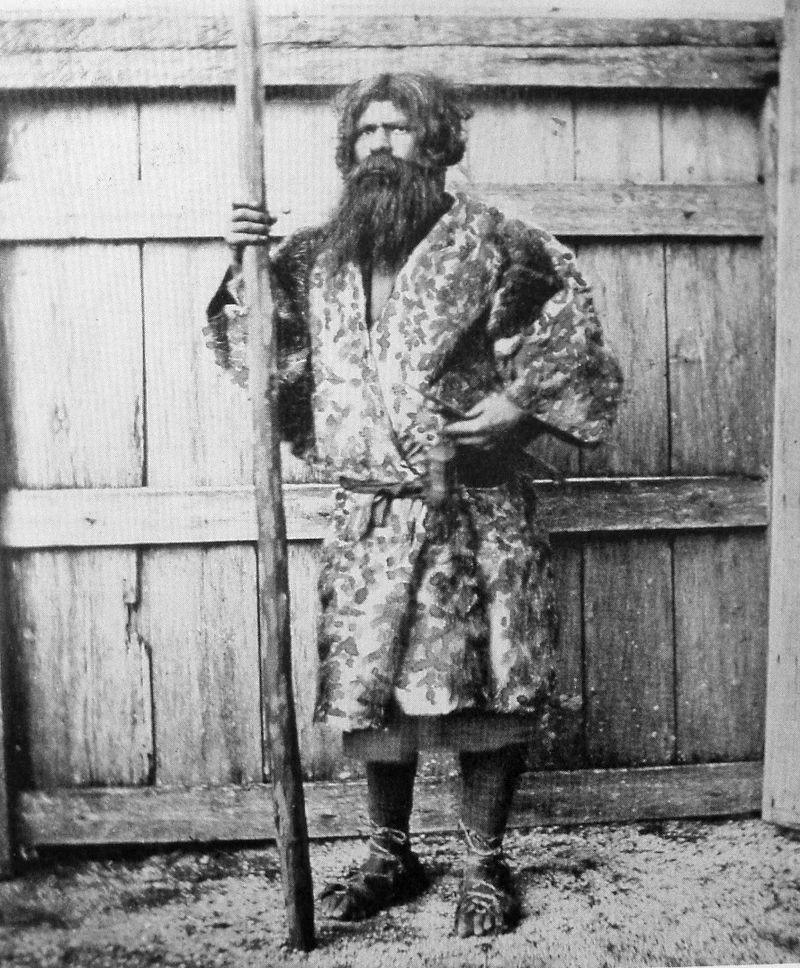
Photos like these were taken to show the difference between the Japanese colonisers and colonised Ainu
Japan answered threats of colonialism with colonialism. As stated by Mori Arinori, the reformers had the view of a 'lips and teeth' policy - Japan was the 'teeth' and needed 'lips' to protect it. One of the first acts of the reformers was to 'incorporate' the island of Ezo into Japan, which they renamed Hokkaido. The Ainu were the indigenous peoples of Hokkaido and had traded with northern Japanese for centuries, but the fear of imperial domination by Russia made Tokyo want to dominate the region. The Hokkaido Colonization Program was set up where former samurai were granted Ainu land, declared terra nullis, and open for distribution. Meanwhile, the Ainu were forced to adopt farming in reservations like Chitose. Like other colonial powers Japan viewed the Ainu as children and tried destroying their culture - their language was banned (in 1993 less the 1% can speak Ainu), the Hokkaido wolf (important to their faith) was driven to extinction, and their home design was also changed. To the south, the Ryukyu Kingdom was annexed and turned into Okinawa prefecture; just as in Hokkaido Ryukyuan identity was attacked. Despite calling Ainu and Ryukyuans 'Japanese' this was far from the case - Ainu in schools were called 'Ah! Inu!' (Ah - A dog), Ainu villages were turned into tourist attractions, and Ryukyuan visitors were horrified at the Osaka Industrial Exhibition of 1903 for being presented as 'savages' in the 'Hall of Mankind.' This was particularly insulting for Ryukyuans as the Japanese state had declared them 'Japanese' even before the annexation; a 'civilising' raid, funded by shipping zaibatsu Iwasaki Yatarō, on Taiwanese indigenous peoples was done in 1874 in revenge for the killings of Ryukyuan fishers.
Japanese Troops arriving in Seoul in 1905
The best known aspects of Japanese imperialism was its actions in China, Taiwan, and Korea. This was supported by both the military and capitalists - it was a way to bolster the military's strength, 'defend' Asia from Euro-Americans, and open up markets and resources for capitalist growth. During the 1880s and 1890s Japan started intervening in Korean affairs - something which caused an uprising as early as 1882. A peasant rebellion called the Donghak Revolution rose up against the Joseon Dynasty in 1894 which brought in both China and Japan. Using this as a way to extend its influence in Korea Japan went to war against China in 1894, and the industrialised military of Japan quickly wiped out the Chinese opponents. Japan took over Korea's politics and economy, and directly annexed Taiwan and Liaodong. Japanese militarists and capitalists pushed for the outright annexation of Korea, which happened in 1910, despite nationalist opposition in Korea. In 1909 Ito Hirobumi, then president of the privy-council, was assassinated by Korean nationalist An Jung-geun for discrimination against Koreans in Japan, having members of the royal family killed, and for dismantling Korean independence. Regardless, the following year Korea lost its independence; even its royal family was brought into the Japanese royal family. During the Meiji era, Koreans were considered 'fellow Asians' but 'requiring' education by Japan - this would soon change to attempts to eradicate Korean culture. Korean land was given to pro-Japanese Koreans and Japanese landowners, and ordinary Koreans became a source of cheap labour for factories. It was under this period that Japan's Korean diaspora began to emerge. Following 1894 Japan joined Euro-American powers in partitioning China, Japan sent troops to put down the Boxer Rebellion as an example. The 1904 Russo-Japanese War began due to competing Russian and Japanese efforts to exercise hegemony in Manchuria (a point we shall discuss soon).

Women in Meiji Japan

We have yet to mention many female voices so far, and this is due to Meiji Japan enforcing intense patriarchy. Meiji reformers argued, partially inspired by Western attitudes, that women's space was in the home with the family. Restructuring the nation as being a family headed by the male emperor meant that women were often sidelined. The state was keen to regulate women's lives, going as far as to regulate hair and clothing in 1872, and women being brought into education was done to ingrain domesticity. This does not mean that women were entirely excluded from Japanese life. Several reformers did campaign for increased women's rights - Mori Arinori ignored conservatives and sent five women to study in the US, and in 1885 Iwamoto Zenji published Women's Education where he equated civilisation with women's rights. Women themselves also challenged the idea of domesticity. In 1876 women comprised 60% of the workforce, and this ratio continued up to 1914. Of course, women were treated horribly in factories being subjected to sexual abuse, poor working conditions, 15 hour work days, and being kept in prison-like housing. However, E. Patricia Tsurumi has shown how women tried to resist this ranging from songs insulting overseers, running away, and wild-cat strikes. Japan's first strike occurred in the Amamiya Silk Factory in Kofu in 1886 when 100 women walked out in response to a dock in wages and an increase in work hours. After four days they succeeded in having this reversed. 
The first issue of Bluestockings
A burgeoning feminist movement further developed in Japan. In the 1870s Itagaki Taisuke's Movement for Freedom and Popular Rights emerged, eventually forming the Jiyuto party, to campaign for expansion of the franchise. Thanks to Kusunose Kita, who received her husband's property and tax liabilities after he died, in 1872 started pressuring the Movement to adopt women's rights. She argued that why should women be taxed like a man, if they lacked the rights of a man? Similarly, Kishida Toshiko in the 1880s became influential by travelling across Japan doing speeches attacking patriarchal systems - in 1883 she was arrested for giving a speech called 'Daughters Confined in Boxes.' This has been seen as the first direct attack on Japan's patriarchal system by a woman. Due to the rising influence of women in politics in 1890 a law was passed barring women from partaking in political activism; this curtailed the growing feminist movement but did not stop it. Socialists like Fukuda Hideko and Sugaya Iwako participated in the underground socialist movements, and in 1911 the influential feminist magazine Bluestockings began publishing.

Resistance
A depiction of the Satsuma Rebellion
Many figures and movements resisted aspects of the Meiji movement - so far we have discussed just a few of them. In the 1870s there were a series of anti-Meiji movements ranging from an attempt by firebrands in Hizen to invade Korea in 1873 as they were angered by the government not doing so, and a few years later in Kumamoto a zealous group tried to reverse the Restoration failed as they refused to use firearms. In 1877 the Satsuma Rebellion broke out under Saigo Takamori, who was angered at inaction over Korea, which lasted for six months and cost over 32,000 casualties. Saigo professed loyalty to the throne, wore his Imperial Army uniform, and declared that ministers were leading Japan down the wrong path. As it was limited to samurai and geographically isolated the rebellion was crushed, and Saigo commit suicide. Not all rebellions were by disgruntled elites. Peasants refused to answer the 1873 Conscription Edict calling it a 'blood tax' as the wealthy could avoid conscription based on a payment. Grassroots rioters attacked government offices, moneylenders, and wealthy merchants and farmers. A similar movement emerged burning down schools in protest of the new tax laws.

Some of the most unique forms of resistance emerged as well. In 1884, Kageyama Hideko had her school for women closed when some pupils attended a political meeting, so the next year she tried to smuggle bombs to Korea to encourage an armed uprising to bring democracy to Korea and Japan. Another female school teacher, Miura Momonosuke in Gunma prefecture in 1884 started recruiting gangsters, farmers, and even sumo wrestlers to take prisoner key imperial officials during an official visit; in neighbouring Saitama 3,000 teachers, artisans, and farmers formed the Poor People's Army to prepare for an armed uprising. As mentioned earlier, the anarchist and Christian inspired socialist movement was quickly oppressed - the first official socialist party was formed in 1906 and lasted two days before being banned. In May 1910 the 'High Treason Incident' was discovered - this was a plot to assassinate the emperor resulting in the execution of 12 leftists (of whom not all were actually involved). One was feminist Kanno Suga who said during her trial 'I think the Emperor as an individual may be deserving of sympathy, but he heads the system that oppresses us and...is politically responsible...The person I consider most abominable as an individual is Yamagata. I think, given the opportunity, I would try to throw a bomb at him.' 

The Russo-Japanese War and Conclusion

As mentioned earlier, when Russia completed the Trans-Siberian railway Japan clashed with it over influence in Manchuria, northern China. In 1904 this sparked a war which saw the Russian navy roundly defeated at the Battle of Tsushima seeing two-thirds of the Russian navy being destroyed. This turned out to be a turning point in history. Japan, who less than forty years before had been a rural and feudal state, roundly defeated what had been considered one of the world's great powers. What is more telling was how it influenced how race and empire were considered. Japan, a non-white nation, had defeated a white power - some in Europe tried to downplay it by saying that Russia was not a 'true' white nation, but its impact was immense. Even in nations it was oppressing Japan became a hero uniting the colonised peoples of the world. From Tibet to America colonised peoples praised Japan. Chinese nationalist Sun Yat-sen said 'We regarded that Russian defeat by Japan as the defeat of the West by the East. We regarded the Japanese victory as our own victory' and Indian nationalist Jawaharlal Nehru said it was a sign that Europe could be defeated. Although the Japanese public were disappointed with the result of the war, the war was a shift in how the world viewed Japan. However, it started a dangerous precedent. Japan would use the war to position itself as the defender of Asia, which it would use to commit atrocities and exploit peoples across Asia until the defeat of the empire in 1945.

When the Meiji Emperor died in 1912 Japan had evolved from a feudal state to a capitalist empire. While inspiring colonised peoples to try and resist colonial domination, the Japanese Empire would go on to become a repressive state. The Constitution would be used to censor pro-democracy and feminist movements, and the rise of the empire would lead to the intense abuses in the wider empire. However, this period also saw the rise of movements which could resist this oppression, and this resistance existing under the surface continues to shape Japan today.

The sources I have used are as follows:
-Marius Jansen, The Making of Modern Japan, (Cambridge, MA: 2000)
-Chris Harding, Japan Story: In Search of a Nation, 1850 to the Present, (London: 2018)
-Janet Hunter, The Emergence of Modern Japan: An Introductory History since 1853, (London: 1989)
-Marius Jansen, (ed.), The Cambridge History of Japan: Vol. 5, The Nineteenth Century, (Cambridge: 1989)
-Andrew Gordon, A Modern History of Japan, (Oxford: 2014)
-D. Howell, 'Ainu Ethnicity and the Boundaries of the Early Modern Japanese State,' Past and Present, 142, (1994), 69-93
-E. Patricia Tsurumi, Factory Girls: Women in the Thread Mills of Meiji Japan, (Princeton, 1990)
-E. Patricia Tsurumi, "Problem Consciousness and Modern Japanese History: Female Textile Workers of Meiji and Taisho", Bulletin of Concerned Asian Scholars, 18:4, (1984), 3-27
-Kumari Jayawardena, Feminism and Nationalism in the Third World, (London: 1986)

Our next World History post will look at the collapse of the Qing and Chinese between two revolutions, we have a list of other World History here. For other blog posts see our Facebook or catch me on Twitter @LewisTwiby.

Sunday, 22 September 2019

World History: Nationalism

Germania, the symbol of German nationalism
Through many of our recent World History posts, we have a list down below, the topic of nationalism has crept up repeatedly. Nationalism has evolved and changed over the years, and differs greatly where you like at it - German nationalism in 1870 will look very different from Indian nationalism in 1900. In this post today we're looking at the forms of nationalism which emerged in the 1800s until the early-1900s; during this period states in Europe, the Americas, and Asia began a drive to forge the idea of a nation state. Today we will look at these varieties, and how they evolved from largely minority pressure groups to widespread movements. 

Imagined Communities
One of the most influential works on the evolution of nationalism and the forging of 'nations' is Imagined Communities (1982) by Benedict Anderson. Of course, Anderson's theory does fall into universalising nationalism across the world, and when we look at nationalism and decolonisation in the future we will definitely see this with African nationalism. The basis of Anderson's theory is that nations - a state encompassing of a people sharing the same identity - are 'imagined communities'. Practically, nothing connects a labourer in Calais to an artist in Paris, but they can feel connected thanks to the idea of a nation - this connection is imaginary forming an imaginary community. Anderson explains the nation with three terms: limited, sovereign, and community. There are issues with this, different regions experienced different and evolving versions of nationalism which didn't fit into Anderson's model. Anderson argues that the nation is limited as 'no nation imagines itself as coterminus with mankind'; sovereign as it is not divinely-ordained and controlled by an absolute monarch claiming divine rule; and community, the perception that it is a horizontal comradeship, 'not so much to kill, as willingly to die for such limited imaginings'. In particular, selective readings of history, national anthems, statues, military conscription, and shared language are often used to forge this imagined community. Anderson writes that we imagine the Tomb of the Unknown Soldier without issue, but we have difficulty imaging the 'Tomb of the Liberal' or 'Tomb of the Marxist'. 

The Rise of Nationalism

Forms of nationalism have existed for centuries before the 1800s, Eric Hobsbawm described this as 'proto-nationalism'. Many of them were based on religious identity, for example the Russian tsars tried to portray Russia as 'Holy Russia' where the 'Russky' became interchangeable with 'krestianin-christianin' (peasant-Christian). Even earlier the Jewish Revolt against Roman rule began thanks to Roman persecution of Jews. The Jews of Palestine, based on their religious identity, saw themselves as a community against an alternate community trying to destroy their way of life. Furthermore, several states had what can be described as a 'homogeneous population' leading to some form of national identity. It should be noted that none of these cases were truly homogeneous, even in the twentieth and twenty-first centuries so-called 'homogeneous nations' are not in fact that homogeneous. The ancient Greeks used 'barbaroi' to describe non-Greek speakers and China regularly referred to non-Han peoples as barbarians. As we saw when we looked at racism, Ming China had the book Luochong Lu which tried to catalogue 'naked creatures'; in reality this othered non-Han peoples. Japanese were described as 'dwarf bandits', and Huns as having different 'breeds'. In Europe the French Revolution inspired the rise of modern nationalism across Europe. With the emphasis on rationality and the guillotining of the French monarch French nationalism took two forms. The first, was that the French borders were wrong being based on arbitrary and irrational lines drawn by dynastic negotiations. They argued, instead, that the French borders should be 'natural' being based on mountains and rivers. At the same time, French nationalism could be inclusive. Enlightenment ideas of universal liberty made many French Revolutionaries to open nationhood to people previously not viewed as French. If you could speak French then you became French, but, on the other hand, the French state (even to this day) instituted rigid French linguistic uniformity. Dialects were discouraged in favour of the French spoke in Paris. 

One of the major reasons why nationalism emerged was the othering of different communities. The French Revolution spread across Europe, and later Napoleon continued the revolutionary trend. While supporters of the revolution implemented the reforms of the revolutionaries, opponents became solidified in their opposition to French occupation. Napoleon planted his family members and close allies on the thrones of various European states which inflamed local elites, and local peoples became enraged by heavy-handed rule and forced conscription. After Napoleon's defeat local elites reversed reforms based on opposition to the French; a good example was the rise in antisemitism in Germany after Napoleon's defeat. French Revolutionaries had emancipated Jews, so Jewish emancipation became associated with the foreign French. Elsewhere, conflict and the other influenced the rise of nationalism. Misrule by British and Spanish Empires in the Americas led to their respective revolutions, and in Spanish America the fear of the subaltern influenced their revolutionary movements. Although Simon Bolivar had admiration for the Haitian Revolution it made others fearful, and elites became nationalists to oppose a possible subaltern revolutionary movement. This is seen in Mexico. The initial War of Independence was led by indigenous and mestizo communities, when they were crushed, and Spanish misrule continued, creole elites became nationalists.

From Elite to Mass Movements
Women in the swadeshi movement
Nationalist movements largely did not emerge as mass movements - instead it took years to develop. Miroslav Hroch identified three stages of the nationalist movement. These stages are far from universal, but they are useful to imagine the development of nationalism. The first, an elite movement looking at cultural and linguistic revival emerges. Elites begin thinking, what makes us different? Educated elites have easier access to histories and languages, as well as the ability to communicate with other intellectuals, and begin attempts to revive their culture. During the 1848 Revolutions Czech nationalists gathered in a Prague theatre, and leading Czech nationalist Frantisek Palacky joked that 'Gentlemen, if the roof collapsed on us now Czech nationalism would be destroyed'. The second, a minority starts to agitate for cultural revival and national emancipation. These were wide and varied in nature. In 1893 the Gaelic League in Ireland directly tied Irish independence, or Home Rule, to Gaelic restoration, and in 1886 the Can Vuong in Vietnam was made of scholars campaigning for restoration of Vietnamese traditions and the monarchy. The rise of readily available print media greatly influenced the development of nationalist movements - despite press censorship hundreds to thousands of nationalist papers were published. Italian nationalist Count Cavour after 1848 published Il Risorgimento to campaign for Italian independence, unification, and economic reforms. Finally, elite movements give way to mass movements which are the ones who bring about independence. The example of India is a good example of this. The Indian National Congress, formed 1885, quickly grew from an elite movement to one of the largest movements in history thanks to the swadeshi movement after 1918. A British officer reporting on the Egyptian Revolution in 1919 said 'Street boys, lower-class natives and seed vendors chanted songs in colloquial Egyptian which insulted British officials and called for the British to leave.' 

Forging a Nation
Disbanded Waverley by J. Pettie (1893)
As we have already mentioned, several ideas and imagery are used to help forge the idea of national communities. Thanks to the rise of capitalist press and media these images could be widely distributed so two individuals on the other side of a state could view themselves as being part of a nation. A key part of this is language. Post-revolutionary France tried to enforce a strict form of the language to silence regional, or possibly separatist, languages in Normandy, Brittany, and Corsica. For 'nationalities without nations' language revival became a way to unite disparate peoples. The Irish Gaelic League was a good example - Irish nationalists united around learning their language which had been ruthlessly suppressed by the British state. Romanticism of individuals and histories was integral to nationalism. Scottish revivalism, not full nationalism, relied on the romanticism of the Highlands and Jacobites - kilts, Gallic, and tartan had been previously banned and limited to the Highland Scots. In the late-eighteenth century and early-nineteenth century Scottish writers reinvented these images to be universal to all of Scotland. Walter Scott is a good example whose novels like Waverley (1814) and Rob Roy (1817) romanticised the Scottish past to turn it to a point of pride. In the 1880s and 1890s Japan romanticised the samurai as noble warriors honouring bushido as a way for Japan to find a unified past, despite the fact that the samurai for two hundred years were bureaucrats and had been demonised just twenty years prior. Figures, both alive and dead, became integral to national identity. Uniting several South American countries was Simon Bolivar, who helped lead them to independence, and after his death his image was used to unite Latin Americans. Despite his dream of a united Gran Colombia territorial nationalism broke the state apart and Bolivar became despised, but with his death and the uncertainty of the future the several states banded together over his image. While still living Giuseppe Garibaldi became the romantic image for Italy. A key figure in the 1848 Revolutions, a dashing fighter in Latin America, a romantic marriage with Brazilian revolutionary Anita Garibaldi, and a humble image of being a farmer he was perfect to unite Italian nationalists. His landing in Sicily in 1860 to begin the fight to unite Italy had become central to Italian nationalism despite the fact that he would only land when he was sure that the expedition had little chance of failure. 

Women were integral to nationalism, despite being subjected to intense misogyny. It is in the nineteenth-century that ideas of the 'Motherland' came into being, and Spain and Latin America started using patria. This means 'homeland' but is a feminine word. The nation was seen as birthing the people, so patriots were seen as honouring the mother. This was not the case everywhere - Germany specifically used 'Fatherland' and Japan made the emperor as the fatherly figurehead of the nation. Furthermore, women became the symbols of nations - quite ironic considering many nations barred women basic rights. Germany was represented by Germania, Britain by Britannia, France had Marianne, and India had Mother India. On the other hand, Mexico used women in a negative way to build national identity. When Hernan Cortes invaded Mexico in the 1520s he used an indigenous woman called Malintzin, (she was also called Malinche, Dona Marina and Marina), as his negotiator, translator, and sexual slave. After independence in the 1820s Mexican intellectuals portrayed Malintzin as the betrayer of the nation and a sexual seducer; this image lasts to this day although since the 1960s feminists have tried to challenge this view. This was done as Mexico tried to romanticise the pre-Conquest Aztec Empire - the Aztecs, in this narrative, only fell because of betrayal from a wilful woman. Finally, women were involved deeply in nationalist movements. We have already mentioned Anita Garibaldi, but there were many others. By looking at history from below we can see the importance of women. British officials in 1919 reported how Egyptian women were at the forefront of the anti-British protests, and several women were leaders in the anti-French resistance in Vietnam. Two peasant women, Co Bac and Co Giang, even led peasant resistance in 1873.

German and Italian Unification
Giuseppe Garibaldi
We're going to quickly look over some various forms of nationalism as a case study. Germany and Italy largely represent 'nationalism from above' or uniting historical regions. Italian and German nationalism had long been divided, and had been dominated by foreign powers. Germany was divided between two major power blocks - Prussia in the north and Habsburg Austria in the south. Meanwhile, Italian states were subjected to division by other European states - most notably the Spanish, French, and Austrians. Nationalist movements had largely been limited to elites, albeit progressive elites like Giuseppe Mazzini who founded the Young Italy movement in 1841. The Revolutions of 1848 sparked the first attempts to unify the two nations, but both failed. The Frankfurt Assembly collapsed over the issue of non-Germans (Palacky famously rejected the Czech invitation to the Assembly), and other whether to include Austria in a future Germany (Grossdeutschland) or not (Kleindeutschland). The Italians, including Mazzini's and Garibaldi's attempts to form the Roman Republic, were soon crushed by conservative monarchs and the Austrians. From 1848 nationalism became a firmly elite and top-down movement. Mazzini's attempts to foster uprisings were collapsed and the German National League reached only 25,000 members. Instead local conservative leaders began using nationalism to disrupt popular movements. Prussia used an economic quasi-union called the Zollverein to attempt to unite the economies of the various German states, and Count Cavour, the Piedmontese prime minister, began a series of reforms making it the strongest of the Italian states. When Austria became isolated following the Crimean War Cavour sought an alliance with Napoleon III of France to oust the Austrians. When Garibaldi led his anti-Bourbon revolt in Sicily Cavour managed to secure control over him to prevent mass movements when nationalists started flocking to Garibaldi. In 1861 enough of Italy was under Piedmontese control that the King of Italy was declared, and when Austria and France were defeated by the Prussians over the 1860s they used it to seize control the rest of the peninsular. Otto von Bismarck became Prussian chancellor in 1862 and he started building up the Prussian army to dominate Central Europe. Nationalists debated which state German unification should happen under - Protestant Prussia or Catholic Austria. Through a series of wars Bismarck defeated the Austrians and French crowning the Prussian king as the German Emperor in 1870.

Nationalism did not end with unification in 1861 and 1870. Italy remained deeply divided on regional lines with Venice, Sicily, Sardinia, and the south remaining culturally different to the north. The south in particular remained poor and distant from the centre of power in the north, and the veneration of Mazzini, Cavour, and Garibaldi we see in the north does not exist in the south. This was similar in Germany. The newly founded empire was dominated by Prussia, and Catholic regions remained disgruntled over unification. Bavaria disliked Prussian political domination as well as Protestant domination over the largely Catholic region. This was made worse by Bismarck's Kulturkampf. Some parts nationalist policy, some parts over power the Kulturkampf aimed to limit the power of the Catholic Church in the German state. Bismarck was keen to make Germany a Protestant power, so the power of the Church had to be curbed - enraging the Bavarians. Furthermore, with the Kulturkampf Bismarck whipped up antisemitism to build German nationalism. As racial thinking made Judaism a race Jews were seen as aliens polluting Germany. Jews, Roma, and Poles were seen as infecting the German nation, and would therefore be seen as potential subversives. 

Zionism
Theodor Herzl
This is a curious form of nationalism as it was a nationalism among a diaspora. Religious Zionism had existed for centuries, but political Zionism is a much more recent identity - in contemporary Israel there is a sect of Zionists who oppose Israel for being made by secular forces and not the divine. Modern Zionism has been seen as originating with Theodor Herzl whose pamphlet Der Judenstaat is seen as popularising Zionism. Herzl was inspired by the rise of antisemitism in Central Europe, and the Jewish Enlightenment reinvigorating Jewish culture. The premise of Zionism was that Jews had to build their own state in Palestine, they had to recreate the old state of Israel. Initially, Zionism was not widely received among Jews. For one, Herzl only managed to communicate with Jews in Western and Central Europe - Jews in Eastern Europe, the Americas, Egypt, Ethiopia, and Palestine were largely disinterested at this moment in time. There were also the issues of the Jewish community being a diaspora. Unlike the Indian or Irish diaspora who had recent contacts with the 'homeland', the Jewish community had not been united for almost two thousand years creating a very diverse community. In Western and Central Europe Jews spoke national languages and only spoke Hebrew in prayer - Prague's Jews spoke German, and sometimes Czech, day to day. In Eastern Europe Yiddish was more widely spoken. Especially in Germany and France, to Herzl's anger, most Jews disliked the idea of Zionism as they saw themselves as citizens of the nations they lived in. There was also a major issue - people, including Jews, already lived there. What made Zionism a popular movement was the Dreyfus Affair, which we discussed when we looked at racism. As Dreyfus was an Alsatian Jew he was seen as the perfect scapegoat, and a natural traitor. France, thanks to the legacy of the French Revolution, had been seen as a country safe for Jews, but the Dreyfus Affair shattered this view. A view emerged that Jews needed their own state to be safe from persecution.

Indian Nationalism
Elphinstone College
We will look in greater detail at Indian independence movements when we look at decolonisation, but we will make a start here. In order to better run their administration the British started opening educational institutions, like Elphinstone College, to raise a new generation of administrators. By doing so it exposed elite Indians to liberal and nationalist writings from across the world - ranging from Japanese reformers to John Stuart Mills. Figures like Dadabhai Naoroji, who taught for Elphinstone, would use this to criticise British misrule. His 'drain theory' criticised Britain for draining the wealth from India to profit the UK. However, the main nationalists were those who wanted to reform religion - such as improving the rights of women, ending child marriage, and challenging caste. As a result, Indian nationalism largely became divided along the lines of religion thanks to this. Syed Ahmad Khan's Aligarh University aimed to reform Indian Islam which resulted in the creation of the Muslim League in 1906. Meanwhile, elite Hindu reformers formed the Indian National Congress in 1885. Under Mahatma Gandhi and Jawaharlal Nehru the Congress would become a much larger movement not specifically for Hindus, but the legacy of this would cut deep. The nationalist movement became divided about what the language should be - sectarian splits meant that Hindus chose Hindi and Muslims Urdu. Today, India's main national language is Hindi and Pakistan Urdu.

Conclusion
Nationalism was one of the key driving movements in the 1800s - only socialism or industrial capitalism can possibly rival it. It shook up the world, and set the stage for more destructive forms of nationalism of the twentieth century. Most importantly, looking at nationalism explains why we have to study history. History and imagery is regularly used, or misused, to construct national identities, but this could be to the detriment of marginalised groups. For example, today in Britain Winston Churchill has been vaulted as a national symbol despite his genocide in Bengal - this paints an image that British Indian experiences are less important than nation building. These debates occurred in the 1800s and still are relevant today.

The sources I have used are as follows:
-Eric Hobsbawm, The Age of Empire, 1875-1914, (London: 1987)
-Kumari Jayawardena, Feminism and Nationalism in the Third World, (London: 1986)
-Liah Greenfeld, Nationalism:Five Roads to Modernity, (Cambridge, MA: 1992)
-Benedict Anderson, Imagined Communities, (London: 1983)
-Eric Hobsbawm, Nations and Nationalism since 1780: Programme, Myth, Reality, (Cambridge: 1990)
-Sumit Sarkar, Modern India, 1885-1947, (London: 1983)
-Mary Fulbrook, (ed.), German History since 1800, (New York, NY: 1997)
-Stuart Woolf, (ed.), Nationalism in Europe, 1815 to the Present, (London: 1996)
-Christopher Duggan, The Force of Destiny: A History of Italy since 1796, (London: 2007)

Thank you for reading. Our next World History post will look at feminism, and for other World History posts we have a list here. For other posts please see our Facebook or catch me on Twitter @LewisTwiby.