Search This Blog

Showing posts with label Japanese history. Show all posts

Sunday, 17 November 2019

World History: Meiji Japan


Throughout the nineteenth-century various states tried to 'modernise' themselves, but many looked to Japan for guidance. Within a space of a decade Japan turned itself from a primarily rural and feudal state, to a capitalist and industrialised one. A British observer called Basil Hall Chamberlain wrote that:
From Andrew Gordon


The last time we discussed Japan we looked at the Tokagawa Shogunate, the last samurai-led government, bakufu, to rule Japan. Even before the arrival of US Commodore Matthew Perry in 1853, which caused Japan to end its isolationist policy towards Europe the year after, the bakufu was facing serious challenges to its authority. The strict social system was becoming blurred with many samurai having to marry their daughters to wealthy merchants, the rise of money undermined the rice-based economy, and with the government in Edo becoming impoverished two hostile domains, Choshu and Satsuma, started to rise in power. Despite strict isolationist policies Choshu and Satsuma had been secretly trading with the Dutch outside of the official port in Nagasaki bolstering their wealth, and the two domains had never forgiven the Tokugawa for seizing power in 1600. Japanese nationalism started to emerge as European and American powers started signing with the bakufu, albeit through coercion, treaties granting them special privileges just as they had done in China, the subject for the next World History post. Angered Japanese nationalists, of various classes, attacked foreigners and those perceived to be aiding them, and issued the cry sonnō jōi (revere the emperor, expel the barbarian). This caused foreign powers to force the bakufu to sign more treaties, which, in turn, inspired more attacks. Meanwhile, the mismanaged economy led to widespread inflation, food shortages and unemployment causing riots countrywide. The people said Ed ja nai ka?, 'Who Cares Anymore?' Thus, this set the stage for the Meiji Restoration.

The Meiji Restoration, or Revolution?
Satsuma samurai during the Boshin War
The southern domains of Choshu and Satsuma had long standing grievances thanks to their defeat by the Tokugawa all the way back in 1600, and the political crisis brought them together in 1866. After decades of secret trading with Western merchants, most recently with Scottish merchant Thomas Blake Glover, they started to build up their force to resist Edo rule. Then in 1867 two major events happened changing the face of Japan forever. The first, the bakufu army was quickly defeated by Choshu; fires breaking out in Edo and Osaka took a portion of the government's army to try and put it out, so the remains were no match against the better equipped Choshu forces. That same year the emperor died bringing his 14-year old son, Mutsuhito, to the throne as the Meiji Emperor. With Satsuma, Choshu, and another domain Tosa putting pressure on the bakufu to grant the new emperor more power this forced the shogun, Tokugawa Yoshinobu, to resign. In early-1868, young samurai from these domains took control of Kyoto, where the emperor lived, and declared the 'Meiji Restoration.' They issued the Charter Oath declaring: the creation of assemblies, the seizure of Tokugawa lands, all classes being united in carrying out state affairs, the banning of 'evil customs', and 'knowledge shall be sought throughout the world so as to strengthen the foundation of imperial rule.' The shogunate and its supporters did not take this laying down - after the fall of the capital Edo they moved to the northernmost island of Ezo in what has been called the Boshin War. Meiji forces won, being supported by Britain, using an army combining samurai and European methods. While the generals wore British uniforms, rank-and-file soldiers wore their older samurai uniforms.

There has been debate about whether to describe the events as a 'Restoration' or a 'Revolution.' Chris Harding described it as a 'coup' as the events of 1868 replaced a system ruled by samurai with one comprised of samurai - just this time they were from Choshu, Satsuma and Tosa and of a younger generation. Meanwhile, others, such as Andrew Gordon, argue that we can refer to it as 'Revolution' as it facilitated the end of Japanese feudalism. Although the ruling class might be the same as pre-1868, the economic and social changes caused by the Restoration, he argues, can only be described as 'revolutionary.'

Building the Meiji State
Iwakura Mission officials - Iwakura is in the centre
The next stage of the Meiji period has often been described as 'emulating' the West, but in reality it can best be described as 'adapting' the West. To centralise power the emperor was moved to the capital of Edo which was renamed Tokyo. Tax, decentralised and originally paid in rice based on harvest size, was replaced by a centrally assessed land tax paid in cash. To curb the power of a resurgent samurai class the hundreds of domains were replaced by fifty prefectures. In order to break the traditional power of the samurai, and to allow wealthy merchants into the hegemony of power, in 1871 samurai/commoner marriage was allowed, and soon after 'samurai' were abolished. These policies were guided by a principle, similar to the Chinese self-strengthening movement, called fukoko kyōhei (enrich the state, strengthen the military). It was no coincidence that one of the major politicians of the Meiji era was the 'Father of the Military' Yamagata Aritomo. Although the bakufu had sent pupils abroad in the early-1860s to study in Europe and the US, a large scale programme was enacted by minister Iwakura Tomomi from 1871 to 1873 in what has been called the 'Iwakura Mission.' The children of Meiji samurai were sent to Europe and America to study engineering, economics, military, politics, and sciences as a way to produce the next generation of rulers who could use their knowledge they acquired elsewhere. Britain, as another island nation and as a heavily industrialised state, was initially the nation to emulate. Some reformers suggested that adoption of Christianity and even more beef dishes could help Japan become more like Britain. However, German unification under Prussia made Germany the state to learn from. German conscription, schooling, and military training were adapted for Japanese means. The German constitution would come to heavily inspire the 1889 Constitution as it placed the monarch in the centre of politics; the new class were keen to limit the power of democracy. When visiting Chinese minister Li Hongzhang in 1885 one of Japan's leading figures, Mori Arinori, was questioned how he could abandon his culture in favour of the West. Mori replied saying that he and Japan were just doing what they had always done - adapt from other nations what suited them. 
The Rokumeikan
As stated by Mori, the new Meiji class did not simply adapt policies and ideas from the West. Following 1853 Japanese communities were looking at themselves to understand why they had easily been humbled by Matthew Perry. This was soon followed by the promotion of Shinto over Buddhism, and attacks on Buddhist temples with it being seen as an alien faith which hindered Japan. If you are in Europe and the US and see Japanese Buddhist artefacts from the 1850s and 1860s it is likely from a temple pillaged during this period. Even though some Japanese ministers advocated converting the nation to Christianity, this was roundly rejected, such as by one of the key political figures Ito Hirobumi, of rejecting Japan. Andrew Gordon has also highlighted the push and pull about the adoption of industrial capitalism. Some, like Kido Koin who in 1872 described industrialism in the US as being 'astonishing' and 'indescribably', saw it as the best way to stop Japan from being dominated by imperial powers, whereas others warned against this. Far from being socialists, several Meiji ministers warned against the adoption of industrial capitalism as they saw the exploitation of workers and ruthless competition as rupturing Japan's Confucian social order. One of the Meiji era's most important figure, Ito Hirobumi, used the phrase kokutai (national body) to describe how Japan should function - the nation was a family with the emperor as the father, and anything which could disrupt the family should be discouraged. The Rokumeikan, finished in 1883 at ruinous cost, is the perfect example of this. Designed by British architect Josiah Conder, it combined European architecture with Japanese lanterns, ponds, and pines where the elite, and middle classes, could interact with foreign dignitaries. This was commissioned by Ito and Inoue Kaoru to put Japan on the world stage. It was not uncommon for dancers to combine kimonos and suits, and the masquerade ball of 1887 caused rumours that etiquette was abandoned - Ito is rumoured to have had an affair with a married woman that night. These scandals, and satire by the West, caused these balls to be abandoned.
The Emperor Meiji in Western guard - this was issued to show that Japan and its rulers were a new power
There was also a keen urge to create a centralised state with a strong army. We have already mentioned conscription, but education was seen as also being of vital importance. The Fundamental Code of Education in 1872 was released which set out to make a break from the Tokugawa era, and began building more schools out of the hands of religious institutions. A 1875 survey of 20,000 schools found that 18% were in new buildings, and this continued to grow. Elementary education was pushed above all - in 1892 it was found that 27% of conscripts were illiterate and that figure vanished by the start of the First World War. The big push for education began under Mori Arinori from 1885 who stated that it was for 'the sake of our country.' Setting the stage for an authoritarian and nationalist state, Mori had elementary education stress devotion to the state and founded the Imperial University in Tokyo. In 1937 it was found that 73.6% of high civil servants and 49.7% of judicial officials had attended Imperial. Centralisation took many forms. During the 1850s and 1860s loosening restrictions on print allowed a boom in newspapers, and soon they were centralised to prevent regional loyalty. Furthermore, to avoid regional loyalties prefecture governors were prevented from serving in the prefecture they were born in, and were often moved around. A key part of centralisation was industrialism. Building railroads and telegraph lines linked even the most rural areas creating a sense of national unity - by 1877 2,827 miles of telegraph lines had been installed.

The 1889 Constitution and Politics
In 1889, largely drafted by Ito Hirobumi and other Meiji conservatives, Japan's first constitution was promulgated. Inspired by the German constitution it created a top-down state where power, in theory but not practice, rested on the emperor. The concept of kokutai placed the emperor as the father of the nation and his subjects as his children. This Constitution would remain in place until 1947, and would serve as a way to unite the nation - the nation was one large family. However, this concept was used to silence calls for democracy, republicanism, and women's rights, and Japanese fascists and militarists later would use it to justify their own take over. As described by Chris Harding, the 1880s up to the 1900s can be described as a 'dancing cabinet' where the role of prime minister regularly shifted between several figures - notably Ito Hirobumi, Yamagata Aritomo, and Matsukata Masayoshi. A big reason for this was that the office of Prime Minister was by the Diet which had a very small franchise; only 5% of the male population could vote and the first election of 1890 saw 450,000 people vote, or 1% of the population. It took until the 1920s for universal male suffrage to be passed, and women could not vote until the 1940s. This veneer of democracy allowed a safe way for opinions to be debated without harming the ruling power, and allowed policies to be easily transmitted to the public. This is shown in which parties were elected to the first Diet - the Jiyuto, Itagaki Taisuke brought samurai together to campaign for a national assembly, and the Kaishinto, capitalists who wanted to bring about a British style government. Until the 1940s Satsuma-Choshu controlled the government - Ito was prime minister four times, and Yamagata twice. More radical demands could, therefore, be easily barred from government. A 1909 Press Law allowed 'dangerous' publications to be banned, and the 1894 Peace Preservation Law was used to curb the extra-parliamentary support of the Jiyuto Party.

Japanese Capitalism
Women working in a textile factory
As when we looked at the history of capitalism, Japanese capitalism had its origins far into the past. By the end of the Tokugawa shogunate the wealth divisions between merchants and samurai had become increasingly blurred, and in the 1850s had funded anti-bakufu movements. Angered by the bakufu excluding them from power, so they threw themselves behind the Meiji reformers. Many of these merchant families would evolve into zaibatsu, or conglomerates, which would hold monopolies over the Japanese economy until the Second World War. Even then, they still exist under a different name. The 'Big Four' zaibatsu, (Mitsui, Mitsubishi, Sumitomo, and Yasuda), would hold great influence over Japan, and many politicians were practically in their pockets. By the 1920s they owned 70% of the stock exchange, 30% of mining and chemicals, and 50% of machinery. A reason why they became so powerful was due to the Meiji state relying on them to industrialise. Fearful that contracts with Europeans to industrialise the state would open the door for Euro-American domination, they instead relied on zaibatsu. Soon enough politicians and capitalists became inseparable - a common story was how politicians would order a bento box, and in one of the slots was a wad of cash from a zaibatsu. As in the rest of the world capitalism would drastically shape the demographics of Japan. The cities grew exponentially as people moved to the docks and urban factories to work. E. Patricia Tsurumi has highlighted how it was socially accepted for young rural women to move to the cities to work in textiles until they married when they would move back to the countryside. Furthermore, as expected, capitalism was entwined with empire.

The Japanese Empire
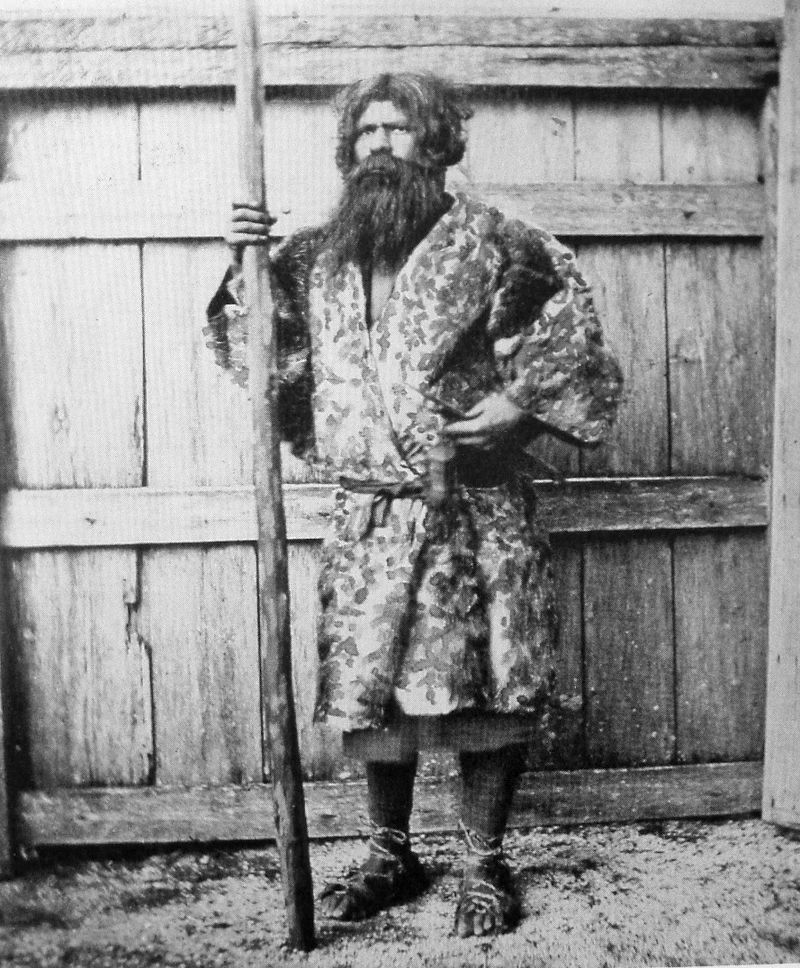
Photos like these were taken to show the difference between the Japanese colonisers and colonised Ainu
Japan answered threats of colonialism with colonialism. As stated by Mori Arinori, the reformers had the view of a 'lips and teeth' policy - Japan was the 'teeth' and needed 'lips' to protect it. One of the first acts of the reformers was to 'incorporate' the island of Ezo into Japan, which they renamed Hokkaido. The Ainu were the indigenous peoples of Hokkaido and had traded with northern Japanese for centuries, but the fear of imperial domination by Russia made Tokyo want to dominate the region. The Hokkaido Colonization Program was set up where former samurai were granted Ainu land, declared terra nullis, and open for distribution. Meanwhile, the Ainu were forced to adopt farming in reservations like Chitose. Like other colonial powers Japan viewed the Ainu as children and tried destroying their culture - their language was banned (in 1993 less the 1% can speak Ainu), the Hokkaido wolf (important to their faith) was driven to extinction, and their home design was also changed. To the south, the Ryukyu Kingdom was annexed and turned into Okinawa prefecture; just as in Hokkaido Ryukyuan identity was attacked. Despite calling Ainu and Ryukyuans 'Japanese' this was far from the case - Ainu in schools were called 'Ah! Inu!' (Ah - A dog), Ainu villages were turned into tourist attractions, and Ryukyuan visitors were horrified at the Osaka Industrial Exhibition of 1903 for being presented as 'savages' in the 'Hall of Mankind.' This was particularly insulting for Ryukyuans as the Japanese state had declared them 'Japanese' even before the annexation; a 'civilising' raid, funded by shipping zaibatsu Iwasaki Yatarō, on Taiwanese indigenous peoples was done in 1874 in revenge for the killings of Ryukyuan fishers.
Japanese Troops arriving in Seoul in 1905
The best known aspects of Japanese imperialism was its actions in China, Taiwan, and Korea. This was supported by both the military and capitalists - it was a way to bolster the military's strength, 'defend' Asia from Euro-Americans, and open up markets and resources for capitalist growth. During the 1880s and 1890s Japan started intervening in Korean affairs - something which caused an uprising as early as 1882. A peasant rebellion called the Donghak Revolution rose up against the Joseon Dynasty in 1894 which brought in both China and Japan. Using this as a way to extend its influence in Korea Japan went to war against China in 1894, and the industrialised military of Japan quickly wiped out the Chinese opponents. Japan took over Korea's politics and economy, and directly annexed Taiwan and Liaodong. Japanese militarists and capitalists pushed for the outright annexation of Korea, which happened in 1910, despite nationalist opposition in Korea. In 1909 Ito Hirobumi, then president of the privy-council, was assassinated by Korean nationalist An Jung-geun for discrimination against Koreans in Japan, having members of the royal family killed, and for dismantling Korean independence. Regardless, the following year Korea lost its independence; even its royal family was brought into the Japanese royal family. During the Meiji era, Koreans were considered 'fellow Asians' but 'requiring' education by Japan - this would soon change to attempts to eradicate Korean culture. Korean land was given to pro-Japanese Koreans and Japanese landowners, and ordinary Koreans became a source of cheap labour for factories. It was under this period that Japan's Korean diaspora began to emerge. Following 1894 Japan joined Euro-American powers in partitioning China, Japan sent troops to put down the Boxer Rebellion as an example. The 1904 Russo-Japanese War began due to competing Russian and Japanese efforts to exercise hegemony in Manchuria (a point we shall discuss soon).

Women in Meiji Japan

We have yet to mention many female voices so far, and this is due to Meiji Japan enforcing intense patriarchy. Meiji reformers argued, partially inspired by Western attitudes, that women's space was in the home with the family. Restructuring the nation as being a family headed by the male emperor meant that women were often sidelined. The state was keen to regulate women's lives, going as far as to regulate hair and clothing in 1872, and women being brought into education was done to ingrain domesticity. This does not mean that women were entirely excluded from Japanese life. Several reformers did campaign for increased women's rights - Mori Arinori ignored conservatives and sent five women to study in the US, and in 1885 Iwamoto Zenji published Women's Education where he equated civilisation with women's rights. Women themselves also challenged the idea of domesticity. In 1876 women comprised 60% of the workforce, and this ratio continued up to 1914. Of course, women were treated horribly in factories being subjected to sexual abuse, poor working conditions, 15 hour work days, and being kept in prison-like housing. However, E. Patricia Tsurumi has shown how women tried to resist this ranging from songs insulting overseers, running away, and wild-cat strikes. Japan's first strike occurred in the Amamiya Silk Factory in Kofu in 1886 when 100 women walked out in response to a dock in wages and an increase in work hours. After four days they succeeded in having this reversed. 
The first issue of Bluestockings
A burgeoning feminist movement further developed in Japan. In the 1870s Itagaki Taisuke's Movement for Freedom and Popular Rights emerged, eventually forming the Jiyuto party, to campaign for expansion of the franchise. Thanks to Kusunose Kita, who received her husband's property and tax liabilities after he died, in 1872 started pressuring the Movement to adopt women's rights. She argued that why should women be taxed like a man, if they lacked the rights of a man? Similarly, Kishida Toshiko in the 1880s became influential by travelling across Japan doing speeches attacking patriarchal systems - in 1883 she was arrested for giving a speech called 'Daughters Confined in Boxes.' This has been seen as the first direct attack on Japan's patriarchal system by a woman. Due to the rising influence of women in politics in 1890 a law was passed barring women from partaking in political activism; this curtailed the growing feminist movement but did not stop it. Socialists like Fukuda Hideko and Sugaya Iwako participated in the underground socialist movements, and in 1911 the influential feminist magazine Bluestockings began publishing.

Resistance
A depiction of the Satsuma Rebellion
Many figures and movements resisted aspects of the Meiji movement - so far we have discussed just a few of them. In the 1870s there were a series of anti-Meiji movements ranging from an attempt by firebrands in Hizen to invade Korea in 1873 as they were angered by the government not doing so, and a few years later in Kumamoto a zealous group tried to reverse the Restoration failed as they refused to use firearms. In 1877 the Satsuma Rebellion broke out under Saigo Takamori, who was angered at inaction over Korea, which lasted for six months and cost over 32,000 casualties. Saigo professed loyalty to the throne, wore his Imperial Army uniform, and declared that ministers were leading Japan down the wrong path. As it was limited to samurai and geographically isolated the rebellion was crushed, and Saigo commit suicide. Not all rebellions were by disgruntled elites. Peasants refused to answer the 1873 Conscription Edict calling it a 'blood tax' as the wealthy could avoid conscription based on a payment. Grassroots rioters attacked government offices, moneylenders, and wealthy merchants and farmers. A similar movement emerged burning down schools in protest of the new tax laws.

Some of the most unique forms of resistance emerged as well. In 1884, Kageyama Hideko had her school for women closed when some pupils attended a political meeting, so the next year she tried to smuggle bombs to Korea to encourage an armed uprising to bring democracy to Korea and Japan. Another female school teacher, Miura Momonosuke in Gunma prefecture in 1884 started recruiting gangsters, farmers, and even sumo wrestlers to take prisoner key imperial officials during an official visit; in neighbouring Saitama 3,000 teachers, artisans, and farmers formed the Poor People's Army to prepare for an armed uprising. As mentioned earlier, the anarchist and Christian inspired socialist movement was quickly oppressed - the first official socialist party was formed in 1906 and lasted two days before being banned. In May 1910 the 'High Treason Incident' was discovered - this was a plot to assassinate the emperor resulting in the execution of 12 leftists (of whom not all were actually involved). One was feminist Kanno Suga who said during her trial 'I think the Emperor as an individual may be deserving of sympathy, but he heads the system that oppresses us and...is politically responsible...The person I consider most abominable as an individual is Yamagata. I think, given the opportunity, I would try to throw a bomb at him.' 

The Russo-Japanese War and Conclusion

As mentioned earlier, when Russia completed the Trans-Siberian railway Japan clashed with it over influence in Manchuria, northern China. In 1904 this sparked a war which saw the Russian navy roundly defeated at the Battle of Tsushima seeing two-thirds of the Russian navy being destroyed. This turned out to be a turning point in history. Japan, who less than forty years before had been a rural and feudal state, roundly defeated what had been considered one of the world's great powers. What is more telling was how it influenced how race and empire were considered. Japan, a non-white nation, had defeated a white power - some in Europe tried to downplay it by saying that Russia was not a 'true' white nation, but its impact was immense. Even in nations it was oppressing Japan became a hero uniting the colonised peoples of the world. From Tibet to America colonised peoples praised Japan. Chinese nationalist Sun Yat-sen said 'We regarded that Russian defeat by Japan as the defeat of the West by the East. We regarded the Japanese victory as our own victory' and Indian nationalist Jawaharlal Nehru said it was a sign that Europe could be defeated. Although the Japanese public were disappointed with the result of the war, the war was a shift in how the world viewed Japan. However, it started a dangerous precedent. Japan would use the war to position itself as the defender of Asia, which it would use to commit atrocities and exploit peoples across Asia until the defeat of the empire in 1945.

When the Meiji Emperor died in 1912 Japan had evolved from a feudal state to a capitalist empire. While inspiring colonised peoples to try and resist colonial domination, the Japanese Empire would go on to become a repressive state. The Constitution would be used to censor pro-democracy and feminist movements, and the rise of the empire would lead to the intense abuses in the wider empire. However, this period also saw the rise of movements which could resist this oppression, and this resistance existing under the surface continues to shape Japan today.

The sources I have used are as follows:
-Marius Jansen, The Making of Modern Japan, (Cambridge, MA: 2000)
-Chris Harding, Japan Story: In Search of a Nation, 1850 to the Present, (London: 2018)
-Janet Hunter, The Emergence of Modern Japan: An Introductory History since 1853, (London: 1989)
-Marius Jansen, (ed.), The Cambridge History of Japan: Vol. 5, The Nineteenth Century, (Cambridge: 1989)
-Andrew Gordon, A Modern History of Japan, (Oxford: 2014)
-D. Howell, 'Ainu Ethnicity and the Boundaries of the Early Modern Japanese State,' Past and Present, 142, (1994), 69-93
-E. Patricia Tsurumi, Factory Girls: Women in the Thread Mills of Meiji Japan, (Princeton, 1990)
-E. Patricia Tsurumi, "Problem Consciousness and Modern Japanese History: Female Textile Workers of Meiji and Taisho", Bulletin of Concerned Asian Scholars, 18:4, (1984), 3-27
-Kumari Jayawardena, Feminism and Nationalism in the Third World, (London: 1986)

Our next World History post will look at the collapse of the Qing and Chinese between two revolutions, we have a list of other World History here. For other blog posts see our Facebook or catch me on Twitter @LewisTwiby.

Saturday, 2 June 2018

World History: The Tokugawa Shogunate

An Edo-era screen depicting Sekigahara
On October 21 1600 the Sengoku period of warfare ended with the Battle of Sekigahara. The deceased ruler of Japan Toyotomi Hideyoshi had placed his son and heir under the care of five powerful daimyō. However, they all wanted power and at Sekigahara the most powerful won: Tokugawa Ieyasu. Ieyasu would found a new shogunate which would rule Japan for over two centuries with it coming to an end in 1868 with the Meiji Restoration. The Tokugawa bakufu (government) would greatly shape Japan with it putting into place many aspects of Japanese life which would continue to this day. We'll look at the world of the Tokugawa and how it changed over the course of its life.

Establishing Tokugawa Rule
Ieyasu
As mentioned Ieyasu established his shogunate after the Sengoku period which saw over a century of warfare in order to unify Japan by leading samurai. The unifiers, Oda Nobunaga and Toyotomi Hideyoshi, never declared themselves emperor or shogun ruling with the existing emperors and Ashikaga shoguns under their rule instead. Although the shogunate had been abolished in 1573 the shoguns lived on and luckily for Ieyasu the last one had died in 1598. However, he had to face the fact that Hideyoshi's son, Hideyori, was still around. Hideyori would remain a thorn in the side of the Tokugawa shoguns as he served as a potentially legitimate opponent to their rule and making it worse was that Hideyori lived in Osaka Castle which was one of the most fortified settlements. In 1602 one of the most powerful daimyo, Shimazu Yoshihiro of Satsuma, who had supported Hideyori at Sekigahara personally met with Ieyasu where he pledged his loyalty to Ieyasu. The next year Ieyasu was officially declared shogun and to ensure Tokugawa rule remained he transferred power to his son, Hidetada, in 1605 so he could rule behind the scenes. By 1611 most lords had declared their loyalty to the Tokugawa. In 1614 Hideyori and the shogunate finally came to blows as Ieyasu had Osaka attacked. Using treachery and diplomacy Hideyori agreed to a truce if some of his defenses were dismantled but Ieyasu's workers overzealously removed more of the defenses than initially agreed. In 1615 they attacked Osaka again and Hideyori, and his mother, commit suicide. 

There were also other ways the Tokugawa tried to establish their rule. Luckily for Ieyasu he had many children which he used to marry to into powerful families or established as major daimyō, and with Hidetada succeeding him as shogun. In 1610 as his adopted daughter was being married off to Tsugaru Nobuhira he sent as a dowry a pair of eight-fold screens depicting Sekigahara - your own wealth could be used to show your power. Later Hidetada married his daughter, Masako, into the royal family and her daughter became the Meishō Empress. From the Sengoku period regional leaders in the domains, han, had become powerful which the Tokugawa had to deal with. There were normally around 250 han but at one time there were just over 500 han meaning there were lots of potential opponents. As a result the Tokugawa has been described as 'centralized feudalism'. I should mention, however, that han and feudalism were applied to Tokugawa rule retroactively in the nineteenth century and most domains were actually fairly small. The Tokugawa used a system called kokudake where to hold the title of daimyō had to have land worth 10,000 koku, about US $6.4 million, and only sixteen domains had a koku rating of over 300,000. Even then only a few dozen, like Maeda, managed to retain their koku rating through the entirety of Tokugawa rule. After 1615 daimyō had to abide by the Code for the Military Houses which gave the domains power but also made them obey the bakufu. In 1622 it was amended to include a clause where daimyō had to leave a family member hostage in Edo but in 1636 this was expanded in a system called sankin-kōtai (alternate attendance). Daimyō were assigned plots of land in Edo for themselves to be kept hostage as their family remained at home and then the next year they would swap. As both their domain and their Edo plot (which could include three fully staffed mansions) had to be maintained this stripped the resources from potential rebels as well as dangling the threat of execution over their heads if they rebelled. 
A depiction of the Shimbara Rebellion - a rebellion by mostly Christian peasants
The Tokugawa also aimed to secure themselves with commoners, heimin, as well as their lords - a peasant uprising could potentially be as dangerous as that by samurai. Making matters more serious in the mind of the bakufu was Christian subversion, something which Nobunaga and Hideyoshi had ruthlessly challenged before. The bakufu and domains conducted registers of population and livestock which were combined with hunting for Christians. Originally this was just in bakufu domains but in 1665 registers, done at Buddhist temples, were ordered to be done in all domains. Bans were also placed on samurai-commoner intermarriage but as we'll see this became blurred during the later Tokugawa period. However, if they wished samurai were granted the ability to kill rude commoners without repercussion. 

Foreign Policy
There is a common misconception that the shogunate was totally isolationist and this was largely due to a Western bias, and even then a flawed bias. Ieyasu was eager to rebuild relations with Korea and China which had been destroyed by Hideyoshi's invasion. He officially declared peace with Korea in 1605 and when Hidetada became shogun Korea sent a mission of 504 men to honor him before visiting Ieyasu. The 1609 Treaty of Kisu resumed trade allowing the Strait of Tsushima to become a wealthy trading zone again where Japanese silver was traded for Chinese silk. Chinese neo-Confucianism came to Japan via Korea through the writings of Yi Hwang (1501-1570), Korean potters in Saga started reproducing blue slipware porcelain, and Korean medicine attracted wide interest. However, Korean-Japanese relations never recovered from Hideyoshi's invasion. The Dutch in Nagasaki were told that the Korean missions were from a tributary state and they celebrated Hideyoshi's 'victory' over Korea; meanwhile, diarist Sin Yu-han while visiting in 1719 complained about the extravagance of Japan and the lack of respect to Confucius. Korean books also referred to Japan as pirates. Also, due to China's wealth Ieyasu was eager to reopen relations and Chinese merchants regularly ignored Ming bans on trade with Japan. In Kwagoe, Odawara and Kyushu 'Chinatowns' even formed to accommodate merchants and over 130 artists were at Nagasaki at the same time once. One of the available contemporary accounts on Chinese families in the early-eighteenth century comes from a Japanese scholar. Like with Korea Chinese-Japanese relations were still hostile - a Chinese book portrayed Japanese as being ape-like so when it was translated into Japanese it had to be heavily edited. Furthermore, Japan continued relations with states in Indonesia, the Philippines and South East Asia as a whole. The Ryukyuan islands and Hokkaido were not under Edo rule at this period and trade occurred with them as well until the 1630s.
A painting of Dejima
Starting in 1633 Tokugawa Iemitsu passed a series of edicts which have been called sakoku or 'closed country'. For this reason we have the image that the Tokugawa were totally isolationist but this is in fact incorrect. Europeans, mainly the Dutch, were limited to the port of Dejima in Nagasaki, Korea to Tsushima domain, Ryukyu to Satsuma, and Ainu trade to Matsumae. Japanese citizens were also barred from leaving. There were several reasons why this policy was implemented. This first is Christianity. Following the end of the Reconquista in Iberia in 1492 Portugal and Spain were eager to spread Christianity which encouraged them to spread their faith in Japan, especially after the Protestant Reformation began. As mentioned earlier Nobunaga and Hideyoshi had ruthlessly suppressed Christian converts which continued under the Tokugawa. In 1637 40,000 Christian peasants, as well as masterless samurai called rōnin, rose up in the Shimabara Rebellion thanks to famine and local misrule. The shogunate blamed Christian missionaries so started ruthlessly started persecuting Christians and banned Europeans from being outside Dejima. As Catholicism was far larger than Protestantism the blame was placed largely on the Iberians who were banned. When Portugal protested again in 1640 from Macao a captain and sixty others were executed. The English faced their own issues forcing the East Indian Trading Company out of Japan leaving their Dutch counterparts, the VOC, in control. As a result the VOC controlled European trade in Nagasaki remaining on their island in Dejima. Intellectual trade happened as well; in 1691 Engelbert Kaempfer published his book History of Japan and Japanese schools had courses called 'Dutch Studies'. Cunning merchants occasionally pretended to be Dutch in order to get trade. The bans on other states were due to how in the Sengoku period domains had utilized foreign trade becoming wealthy themselves; the Tokugawa feared this could allow a rebellious domain to become wealthy. The sakoku bans were ignored by both Japanese and foreigners repeatedly throughout Tokugawa rule as well show the limitations of the policy.

Culture under the Shogunate
Hokasai's Great Wave from the 1830s
Without the stress from war city culture boomed. This was particularly noticeable in Edo (modern Tokyo) thanks to the shogunate's sankin-kōtai policy. Normally the imperial court in Kyoto had been associated with culture but as the samurai, and their families, were confined to Edo they engaged in tea-drinking, poetry, art, and general literature. Under Tokugawa Tsunayoshi (r.1680-1709) we see the Genroku period known as a Golden Age of Edo culture due to peace and prosperity. We see a period where Edo became the center of Buddhist and Chinese studies as well as protection of animals. As Tsunayoshi opened the first kennels for stray dogs he became known as inu kubō, 'dog shogun'. In Edo we also see street gangs called kabukimono and the 'six gangs of Edo' made up of 'street knights' going around showing their machismo in fine clothes and garbings. The wealth of Tokugawa rule allowed merchants as well to take part in activities once reserved for the traditional samurai elite. According to R.H.P. Mason and J.G. Caiger the cities saw what they described as 'Japan's version of bourgeois individualism' through culture such as the novels by Ihara Saikaku (1642-93). Saikaku was the son of a wealthy Osaka merchant whose stories revolve around the theme of money and erotic love. One of Japan's greatest artists, Hokusai, made his mark during this period as well. Women could also engage in this culture by either making it themselves or consuming the arts. Rural culture was less vibrant compared to that of the cities, mostly as disposable wealth was less of a factor for a peasant compared to their urban counterparts. However, this does not mean that rural Japan was excluded from Tokugawa culture. The kabuki theater was extremely popular, so much so that they became popular in the cities, which is unusual. Travelers, among others, were seen as being at the bottom of society as they were not limited to their place of birth but the kabuki theater was popular. In a unique twist samurai and commoner sat together watching kabuki plays. Today kabuki remains a major part of traditional culture. Similarly rakugo gained popularity as much as their kabuki counterparts.

Society, Economy and Protest
A kabuki theater from the 1600s
In theory Japan based society on Confucian values with the samurai at the top then followed by peasants, then artisans, merchants and then a group similar to Indian Dalits called the eta, now known as burakumin. Women were in theory meant to be subservient to men. In practice this became much more blurred throughout Tokugawa rule. Wealthy women could produce arts and rural, poor women often escaped some of the more restrictive aspects of their wealthier counterparts. Compared to Meiji Japan which came later we see more acceptance to same-sex relations, although it was not accepted. The aforementioned Saikaku featured a bisexual main character in The Life of an Amorous Man (1692). Hokusai also portrayed same-sex relations in some of his paintings as well. As the Tokugawa required a widespread and lasting expansion of domestic trade merchants became wealthy and with them artisans did as well. In the cities guilds became fairly prosperous through a mixture of trade and stability following the Sengoku period. This prosperity benefited also from little taxation on urban merchants and artisans, and wealthier guilds could give 'thank-money' in return for licenses. Due to this boom in wealth many samurai chose to take up the abacus rather than the sword for a livelihood. For this reason the blurring of social boundaries happened. As we saw the kabuki theater became a place where social stratification was ignored but it became more evident elsewhere. As samurai became poorer and merchants/artisans became wealthier social distinctions blurred so a samurai could only be told apart by if they had a sword. Even then by 1853 some samurai had sold their swords to merchants, take loans from merchants or marry their children into merchant families. Some of the later major Japanese companies, like Mitsui, had their origins in the Tokugawa period. Sometimes shoguns would slap down too extravagant merchants - in 1705 Tsunayoshi had a lumber contractor's home confiscated for this reason.  

Protest from commoners did happen throughout the period, even before the shogunate's collapse, like many other contemporary societies. As mentioned earlier we had the Shimabara Rebellion thanks to famine, local misrule, and religious issues. Local misrule and problems in the countryside regularly caused protest among the peasantry, both violent and non-violent. Throughout the roughly two-hundred and fifty years of Tokugawa rule peasants 'rebelled' over 2809 times and 1000 riots took place. From 1621 to 1720 daihyō osso (direct petition) was the most common form of protest followed by gōso (violent collective action) and uchikowashi (smashing and breaking) after the 1730s. Often during the late Tokugawa peasants, tenants, artisans and day laborers would protest together ignoring social boundaries. Although Confucianism helped enforce conformity it could be used to validate protest. In 1726 a peasant rebel leader in Mimasaka said that their revolt was due to the local official misrule and in 1653 daimyō Hotta Masanobu crucified village elder Sabura Sōgorō for presenting a petition to the local lord. He was then seen as a martyr as he had presented his grievances in a respectful way but had been killed anyway. Even though peasants viewed themselves as righteous the bakufu did try and limit protest: 1622 collective protests were banned, 1633 justifiable grounds for a petition were narrowed, and 1721 the shogun revoked the rights of peasants to protest against misrule of lords. However, by the end of the shogunate merchants began funding peasant rebellions over disgruntlement that they were wealthy but seen as being below the samurai who had largely become bureaucrats or drunken brawlers in Edo.

Why did the shogunate decline?
A Japanese depiction of Perry's black ships
By the nineteenth century the economic boom of the shogunate had started to drop. Inflation rose and unrest began over general disgruntlement. Samurai were losing their wealth, merchants were angry that they were seen as being below others in society, certain samurai were disgruntled over their position, and generally the domestic trade was decreasing through inflation. The bakufu could likely have lasted longer than it did if not for the events of 1853. Commodore Matthew Perry of the United States with his 'black ships' demanding Japan open its ports for trade with the US, and later over European powers began signing the 'unequal treaties'. We'll discuss this with a later post so I'll summarize it hit. These treaties gave foreign powers preferable rights over Japan, including allowing foreigners to abide by their own laws rather than that of Japan. This caused what can be described by a nationalistic backlash called sonnō jōi (revere the emperor, expel the barbarian). Foreign powers used this to get more treaties from the bakufu fueling a bigger nationalist backlash. Meanwhile, samurai from Satsuma and Choshu, who had become wealthy but were not respected, decided to take control leading to the Meiji Restoration. However, that is a story for another day.

Conclusion
The Tokugawa shogunate greatly influenced Japanese history. Here the institutions and economic boom planted the seeds for the modern Japan. Samurai contributed to the emergence of a new Japanese culture as merchants benefited from a stable society allowing the old feudal order to begin to be challenged. Largely separated from the rest of the world it allowed a distinctive Japanese identity to emerge which would influence the future post-shogunate Japan. The later Meiji reformers would look at the Tokugawa and learn from them, and later Japanese governments would constantly look at them for inspiration. Similarly many aspects of Japanese popular culture have taken inspiration from the Tokugawa era ranging from kabuki plays to anime and manga.

The next World History post shall take us to China to look at the Qing dynasty. The sources I have used are as follows:
-R.H.P. Mason and J.G. Caiger, A History of Japan, (Melbourne: 1997)
-Marius B. Jansen, The Making of Modern Japan, (Cambridge, MA: 2000)
-Nishiyama Matsunosuke, Edo Culture: Daily Life and Diversions in Urban Japan, 1600-1868, trans. Gerald Groemer, (Honolulu, HI: 1997)
-Irwin Scheiner, 'Benevolent Lords and Honorable Peasants: Rebellion and Peasant Consciousness in Tokugawa Japan', in Tetsuo Najita and Irwin Scheiner, (eds.), Japanese Thought in the Tokugawa Period, (Chicago, IL: 1978)
-James White, 'State Growth and Popular Protest in Tokugawa Japan', Journal of Japanese Studies, 14:1, (1988), pp.1-25
-Chie Nakane and Shinzaburō (eds.), Tokugawa Japan: The Social and Economic Antecedents of Modern Japan, trans. Conrad Totman, (Tokyo: 1990)

Thank you for reading. For other World History posts please see here. For future blog updates please see our Facebook or catch me on Twitter @LewisTwiby.

Sunday, 11 March 2018

World History: Sengoku jidai

The Sengoku period
Sengoku jidai, or Warring States period, was a period in Japanese history starting in around 1467 and ending over a hundred years later around 1603. The last time we looked solely at Japan was when we discussed the Heian period which saw the rise of Japan's first shogunate. Until 1868 the emperor held de jure power but the shogun was the de facto ruler. The Sengoku jidai threatened all of this and remains one of the most cultural significant parts of Japanese history. Key players in the Sengoku jidai remain the most well know samurai and even the ninja originated during this time. How though did the Sengoku jidai begin?

The Ōnin War
The Onin War
The Sengoku jidai started with the Ōnin War. Since the early-fourteenth century the Ashikaga shogunate had been ruling Japan but there were issues for them. Their capital, where the emperor also was, of Kyoto had gone over 100,000 people meanwhile over areas of Japan saw a population increase as well. Trade with China had made several areas very prosperous which gave the daimyo (regional lords answering to the shogun) increased autonomy. Meanwhile, periodic famines and earthquakes had caused peasant protests. However, central authority remained strong until arguably 1441 with the death of Ashikaga Yoshinori, the ruling shogun. Yoshinori was known for his bouts of tyranny and when he was visiting the Akamatsu family they feared they would be next so they killed him. Yoshinori was followed by two relatively weaker shoguns with the Ōnin War starting under the reign of Ashikaga Yoshimasa. Yoshimasa was not a military leader but as he was a great patron of the arts Ashikaga rule remained intact. By 1464 he did not have a heir so he asked his younger brother, Yoshimi, to end his life as a monk and instead become the shogun when he died. Things went downhill when Yoshimasa had a son in 1465, Yoshihisa. A squabble between the brothers developed between who would succeed Yoshimasa: Yoshimi or Yoshihisa. Japan's most powerful families waded into the debate with the Hosokawa, Yamana, Ōuchi, Hatakeyama, and Shiba clans wading into the debate where some - like the Hatakeyama - went into a civil war. In 1467 the debates turned into a full blown war. For the next ten years the clans went to war mostly around Kyoto with it being burnt several times. With the authority of the bakufu (shogun court) evaporating Yoshimasa stayed in his complex writing poetry to cope with what was happening. By 1477 both sides had become exhausted and eventually Yoshihisa became shogun under the thumb of the Hosokawa.

However, the bakufu was weakened and with Kyoto devastated central authority had practically ended in Japan. The war had allowed regional daimyo and shugo (constables) to become powerful as their overlords had lost their power fighting during the war. Peasants also became increasingly autonomous with the Ikkō-ikki which was a 'mob' of peasants, Buddhist monks, Shinto priests and local nobles to defend their communities. In particular they followed the teaching of Jōdo Shinshū Buddhism - which taught that all believers can be saved by the Amida Buddha's grace. Now that regionalism had surpassed the power of the court in Kyoto (under Hosokawa rule) the bakufu had little direct control. If one of the regional daimyo could control Kyoto this would therefore give them legitimacy to conquer the rest of Japan. To make this confusing we have the emperor in theory exercising power but they really answered to the Ashikaga shoguns who answered to the Hosokawa, and those fighting were originally just fighting to control the Ashikaga.

Economy and Culture
One would imagine that with daimyo in control cultural and economic life would have disintegrated but in reality it didn't. First off we'll look at the economic life during the Sengoku jidai. As the bakufu went into decline powerful clans took over the economy - so much so that in 1500 the funeral rites of Emperor G-Tsuchimikado had to be postponed. Regional daimyo instead stopped sending taxes to the bakufu and instead kept resources for themselves. Gold, silver and copper could be mined and traded between different regions, and miners would become so valuable that daimyo used them as sappers when attacking enemy fortifications. There was also the growth of the jōkamachi - towns-below-the-castle - which became the center for local trade in Japan. As mentioned when we looked at Heian Japan society was heavily based on Confucian values, imported from China, which placed samurai and peasants at the top, followed by artisans, and finally the merchants (who were seen as parasites). At the jōkamachi samurai offered protection to merchants and artisans as it helped enrich their own coffers - social values could be set aside in favor of profit. Meanwhile, the larger families of the Hosokawa and Ōuchi could replace the bakufu as the center of trade with China. Being powerful clans and having bases on the sea - like Sakai and Hakata - they were the prime position to take control of the Chinese trade until the Ming emperor ended it 1549. Traders from Sakai and Hakata developed an intense rivalry which lead to fighting in the Chinese port of Ningpo in 1523. Something which we'll discuss later is the origins of trade with Europe.
An example of suiboku painting
Cultural life flourished during the Sengoku jidai. Kyoto had been for generations dominated Japanese cultural life but like with the economy it expanded outside the city. A priest Sesshū (1420-1506) had been in China during the Ōnin War and when he returned to Japan he brought a new style of painting with him called suiboku - here black ink and water are used to produce varying shades on white absorbent paper. After finding Kyoto ravaged Sesshū traveled west getting patronage from the Ōuchi. One scroll which he drew was fifteen meters long showing rural scenes through spring to winter. Sesshū and other suiboku painters drew heavily from Zen Buddhism. The tea ceremony is one aspect of Japanese culture best known in the West and owes much of its history to daimyo patronage during the Sengoku jidai. It had originated in ancient times but it developed during this period. 

Japan and Europe
Francis Xavier
History enthusiasts or those who have read the previous World History posts will notice that the Sengoku jidai coincided with when Europe colonialism began. At this stage Europe was the weaker partner as they came into contact with India, China and Japan. However, Europeans, in particular Iberians, had slowly started establishing themselves in Asia - Portugal established itself in 1556 while Spain did so in Manila in 1571. From the 1540s Europeans traded with Japan and for the most part Japan used Iberians as an intermediary. China had blamed Japan for the wakō, pirates, so had been barred from trading whereas the Europeans were free to trade. In exchange for silver Iberians would bring back Chinese silks which were seen as possibly the best in the world. Meanwhile, Japan was largely disinterested in European goods so originally it was just luxury goods like clocks which were traded. However, later on, although it remained limited, Japan exported swords, lacquer ware, and copper in return for gold, certain plants and most importantly guns. Tobacco was first taken from the Americas and planted in Japan by 1600, cotton was reintroduced, and potatoes and sweet potatoes got the name jaga-imo (Jakarta potatoes) as they came to Japan via Dutch settlements in Indonesia. Tempura is believed to be of Portuguese origin while the Japanese for bread is the same in Spanish and Portuguese (pan). Christianity was also introduced by Jesuit missionary Francis Xavier. The Portuguese poet Camões even wrote in his poem Lusiadas:
O Japan, land of fine silver, In future you will shine with the Divine Law.
It would decades though for Christianity to become so important that Japanese rulers were to notice it, or see it as a threat. Missionaries were largely limited to north Kyushu where it did not displace Buddhism or Shintoism. 

Oda Nobunaga
We'll focus the reunification of Japan on the three 'Unifiers of Japan' as the wars of the Sengoku jidai can be extremely confusing at times - just like the Chinese Warring States period or the War of the Roses in England. The first figure is Oda Nobunaga. Nobunaga has left as complicated legacy in Japan: some see his military prowess and see him as a great figure, whereas others look at his intense brutality to enemies and Buddhists. A change in his personal history could have drastically changed Japan's history. At the age of 25 Nobunaga became head of the Oda clan in Owari after an eight year succession conflict in 1559. Just a year later Nobunaga decided to take part in the wars for Kyoto and therefore Japan as a whole. Daimyo of Suruga and Totomi, Imagawa Yoshimoto, also had designs on Kyoto so he decided to go through Owari to get there. With a much smaller force at the Battle of Okehazama Nobunaga's force of 3,000 defeated Imagawa's force of 25,000. Nobunaga split his army in two and sent one half into a mountain temple where they set up a dummy army. Imagawa was certain of his abilities and began his siege, and Nobunaga launched a surprise attack. Imagawa even thought the attack was his own forces being rowdy so gave an order to keep it down as he watched a play. He was soon killed by some of Nobunaga's soldiers. Before marching west to Kyoto he decided to secure his east flank by making alliances with important clans including the Hojo in Sagami, Tokugawa Ieyasu in Mikawa, and Takeda Shingen in Kai. Using European firearms Nobunaga began easily winning battles until he captured Kyoto in 1568 where he put the shogun, Ashikaga Yoshiaki, and the emperor, Ogimachi, under his control. 
Oda Nobunaga
Nobunaga could be brutal when he wished. In 1573 Yoshiaki resented the apparent upstart from Owari so started intriguing against him. Nobunaga soon discovered this and chased him from Kyoto where Yoshiaki was forced to become a Buddhist monk. Thus the Ashikaga shogunate came to an end. Nobunaga lived by the motto 'Rule the Empire by Force' and he firmly lived up to this with his attitude to Buddhists. Periodically through Japan's history rulers have begrudged the important role of Buddhists in society and during this period many had become important through the collapse of central power. One group included the Tendai monks who lived in the Hieizan mountain overlooking Kyoto and due to it being a sacred site it had often been spared from attack as a result. Nobunaga didn't care about this. In 1571 he set fire to the thickets around the mountain and had soldiers massacre everyone there. Ten of thousands of monks, women and children were slaughtered while burning to the ground a major site of religion, art and culture. He also began a siege in 1570 of Shinshu temple on an island in Osaka which was virtually impregnable as long as the monks could get supplies. Nobunaga refused to budge so much that it took until 1580 for the defenders to surrender. Not even a year later he sent an expedition to wipe out the Buddhists in the Shingon monasteries in Koyasan until the emperor personally intervened to spare them.

While Nobunaga was waging war in the west against independent daimyo he actually started ruling. He opened trade with Europe, Siam, the Philippines, and Indonesia while continuing trade with China and Korea. Domestically he wanted to preserve the jōkamachi economy by banning monopolies and banned guilds in an early version of the free market - although I would not apply the idea of the free market as we now know it to Sengoku jidai Japan. Meanwhile, Nobunaga was eager to preserve this military gains by having a series of fortifications made, as well as securing musket factories to ensure he had the superior firepower. Furthermore, he changed the warrior system so those who had proved their loyalty and prowess, including those from a lower class, could become retainers. However, in 1582 this did not stop one of his best generals, Akechi Mitsuhide, from sieging Nobunaga's palace. He was forced to commit seppuku (suicide) as his son died in battle. This was not the end of the story.

Toyotomi Hideyoshi
Hideyoshi
The second unifier is Toyotomi Hideyoshi. Like Nobunaga he has a mixed legacy where the brutality of the last years of his life has overshadowed the successes of his early life. We know little of Hideyoshi's life before 1570 indicating that he must have been from a lowly family, likely the son of a peasant, from Owari. It would take until the late-1800s for someone to rise as rapidly as he did again. Through his loyalty and military prowess he rose to be Oda's second-hand-man so he was sent west with Akechi. When he heard about Akechi's coup Hideyoshi made a quick peace to return east where he destroyed Akechi's force, and Akechi himself, at the Battle of Yamazaki. Over the next eight years Hideyoshi finished the reunification of Japan but he did so strangely more peacefully than Nobunaga. Although he often was ready to fight Hideyoshi he rather laid siege to castles and forts with a huge force forcing the defenders to surrender. Unlike Nobunaga who brutally treated those who surrendered Hideyoshi spared them but reduced their lands instead. Even with his allies he was cautious not to let them become too power: he got Tokugawa Ieyasu to surrender his ancestral lands (to redistribute among over loyal subjects) in return for new rich lands. The only time he did not spare those who surrendered was with his final battle. In 1590 the Odawara castle in Sagami of the Hojo family finally fell so Hideyoshi had them commit suicide and gave their lands to Tokugawa. This has been interpreted in two ways: one being Hideyoshi losing his mind and becoming more violent, or that the Hojo had plenty of chances to surrender but always refused to. After the unification of Japan finished.

Hideyoshi effectively became the new shogun - although he did offer the last Ashikaga to be shogun but he refused. European kings wrote to him on the same level as the Chinese emperor saw him as de facto emperor. It is hard to imagine a peasant son becoming so important. In 1590 he also finished Nobunaga's construction of a castle in Osaka. Now with central authority secure Hideyoshi ordered a census and wanted to return back to tradition. During the Sengoku jidai many peasants had decided to arm themselves but traditionally only the samurai were meant to hold swords. To rectify this and make society more clear cut Hideyoshi passed a decree in 1588 called the 'sword hunt'. Peasants had to chose whether to be a warrior or a farmer. The metal from the collected swords were melted down to form the Buddha statue in the Asuka-dera monastery in Nara. Finally, Hideyoshi banned slavery but did allow indentured labor to continue. We mentioned the tea ceremony earlier and one reason why it became so important was due to Hideyoshi: he used the ceremony to show his own power.

In later life Hideyoshi became more brutal and erratic. In 1587 he banned Christian missionaries as he feared they would create an alternate form of authority for Christian daimyo - something especially dangerous in Japan as the emperor was believed to be descended from the goddess Amaterasu. For a long time he overlooked individual Christians until 1597 he had 26 Christians (including three children) publicly crucified in Nagasaki. Then in 1592 he began an invasion of China. Historians still do not understand why whether it is due to fulfilling a dream of Nobunaga, delusions of grandeur, or a desire to renew trade with China. He wrote letters to Ryukyu, the Philippines, Goa, and Taiwan detailing his honors and importance. One even said 'When my mother conceived me, she was given a miraculous omen with respect to the sun, and on the very night I was born the room was suddenly aglow with sunlight, thus changing night to day.' As Korea refused to give Hideyoshi access (being a vassal of China) so his forces could quickly move onto Beijing the Japanese empire became bogged down in Korea. His forces easily won battles but the Sengoku jidai had few naval battles meaning the Korean navy easily destroyed the Japanese one. Also, the tactic of sieging castles into submission didn't work well in Korea as they were an invading force so couldn't rely on a possibly loyal population. Meanwhile, there was a succession crisis. Hideyoshi had made his nephew his heir but then in 1593 he had a son, Hideyori. Due to his nephew's public brutality and corruption Hideyoshi could have easily disinherited him but instead he chose to have his nephew's entire family executed. In 1598 he finally died.

The Creation of a new Shogunate
The Battle of Sekigahara on a screen commissioned by Tokugawa Ieyasu
Before his death Hideyoshi appointed five leading daimyo to a regency council called the Council of Five Elders: Tokugawa Ieyasu, Ukita Hideie, Maeda Toshiie, Uesugi Kagekatsu, and Mōri Terumoto. All swore to respect Hideyori as much as they respected Hideyoshi but in reality each vied for power. Ieyasu had a large family and the largest domain making him the best placed to move in. A son, an adopted daughter, and two granddaughters were married into strategically placed families creating lots of powerful allies. Maede was in ill health before Hideyoshi died and died himself in 1599 causing accusations of foul play. Soon Ieyasu was challenged by a group led by the young Hideyori and leading daimyo Ishida Mitsunari. In 1600 the two sides, both professing loyalty to Hideyoshi, fought at the Battle of Sekigahara. Tokugawa won a decisive victory beginning the Tokugawa shogunate. Although it would take until 1615 the Tokugawa would reshape Japanese history.

Conclusion
The Sengoku jidai shaped Japan greatly. Thanks to a breakdown of central authority during the Ōnin War new social structures emerged to cope. Then the 'Unifiers' of Nobunaga, Hideyoshi, and Ieyasu went on to change how politics worked in Japan. Meanwhile, this period has greatly influenced thought in Japan, and also how the West views pre-Meiji Japan. As mentioned earlier the ninja were active during this period but they were mostly peasants acting as spies and mercenaries. The current view on ninjas evolved through a romanticism of this era during the nineteenth-century. When you hear the names of many famous samurai they often refer to this period. Despite being over a hundred years of being fractured Japan was greatly shaped by the Sengoku jidai.

The sources I have used are as follows:
-R.H.P. Mason and J.G. Caiger, A History of Japan, Revised edition, (Singapore: Tuttle, 1997)
-Marius Jansen, The Making of Modern Japan, (Cambridge: Harvard University Press, 2000)
-Philip C. Brown, 'Unification, Consolidation, and Tokugawa Rule', in William M. Tsutsui, (ed.), A Companion to Japanese History, (Malden: Blackwell Publishing Ltd., 2009)
-H. Paul Varley, The Ōnin War: History of Its Origins and Backgrounds with a Selective Translation of The Chronicle of Ōnin, (New York: Columbia University Press, 1967)
-John Whitney Hall, Nagahara Keiji, and Kozo Yamamura, (eds.), Japan before Tokugawa: Political Consideration and Economic Growth, 1500 to 1650, (Princeton: Princeton University Press, 1981)
-Conrad Totman, A History of Japan, Second Edition, (Malden: Blackwell Publishing, 2005)

Thank you for reading. Before we look at the Tokugawa we'll be heading west to look at the Three Gunpowder Empires. The first of which we'll look at is the Ottoman Empire. For future World History posts please see our list. For future blog posts please see our Facebook or catch me on Twitter @LewisTwiby.